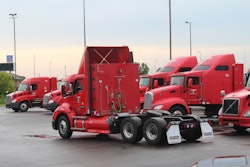
First-ever heavy truck fuel economy standards on the way
Average truck price likely to climb more than $6,000
Work trucks, buses and other heavy-duty vehicles will, for the first time, have to trim fuel consumption and greenhouse gas emissions under new fuel efficiency standards. The White House says the standards – which apply to vehicle model years 2014 to 2018 – will save businesses billions of dollars in fuel costs, help reduce oil consumption and cut air pollution.
 The White House says the heavy truck fuel efficiency standards will save businesses billions of dollars in fuel costs, help reduce oil consumption and cut air pollution.
The new targets announced Aug. 9 by President Obama affect three categories of vehicles. Big rigs or semis will have to cut fuel consumption and emissions by up to 20 percent. Diesel-powered heavy-duty pickups and vans will have to cut consumption by 15 percent, or by 10 percent if the vehicles run on gasoline. The standards also will mandate a 10 percent reduction in fuel consumption and emissions for work trucks such as concrete mixers, garbage trucks, fire trucks and buses.
Within each of those categories, more specific targets are laid out based on the design and purpose of the vehicle, providing a flexible structure intended to allow serious but achievable fuel efficiency improvement goals charted for each year and for each vehicle category and type. The administration released no mpg equivalent for the new standards, saying that doing so would be confusing given the different categories of vehicles, the different types of vehicles in each category and the varying payloads that each one carries.
The U.S. Environmental Protection Agency and Department of Transportation projects savings of $50 billion in fuel costs and 530 million barrels of oil over the lives of the vehicles covered by the new standards, along with improved air quality and public health. The higher costs of the more fuel-efficient trucks – likely to boost the price of a truck by an average of more than $6,000 – will be returned through reduced fuel costs of about $73,000 over the lifetime of the vehicles, the agencies say.
“Thanks to the Obama administration, for the first time in our history, we have a common goal for increasing the fuel efficiency of the trucks that deliver our products, the vehicles we use at work and the buses our children ride to school,” said U.S. Transportation Secretary Ray LaHood. “These new standards will reduce fuel costs for businesses, encourage innovation in the manufacturing sector and promote energy independence for America.”



The National Highway Traffic Safety Administration and EPA first announced their intentions last fall and developed the standards in coordination with truck and engine manufacturers, fleet owners, the State of California, environmental groups and other stakeholders.
“This administration is committed to protecting the air we breathe and cutting carbon pollution – and programs like these ensure that we can serve those priorities while also reducing our dependence on imported oil and saving money for drivers,” said EPA Administrator Lisa Jackson. “More efficient trucks on our highways and less pollution from the buses in our neighborhoods will allow us to breathe cleaner air and use less oil, providing a wide range of benefits to our health, our environment and our economy.”
Obama previously had announced an agreement with 13 automakers to pursue the next phase in fuel economy of 54.5 mpg for cars and light-duty trucks by 2025; that followed a 2009 deal committing cars and trucks to averaging 35.5 mpg by model year 2016. “While we were working to improve the efficiency of cars and light-duty trucks, something interesting happened,” Obama said. “We started getting letters asking that we do the same for medium- and heavy-duty trucks. They were from the people who build, buy and drive these trucks. And today, I’m proud to have the support of these companies.”
The American Trucking Associations praised the administration for their work. “Our members have been pushing for the setting of fuel efficiency standards for some time,” said Bill Graves, ATA president and chief executive officer. “It sets us on the path to a future where we depend less on foreign oil, spend less on fuel and contribute less to climate change.”
The Diesel Technology Forum said the work done in recent years by truck and engine manufacturers to meet increasingly tighter emissions standards now will pay off. “Further improvements to the diesel engine will be made and combined with enhancements to other vehicle components to tackle this new chapter of regulations,” said Allen Schaeffer, executive director of the nonprofit organization. “Diesel also provides a unique technology platform suitable for expanded use of hybrid powertrains and lower-carbon renewable fuels – both strategies for reducing GHG emissions in the future.”
Schaeffer said U.S. fleets now consume about 22 billion gallons of diesel fuel annually. “Because of the sheer magnitude of commercial vehicles operating in the United States, this regulation has the potential to result in significant environmental and energy efficiency gains,” he said.
“This is an important milestone for our industry and our country,” said Douglas Stotlar, president and CEO of Con-way Inc. “We are pleased to be part of a realistic solution that will ultimately help reduce greenhouse gas emissions and conserve natural resources by helping to increase the fuel efficiency of our industry.”
– Dean Smallwood
IN BRIEF
* US 1 Industries shareholders voted to adopt the company’s Feb. 18 plan of merger, under which US 1 became a subsidiary of Trucking Investment Co. Inc. As a result, US 1’s common stock became ineligible to trade on the Over-the-Counter Bulletin Board, and the Valparaiso, Ind.-based company filed to deregister its common stock.
* Gordon Trucking Inc. acquired Edwardsville, Ill.-based Buske Lines Inc., which serves customers throughout the Midwest and Southeast. Seattle-based Gordon obtained Buske’s 150 power units, 375 refrigerated and dry-van trailers and a shop.
* FedEx Freight is implementing a 6.75 percent general rate increase that applies to shipments within the contiguous United States, between the contiguous United States and Canada, and within Canada. The rate for cross-border FedEx Freight shipments between the United States and Mexico also is increasing 6.75 percent for only the U.S. portion of the shipment.
* Old Dominion Freight Line announced base rate increases of an average of 4.9 percent based on length of haul rather than across-the-board increases. Charges in intrastate, interstate and cross-border lanes are affected. Similar increases also are being taken on Alaska, Hawaii, Puerto Rico, Caribbean, Canada and Mexico.
* Paul Phillips, a Con-way Freight professional truck driver from Coarsegold, Calif., was named the 2011 Bendix National Truck Driving Championships Grand Champion. Phillips’ driving skills and knowledge of transportation and truck safety information topped those of 428 other drivers in the championships held in Orlando, Fla.
Truck, engine makers committed to doing their part
Truck and engine makers alike were uniform in their approval of the new medium- and heavy-duty fuel efficiency standards announced last month. Navistar commended the U.S. Environmental Protection Agency and U.S. Department of Transportation for developing a single national standard for GHG and fuel efficiency. “We were pleased to be part of the process providing the agencies with information on the positive impact of total vehicle technology integration on fuel efficiency and GHG emissions,” said Daniel Ustian, chairman, president and chief executive officer.
Volvo Trucks said that while it already has done a tremendous amount of work toward improving the fuel efficiency of its tractors and reducing emissions, the company also recognizes that it is “part of the problem” and is committed to being part of the solution. “Our focus moving forward is to continue improving fuel efficiency and reducing the carbon footprint of both our products and operations, standing side by side with our customers in managing through the implementation of this new rule,” said Denny Slagle, president and CEO.
Cummins announced plans to certify its engines early to meet the standards and said it has worked proactively on the regulation with a wide range of stakeholders over the past several years. “This regulation will add real value for our customers, as better fuel economy lowers their operating costs while significantly benefiting the environment,” said Rich Freeland, vice president and president – Engine Business.
Eaton said the new standards provide incentives that will serve as a catalyst for deploying new fuel-efficient technologies such as hybrids and advanced drivetrains. “We are committed to work with our customers to make vehicles, large and small, cleaner and more efficient,” said Alexander Cutler, chairman and CEO.
Bendix said it offers a range of product solutions – including air management and other technologies – to help OEMs and fleets meet the new standards. “Protecting the environment for future generations is everyone’s responsibility,” said Joe McAleese, president and CEO.
– Dean Smallwood
Most drivers don’t understand CSA, report shows
More than 77 percent of drivers incorrectly believe that a trucking company inherits past violations from new hires, while nearly two-thirds of drivers are somewhat or extremely concerned that they will lose their jobs as a result of the Federal Motor Carrier Safety Administration’s Compliance Safety Accountability regulatory program, according to a report released last month.
 According to ATRI’s report, most drivers may not have a solid understanding of what CSA is and does.
The American Transportation Research Institute’s CSA Driver Survey Report details the extent to which CSA has exerted an influence on the daily lives of commercial drivers. ATRI’s report also describes and analyzes driver attitudes toward and comprehension of CSA based on survey data collected from 4,555 U.S. truck drivers.
While findings reveal that truck drivers continue to have myriad concerns related to CSA, ATRI discovered that drivers may not have a solid understanding of what CSA is and does. The report also offers recommendations for enhancing driver knowledge and support through multiple training and education sessions, as well as other sources of familiarization.
“ATRI’s study clearly points out that motor carriers, state trucking associations and FMCSA collectively need to do more to educate drivers about CSA and what it does and doesn’t mean for their jobs,” said Ed Crowell, Georgia Motor Trucking Association president and chief executive officer.
ATRI currently has a similar motor carrier survey under way.
Driver pay to keep climbing, analyst predicts
Over the next 12 months, company driver pay will rise 3 to 5 cents a mile and owner-operator pay 4 to 6 cents a mile as carriers compete for a diminished supply of quality candidates, a forecast pay specialist predicted last month. The lower end of those ranges will occur even if the national economy continues in the doldrums, while the higher numbers will be achieved if manufacturing improves, said Gordon Klemp, president of the National Transportation Institute.
Klemp said sign-on bonuses, which have re-emerged in the past couple years, will continue, and he also predicted increased use of productivity pay programs. Based on a second-quarter survey of 350 carriers, Klemp offered the following observations:
• The quality of available driver candidates is “marginal at best”;
• Driver supply and demand is out of balance; and
• Wages have moved up in the last year and should go higher.
The pool of qualified drivers is being reduced by factors such as the underground economy, part-time jobs and regulatory hurdles such as Compliance Safety Accountability and potential hours-of-service changes.
Klemp said he’s seen innovative pay programs emerge in the last six to nine months, and all revolve around five key components: regionalization, equipment utilization, fuel, customer service and safety. “We’ve seen a number of programs that carriers think are working really well,” he said. “All of those put money in the carriers’ pockets, so they’ve got dollars to spend on the driver side.”
$417.3M in DOT grants set aside for state highway projects
The U.S. Department of Transportation announced $417.3 million in grants to fund an array of efforts ranging from interstate maintenance to research into innovative bridge materials and construction methods.
 The Federal Highway Administration invited states to apply in June for federal funding from 14 grant programs.
“Transportation investments like these will create jobs, increase mobility, improve quality of life for all Americans and strengthen our national economy,” said U.S. Transportation Secretary Ray LaHood. “The demand from the states for these funds shows just how critical the need is for infrastructure investment.”
The Federal Highway Administration invited states to apply in June for federal funding from 14 grant programs. Requests poured in from every state, Puerto Rico and Washington, D.C. – more than 1,800 applications, totaling nearly $13 billion, which is more than 30 times the funds available.
“At a time when states are facing serious budgetary constraints, these grants will help fill a critical need,” said Federal Highway Administrator Victor Mendez. “Investments like these are immediate and long-lasting and will help create jobs.”
Among the grant recipients, North Carolina received $3.75 million to improve the I-40/I-77 interchange near Statesville. The project is the North Carolina Department of Transportation’s top priority and, when completed, will reduce traffic congestion and improve safety. When the current interchange was built in the late 1960s, it was expected to handle only 5,000 vehicles each day. Currently, the ramps carry about 70,000 vehicles per day.
Colorado received $3.76 million to help with accelerated bridge construction techniques that will speed completion of its replacement of the Pecos Street Bridge over I-70. These techniques will allow the bridge to be put in place all at one time, over a 50-hour period, instead of disrupting traffic over 12 months.
“The list of state highway projects in need of financial help grows almost daily,” Mendez said. “We are glad to see these funds put to use but recognize there is still much to do to meet America’s transportation needs.”
Congress created the discretionary grant programs to give FHWA the latitude to support projects that maintain the nation’s roads and bridges, improve roadway safety and make communities more livable. In previous years, Congress designated some of this grant money for specific projects, and FHWA awarded the remainder through a competitive process. Because the fiscal year 2011 budget passed by Congress last April directed that all such funds be discretionary, FHWA awarded these funds through a competitive process.
In the last 12 months, 48 percent more carriers have begun offering regional pay packages to meet demands for higher pay in some markets, Klemp said; the spread now averages 11 cents a mile.
Higher compensation also accrues to drivers willing to forego home time and stay on the road longer in time increments that range from six days up to 45 days and longer. Teams will continue to attract higher bonuses, with several carriers offering $6,000, Klemp said; in the last year, the top bonus hit $10,000.
– Max Kvidera
Volvo, Mack to participate in SuperTruck project
Under a SuperTruck contract established with the U.S. Department of Energy, Volvo Technology of America will receive $19 million in federal funding to be used by the Volvo Group’s North American truck-related operations to improve the freight-moving efficiency of heavy-duty trucks and reduce greenhouse gases. Mack Trucks – a part of the Volvo Group – also will participate.
 Volvo says being an integrated manufacturer allows it to optimize solutions across product platforms.
“Our partnership will help drive the development of technologies needed to maximize energy efficiency as we address the reality of a finite supply of petroleum-based resources,” said Peter Karlsten, Volvo Powertrain president and senior vice president of technology for the Volvo Group. “Volvo Trucks and Powertrain now are able to explore some planned fuel efficiency-improving technologies earlier in our product development cycle than normally scheduled – and also investigate advanced technologies that normally would not be economically feasible.”
The company says a team of researchers and engineers in Greensboro, N.C., and Hagerstown, Md., will spend the next five years developing high-efficiency heavy-duty truck technologies aimed at moving more freight with less fuel, thereby reducing emissions. Improved truck aerodynamics and energy conversion efficiency – maximizing the output potential of the energy source – are two areas that hold promise for Class 8 efficiency gains.
“Freight transportation plays a vital role in our daily lives and the strength of our nation, so it’s essential that we step up our efforts to create the best, most efficient heavy-duty truck solutions possible,” said Ron Huibers, Volvo Trucks senior vice president of sales and marketing. “This public-private partnership is an important step forward as we continue to expand our technology leadership.”
The company says its North American truck and powertrain operations also have been participating in other DOE-funded heavy vehicle fuel efficiency efforts, and that being an integrated manufacturer also improves the efficacy of product development and allows it to optimize solutions across product platforms.
“Integrated proprietary components provide superior performance because they’re specifically designed to work together,” said Kevin Flaherty, Mack senior vice president, U.S. and Canada. “We look forward to bringing this kind of expertise to the SuperTruck table.”
– Jack Roberts
RigDig takes guesswork out of buying used trucks
RigDig says its truck history reports help fleet managers, dealers and owner-operators make informed used truck purchase decisions. By logging onto www.rigdig.com and typing in a truck’s vehicle identification number, truck buyers and sellers can get critical information to help make smarter buys in an easy-to-use report.
 RigDig provides used truck buyers and sellers an easy-to-use report with critical data to help make more informed decisions.
“The launch of RigDig marks the first time buyers can check a truck’s background using a service designed specifically for the commercial truck market,” said James Vogel, general manager. “By meshing a variety of data sources that track junk and salvage vehicles, total loss insurance claims, title and odometer brands, accidents, inspections, ownership, cargo hauled and CSA scores, RigDig gives truck buyers a level of confidence in making purchase decisions that’s unprecedented.”
RigDig was developed by the researchers at Equipment Data Associates, a division of Randall-Reilly Business Media & Information that has been compiling equipment-related information in trucking, construction and other industries for more than 20 years. Beginning in 2008, the experts at EDA, in conjunction with Randall-Reilly’s Trucking Media Group, conducted more than 50 in-depth interviews with companies operating in the trucking industry, analyzed every facet of the vehicle history reports designed for the consumer vehicle market, and determined that there wasn’t a good source of information available for consumers on used commercial vehicles.
“That put us on a mission to arm the used truck buyer with information to help them make a more informed purchase decision,” Vogel said. “Three years later, after building, acquiring and partnering with the best information sources available, we were ready to launch RigDig.”
RigDig reports can protect the used truck buyer from making bad investments by alerting them when the truck may be:
• A junk or salvage yard vehicle. Through RigDig’s partnership with the Department of Justices’ National Motor Vehicle Title Information System, RigDig can alert buyers to trucks that may have shown up at a junk or salvage yard. Often, junked vehicles are rebuilt, but these rebuilt vehicles always aren’t identified with a “Rebuilt” title brand. Also, VIN cloning is a white-collar crime that begins by using VINs from junked vehicles. RigDig helps protect the consumer from purchasing, selling or insuring a VIN cloned vehicle;
• A total loss insurance claim. Also provided through RigDig’s integration with NMVTIS, RigDig can help the used truck buyer know if a vehicle was written off as a total loss before they buy or sell;
• DMV title brands, such as junked, salvage or flooded. RigDig’s partnership with the Department of Justice’s NMVTIS database allows RigDig to deliver title information in real time. This can protect the consumer from purchasing a vehicle that was just stamped with a “Salvage” brand earlier in the day;
• Involved in a federally recordable accident. These are the most severe accidents that resulted in an injury, fatality or a towaway. RigDig’s database includes more than 639,000 federally recordable towaway accidents for Class 3-8 trucks (for valid VINs) since 2000. Of these accidents, more than 23,000 resulted in a fatality;
• Involved in a less-severe nonfederally recordable accident. These are identified through a post-accident inspection. RigDig’s database includes more than 139,000 post-accident inspections for Class 3-8 vehicles since 2000;
• Improperly maintained. Multiple inspection or out-of-service violations identified in a RigDig report may indicate poor vehicle maintenance that could make the vehicle less safe or result in higher repair costs. RigDig users also can learn the safety rating, Compliance Safety Accountability vehicle maintenance status, the name of the carrier/owner of the vehicle and the type of operation in which it was used. Carriers with nonsatisfactory safety ratings may not maintain their vehicles as well as those with satisfactory ratings. Vehicles involved in severe-service applications may have seen years of hard use;
• Modified or altered. RigDig reports also provide a truck’s original factory specifications so users can see if a truck has been modified before they take it as a trade-in or purchase it at auction; and
• Tied to UCC liens. Buyers also can check to see if any Uniform Commercial Code liens were tied to a truck’s VIN.
A single report can be purchased for $34, and a pack of three reports can be purchased for $60. Also, there are monthly subscription plans available for dealers, fleets, insurance companies, finance companies, warranty companies or any other company or individual whose business is impacted by used-truck purchase transactions.