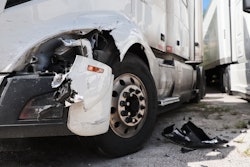
Accident reconstructionists such as Bloomberg Consulting use physical evidence as well as truck data to run computer simulations of accidents.
On a clear, dry day, one of your best drivers rear-ends a car in the middle lane of a six-lane highway. Police estimates and eyewitness accounts put the truck’s speed at 70 mph in a 55 mph zone and assert that your driver didn’t brake or steer to avoid the collision. But your driver insists that he was driving below the posted speed limit, that he braked properly and that he took all reasonable evasive maneuvers given fairly dense traffic in the left and right lanes. Plus, your driver claims that the motorist had been reckless and that his view of the car had been obscured by other vehicles.
You are facing a nasty lawsuit, but you have valuable tools at your disposal – data and lots of it. The engine’s electronic control module (ECM) tells you how fast the truck was traveling, when the driver braked and what some of his key actions had been in the minutes leading up to the accident. The onboard computer, which integrates ECM data with vehicle location and other data, corroborates your driver’s route and to some extent his speed and direction at the time of the accident. And because the truck was equipped with a collision avoidance system, you have data showing what the vehicles around your truck – including the car that was hit – were doing in the moments before the accident and at the time of impact.
This isn’t a hypothetical scenario. It’s an account of an actual crash, according to Chris Bloomberg of Bloomberg Consulting, an engineering, biomechanics and accident reconstruction firm. Because this carrier collected and retained all the data described above, Bloomberg says, it was able to confirm the truck driver’s version of events. Importantly, the carrier also was able to prove that the truck was governed at 57 mph at the time of the accident.
“This kind of data is a huge advantage for carriers,” Bloomberg says. “A lot of information on trucks can bolster your case. But everyone is leery of collecting it. They think the data will hurt them. But we don’t find that to be the case very often.”


Knowing everything
“When we have an accident, we know immediately where we stand,” says Peter van Voorst, vice president of transportation for Clifford W. Perham Trucking, a subsidiary of New England-based Shaw’s Supermarkets. The company operates about 150 trucks equipped with Cadec’s Mobius TTS Mobile Information System. While Perham Trucking uses the system primarily to produce logs and track trucks, it also collects RPM and speed data from truck ECMs and combines that information with GPS data for the last three minutes leading up to a collision.
“Whenever we have an accident, we want to know how fast our guy was going,” van Voorst says. “That’s the first question that comes up in most accidents. You have it right there in real time. If you’re in the right, you know it.”
Dean Newell agrees. “If I’m in the right, I want to know I’m right,” says Newell, vice president of safety for Maverick Transportation. The company uses Eaton’s Vorad collision avoidance system, complete with its accident reconstruction feature, which records data in addition to alerting the driver to potential hazards. Maverick has used the Vorad system for three years, primarily to prevent accidents. But when an accident does occur, the company quickly can access down-to-the second data from a crash. “It’s helped us in a couple of situations. It let us know where we stood right up front.”
Odds are that this kind of data will point to a sequence of events that is more favorable to your company than the one the plaintiff would pose to a jury. Indeed, even AAA’s own research foundation concedes that a majority of truck-car collisions are the fault of the automobile driver.
But believe it or not, there are benefits to having data that confirms that your driver really was at fault. You promptly can learn the truth that likely would emerge from physical evidence anyway. You then might enter into negotiations over a fair settlement rather than risk a much higher judgment in court. Plus, you avoid the huge expense of accident investigation and litigation.
“They don’t have to spend all the money on lawyers to find out that they’re at fault,” says Les Dole, president of onboard computer developer Cadec.
Data everyone produces
The data typically used in accident investigations comes from ECMs related to the engine, brakes and other truck components systems; onboard computers that include vehicle locating; and collision warning systems.
ECMs are the most common sources of data related to an accident, as they collect information on virtually all trucks operating today. The data is pretty much standard across engine platforms, says accident reconstructionist Leo Strupczewski, and includes parameters helpful in accident reconstruction like truck speed, RPMs, throttle position, hard brakes, last stop and engine configuration, including speed governors.
Not only is ECM data common to all truck operators, it increasingly is common on automobiles as well, especially in the electronics that govern the activation of air bags. That means that in many accidents, all the parties are producing some degree of data.
“General Motors has written the standard, and now Ford and luxury car makers are trapping information that is available to everyone,” Strupczewski says. “There’s a lot of information there now. GM’s platform gives you five things – throttle position, RPMs, vehicle speed, seat belt buckled and whether the brake pedal was activated. It will trap up to five seconds of pre-crash data.”
While that data isn’t as extensive as what can be generated by today’s trucks, it can give a clearer picture of fault in an accident. Bloomberg says the information is just another tool in a safety manager’s toolbox. “They have this tool at their disposal to get these cases settled one way or another,” he says.
Whether or not you gather data from automobiles involved in an accident, you can count on receiving a request for your truck’s ECM data. “It may not be the first data plaintiffs look at, it may not be the last thing they look at, but they will look at it,” Strupczewski says.
Because carriers know ECM data exists and could be subject to discovery in litigation, some believe their best strategy is never to preserve ECM data. But defense lawyers experienced in motor carrier litigation generally believe that failing to preserve data relevant to an accident is more dangerous than keeping data damaging to your defense. They fear something called spoliation – the destruction, alteration or mutilation of evidence – especially by a party for whom the evidence is presumed to be damaging. Judges can tell jurors that because you didn’t download data from the ECM, jurors are free to conclude that the data was damaging to your company’s case, says Greg Hirtzel, an attorney specializing in trucking with law firm Post & Shell.
“In cases where punitive damages are alleged, the failure to preserve this information will be argued by plaintiff’s attorney to be a thinly veiled attempt by the motor carrier to hide the truth from the jury about the company’s practices,” Hirtzel says. Such a charge could lead to a big payoff day for the plaintiff and a bad financial day for the carrier. (For more information on spoliation and electronic data, see “Shred of Evidence,” CCJ, November 2003.)
“All the ECM data is discoverable in the event of an accident,” Maverick’s Newell says. “They can pull your DDEC (Detroit Diesel’s engine data management system) and look at the data right out of the engine.”
Computer on board
Onboard truck computers offered by Cadec, Xata, PeopleNet and others now mine that same data stream and combine ECM parameters with additional information, such as GPS location and speed. While GPS data generally is helpful to corroborate logs and location, it also is helpful in accidents because, assuming the data is accurate, it can show where a truck was in the moments beforehand and verify its speed at that time.
This last point is important because ECM data can prove unreliable in certain accidents. At impact, for instance, truck axles may come off the ground, and the resulting loss of friction may result in an inaccurate speed reading by the ECM, Bloomberg says.
In rollover accidents, GPS confirmation particularly can be telling for much the same reason, says Glenn Williams, PeopleNet’s senior product marketing manager.
“The truck is on its side or back, and the wheels are still turning,” Williams says. “The ECM will still show the truck moving, but we know that exact time the vehicle began rolling over.”
PeopleNet is rolling out an accident reconstruction option for its wireless fleet management system that will record both GPS speed and location and ECM information. The recording is triggered by certain events, like a sudden deceleration. Product development largely has been driven by private fleets, where “there is a very high demand for this kind of product,” Williams says. “This gives fleets the tools to say this was not my driver’s fault.”
That’s why Blue Bird Ranch, a 43-truck operation based in Jonesboro, Maine, is beta-testing the system. “We want to have data on our side for a change,” says Bill Sternbergh, safety and information technology director. Sternbergh says the company recently had an accident where he felt the motorist was at fault. But his insurance company settled, arguing it was easier to pay a small exposure than to battle in court. Now he hopes having accident reconstruction data will give him leverage with his insurer.
“The disadvantage we face is the trucker is guilty whether he did anything or not,” Sternbergh says. “Someone can run into the side of my trailer, and they want me to pay for their damage. They’re thinking big dollars and big pockets. I want a little ammunition to fire back at them. It’s going to help me if my driver was doing what he was supposed to be doing.”
Many trucking operations already have onboard computer systems that could be updated easily, if necessary, to track data parameters that would aid in accident reconstruction. Clifford W. Perham Trucking used Cadec’s tracking and log books systems years before an accident reconstruction option became available, van Voorst says. “We like it for both for safety and operational stuff. Whenever we have an accident or incident, we look over the data immediately. It keeps your drivers running the speed limit because they know the system is in there.”
The system also protects drivers, van Voorst says. “When you have driver-motorist confrontation, the driver’s stories are usually far more credible than the motorist’s. This system confirms that.”
Destruction of data generated by an onboard recorder would be subject to the same spoliation risk as discarding ECM data. “You’d be crazy to get rid of the stuff,” attorney Hirtzel says. Dole acknowledges that the significance of recorder data in accident reconstruction is recognized widely. “Officers will cut the unit out of the truck right away and keep it as evidence,” he says.
Aside from their differing capabilities, a huge difference between ECMs and onboard computers is that onboard computers are optional. But again, it’s a matter of knowing everything. While plaintiffs attorneys will seek data from onboard computers, “there have been plenty of times the unit has been used in courts to absolve trucking companies,” Dole says. “If it tells you you’re in the right, you should use the data to fight in court. If you are in the wrong, you better settle. In either case, it’s very helpful data.”
It’s not all about you
While ECM and onboard computer data are useful, details provided by a collision warning system may be golden. Eaton’s Vorad accident reconstruction module – a small, hardened data storage device – collects the same data from the truck ECM and Vorad’s collision warning system. Using front, side and rear facing radar, the collision warning system can track a truck’s following distance and position to other objects such as cars and bridge abutments. It also can fix the position of up to 20 other vehicles relative to the truck and track them during a 10-minute window. Combined with ECM data, it can show the truck’s speed, deceleration and braking movement – all in relation to other vehicles.
“There was a truck driver who was falsely accused of killing two motorists in a car on a two-lane highway,” says Jeffrey Barylak, Eaton’s global marketing and new business development manager. In the accident, the trucker struck two vehicles that had earlier collided head-on. At court, plaintiffs argued the trucker struck and killed the occupants of those vehicles and did little to avoid the earlier accident.
“Our system recorded the entire crash that happened in front of the driver,” Barylak says. “When the crash occurred, the trucker was traveling at a safe distance. He slowed to 25 miles per hour before impact and even took evasive measures. The court determined individuals in vehicles were already dead.” The suit ultimately resulted in a multimillion dollar settlement, but the carrier was off the hook for any part of it. “It helped keep this fleet from going out of business,” Barylak says. “This is a safety belt for them.”
Not all carriers believe that yet. “We’ve had some fleets that have told us we don’t want people to know there’s [collision avoidance] data because they’ll use it against us,” says Mike Coyle, president and CEO of TST Corp, producer of Eagle Eye. “This is a two-edged sword – on the one hand you have the ability to reconstruct and learn from the accidents; on the other hand, any data you record would be ‘discoverable’ data that can be used against the truck owner in a lawsuit.” Carriers that want to record data gathered by Eagle Eye have that option, however. TST Corp. is integrating Eagle Eye with in-truck computer systems to record near-miss information and data that can be used for accident reconstruction.
Pest control giant Terminex is testing the system, which integrates with Networkcar’s tracking and vehicle management system. Terminex came to TST Corp. looking for ways to monitor drivers. “If they had a driver tailgating, or experiencing near-misses at various speeds, they wanted to know it in real time,” Coyle says.
The system, which records data that can be used for accident reconstruction, illustrates why many carriers are afraid of collecting all the data: What if a driver, who had a history of near-misses and tailgating, was involved in a wreck that wasn’t his fault? Wouldn’t the historical data hurt the carrier in settlements or litigation?
The carriers that use such systems say that’s looking at the issue from the wrong viewpoint. Collision warning systems that preserve data can be used to learn how to avoid accidents altogether. “You use it to improve the safety of your fleet,” says Maverick’s Newell. “We’re proactive with the system. I download the data and look at things like following distance.”
Judging whether to collect your own data ultimately may come down to how confident you are in your drivers and your safety programs. “These systems tell you what your chances are,” says van Voorst. “If you run a tight operation, it will generally benefit you. Hopefully you hire drivers that obey the rules.”
ANALYZE THIS
Having accident data is one thing; understanding it another.
An accident involving an 18-wheeler produces a lot of data. On the ground, police investigators photograph skid marks and talk to witnesses. Accident reconstructionists measure bends in metal, estimate angles and calculate stopping distances. ECMs give up RPM, braking and speed data; onboard computers collect GPS data; and collision warning systems provide minutes of radar details, including information about vehicles that weren’t ultimately party to an accident.
While the electronic data produced by the truck is readily accessible, especially in systems culling numbers specifically for accident reconstruction, downloading and viewing the data isn’t the same as interpreting the data.
“It’s not as straight forward as it appears to be,” says engineer and accident expert Chris Bloomberg. “A precursory glance at the data won’t tell you everything you need to know.”
One of the problems with amateur reconstructionists is they tend to focus on one specific set of data, like speed, which may have little or nothing to do with the cause of the accident or culpability in the event of litigation.
The companies that sell systems to collect and analyze accident data do more than just provide numbers. Depending on the options customers choose, Eaton Vorad users can receive animated graphical interpretations – similar to what an engineering firm might produce from data collected at an accident. PeopleNet and Cadec systems can present accident data in graphical interfaces as well to give safety managers a better picture of what happened in an accident.
Viewing the data in something a simple as an Excel spreadsheet can be helpful, especially in smaller accidents. Its immediacy – several systems report the data wirelessly – can save time and give carriers an idea to their culpability quickly.
But when an accident is severe, you may want to bring in an expert. At Clifford W. Perham Trucking, the safety and operations managers read their Cadec reports and understand them – but its insurance company sends in an accident reconstructionists if an accident is major. “The accidents always wind up at the desk of our safety manager,” Peter van Voorst says. “But if the accident is big enough we have a reconstructionist look at Cadec and compare it to their own findings.”
“Get someone professional to look at that data and the overall facts of the accidents,” Bloomberg says. “You need to go look at the scene. Otherwise, you may make some frightful mistakes.”
The reason: accident data from truck systems is incomplete. It only shows what the truck was doing – and then only what the instruments on the truck are measuring. Other immeasurable factors – especially the behavior of a motorist — can contribute heavily to the causes of an accident. A safety manager looking at jus the data won’t know what else happened and could make a poor decision.
Lack of expertise in handling data is part of the reason Eaton Vorad offers a tier of accident reconstruction service that includes expert analysis and even independent assistance at trial.
“The key to accident reconstruction isn’t just getting someone to look at the information,” says accident reconstructionist Leo Strupczewski. “It’s getting somebody who can interpret all the information that’s available.”