













Wide single tires have always appealed, at least in theory, to fleets hungry to swap weight for payload, since they weigh considerably less than the duals they replace. And wide-single manufacturers’ claims of improved fuel economy also seem reasonable, since the tires’ smaller footprint and half as many sidewalls mean less flexing and less energy wasted on rolling resistance. Also, they eliminate the possibility of mismatched duals, which, having different loaded radii, tend to fight each other with every revolution, consuming tread and fuel.
And, with wide singles, there are fewer tires to mount, dismount, inspect and rotate, which should serve to reduce maintenance cost and downtime.
About the only fly in the créme brulée has been the fear of on-road tire failure. If a wide single blows on a single-drive-axle tractor, a driver’s got obvious problems. And if one fails on a tandem, the operator might be able to limp to the nearest truck stop or garage – depending on how heavily the truck is loaded. But, it’s been unlikely that the facility would stock a replacement.
The AIRCept unit fits around the rim inside a Greatec tire, protected from damage.
As we reported in July, Michelin, with its X-One wide single, has addressed these problems with beefier construction, better availability and standard sizing, allowing a set of duals to be bolted on in place of an X-One in a pinch.
Now comes news that Bridgestone Corp. of Japan, parent company of Bridgestone/Firestone North American Tire, has developed a self-inflating liner that goes into action when one of its Greatec wide singles experiences a sudden loss of air pressure.
Called AIRCept (for “assistant inner ring interceptor”), the unit fits around the rim inside a Greatec tire, protected by the tire from most kinds of damage. A special valve, developed by Pacific Industrial and Bridgestone, permits inflating the tire and AIRCept unit to different pressures – simultaneously.
The AIRCept system’s outermost layer is a reinforcing sheath of non-woven aramid fabric, which keeps the system at its normal standby size in ordinary operation, but allows for expansion when needed.
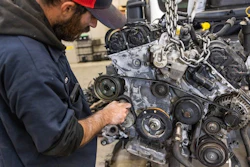
AIRCEPT unit at standby shape and size.
When pressure is lost in the main tire cavity, pressure inside the AIRCept unit causes it to expand, filling the entire interior of the tire, and supporting the load. The system operates in conjunction with a tire pressure monitor that sends a pressure-loss alert to the driver, who can then continue to drive for up to 16 miles at 38 mph.
Initially, the system will be available only in Europe. Reportedly, DaimlerChrysler will use the Greatec-AIRCept combination for upcoming models in its Mercedes-Benz Actros line of trucks. Then, as markets develop, and if Greatec tires become popular in other parts of the world, AIRCept availability may be expanded.
Thanks to continuing improvements in tire technology, we may eventually see newfound popularity of wide singles – an idea that once seemed only half baked.