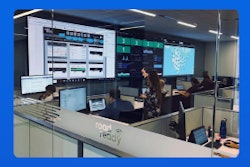
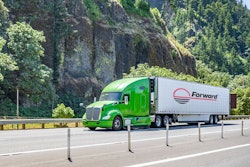
Rand McNally’s navigation software uses the same IntelliRoute engine and practical mileage calculations that fleets would use in the office for billing and payroll.
Routing engines
needed to
provide the intelligence move equipment efficiently
Technology that serves up the mileages, routes, tolls, fuel prices and other data to a trucking enterprise is more than software – it is the engine for fleet automation and cost control.
Straight out of the box, any such engine will come standard with predetermined mileages and routes based on shortest, most practical or least-cost configurations. The routes may vary somewhat according to vehicle profiles and if hazardous goods are onboard.
Whatever the case may be, any fleet using only predetermined mileages and routes to operate a business is running on the “old standard.” The “new standard” is to use highly integrated systems to create a more complete approach to routing.
To maximize efficiency and performance, fleets such as U.S. Xpress use mileage and routing engines that incorporate real-time information from their dispatch, accounting, mobile computing and other platforms.
“We are integrating available commercial products and adding our cost factors for time and miles to determine the overall best possible lowest-cost route,” says John White, president of the Chattanooga, Tenn.-based truckload company. “The process has provided encouraging results for a more efficient, holistic solution that has in turn resulted in a significant return on invested capital.”
Pinpoint accuracy
An essential part of creating a new standard for routing systems is using the latest information available from today’s software.
 ALK Technologies has included precise toll plaza information (shown in far right column) in the version 24 release of its PC Miler mileage, mapping and routing software.
Having fuel prices integrated with mileages and routes is one example. ProMiles offers fuel optimization for no extra cost in its ProMiles XF truck mileage and routing package for both online and client-installed versions. ProMiles calculates optimal routes and fuel plans by using current fuel price information through direct feeds of fuel transactions from vendors of fuel purchasing cards.
Integrating precise toll costs and plaza location data into routes offers another money-saving opportunity.
Celadon Group, an Indianapolis-based truckload carrier with more than 2,500 power units, pays more than $3 million in highway and bridge tolls annually. Celadon’s information systems automatically generate a route and fuel purchase plan when a driver is assigned to a load – perhaps between Chicago and Detroit – and the route plans are sent to drivers via mobile communications.
Until last year, if the Chicago-to-Detroit route included a toll road, the only information the Celadon driver would receive was the name of the toll road, the distance to travel and the estimated cost. For lack of information, the company was unable to send drivers the precise plaza locations of where to enter and exit from toll roads.
While its routing was automated, Celadon used a manual process to authorize and reimburse drivers for tolls. To authorize a toll expense, a driver would send a Qualcomm macro message to his driver manager to request an amount for tolls authorization. If the request was approved, drivers later would scan-in their toll receipts for the payroll department to process.
More fleets now are using highly integrated systems to create a more complete approach to routing.
The company did not use transponders such as E-Z Pass because it lacked the data to verify that transponders would be used only for approved tolls. This changed when the company found a way to compare drivers’ actual entry/exit locations to the authorized locations.
In June 2010, ALK Technologies included plaza-to-plaza toll road information in the version 24 release of its PC Miler software. Along with using the latest version of PC Miler, Celadon developed a custom application to verify automatically that drivers were using approved tolls. This application used E-Z Pass data and PC Miler route data to verify that drivers were using only approved segments of toll roads.
 PeopleNet and Maptuit are developing real-time management alerts to notify fleet managers when a driver exceeds parameters for out-of-route situations.
Today, for each dispatch, drivers receive precise toll plaza entry and exit locations along with their fuel and route plans. On a monthly basis, the E-Z Pass transactions are compared to the approved toll routes for each driver, and if necessary, unauthorized toll costs are deducted from driver pay.
Celadon plans to equip its entire fleet with transponders this year. When complete, Celadon will save about $250,000 a year in toll expense alone and $750,000 overall when factoring in labor and other costs due to the automation, says Mike Gabbei, chief information officer.
ALK Technologies plans to improve data quality and accuracy by including toll cost data specific to the time of day in version 25 of PC Miler.
In-cab navigation
For many years, fleets have used mileage, mapping and routing software in the office to automate billing and payroll processes. As wireless communication costs have come down, fleets no longer carefully have to script the directions they send to drivers to save money on per-character charges. Nowadays, text-based directions are another form of the old standard for routing drivers.
A growing number of fleets now use next-generation onboard computers, wireless communications and software applications to generate turn-by-turn directions that guide drivers to their final destinations.
In-cab navigation eliminates the ambiguity of text-based directions and makes drivers’ jobs easier, says Tom Benusa, chief information officer of Transport America, an Eagan, Minn.-based truckload carrier. Driver satisfaction with navigation was the main reason the company chose to implement the technology.
Transport America runs the Maptuit NaviGo navigation application on the Qualcomm MCP 200 onboard computing platform. Each time the company assigns a driver to a load, the vehicle’s location, route line and fuel stops are sent from the office to Maptuit’s servers. An optimal route is calculated and sent to the NaviGo onboard navigation system.
To receive turn-by-turn navigation between each stop, drivers simply touch the location on the screen in the order they wish to be routed. Sometimes mileages will vary slightly between the actual route computed by Navigo and the predetermined mileages that Transport America uses in its billing and payroll process. Navigation has elevated drivers’ awareness of these differences, Benusa says.
ALK Technologies’ CoPilot Truck in-cab navigation system uses the same routing technology and map and mileage database as its PC Miler software used by fleets and shippers for its mileage standards. Using the same routes and mileages for navigation used for billing and driver pay brings consistency to fleet operations, says Michael Kornhauser, ALK’s vice president and managing director of CoPilot.
RandMcNally offers an in-cab navigation device, TND, which has the same IntelliRoute engine and practical mileage calculations fleets use in their billing and payroll processes. The TND device includes additional route information to provide drivers with alerts for immediate changes in a route such as speed limits, sharp curves, steep hills and state boundaries.
The company recently announced that its IntelliRoute truck-specific routing, turn-by-turn directions and mileage calculations now are integrated fully with the TruckPC onboard computing platform. Last fall, RandMcNally purchased an ownership stake in DriverTech, which offers the TruckPC.
Integration between IntelliRoute TND navigation and the TruckPC platform provides another set of tools fleets can use to analyze driver route performance. Driver speeds can be compared to posted speed limits, and fleet managers can monitor for out-of-route mileages.
Real-time route monitoring
Providing drivers with dynamic turn-by-turn navigation may eliminate some out-of-route mileage and improve route compliance in other areas. But to optimize savings and obtain maximum control, fleets can monitor route performance in real time.
Zonar’s Web-based fleet management portal, Ground Traffic Control (GTC), has a dispatch, route management, navigation and two-way messaging application called Zing. Dispatchers that use Zing can send drivers to a new location, complete with turn-by-turn navigation, simply by selecting a vehicle on the digital map in GTC and dragging it to a location. Zing automatically pushes the route to an onboard computer with a Garmin display unit.
Once the route is pushed to the vehicle, dispatchers and fleet managers can receive alerts if a driver remains off route for more than an established period of time. Zonar also is able to track the precise amount of fuel consumed from the precise moment that a driver leaves the assigned route by using a Zonar feature called geospatial fuel reporting, says Chris Oliver, Zonar’s vice president of marketing.
PeopleNet offers the capability to compare planned routes to actual driven routes, by driver, through the Maptuit NaviGo application offered on its BLU in-cab computing platform. Through an optional feature called NaviGo Compliance, fleet managers can view reports to see any deviations from the route that NaviGo generated at the time of dispatch.
PeopleNet and Maptuit are developing real-time alerts for out-of-route situations. “The vision, going forward, is not only to alert dispatch in real time but do more coaching in the cab when you have identified these situations,” says Matt Voda, product marketing manager for PeopleNet.
Qualcomm offers Maptuit NaviGo for its Mobile Computing Platform 110 (MCP110) and MCP200. ALK CoPilot Truck will become the standard navigation application on the MCP50 this fall, and will be an option to fleets using the MCP110 and MCP200.
Xata, a provider of onboard computing and fleet management software, offers ALK’s CoPilot Truck in-cab navigation on both its full-featured XataNet fleet management system and its Turnpike system that uses mobile handsets such as the BlackBerry and Android platforms.
Separate from navigation, Xata interfaces with a number of routing software systems to monitor route performance. Through this interface, route plans can be sent automatically from the routing software to Xata servers to detect and notify fleet managers immediately when an asset goes off route and how this may impact future route performance in terms of delays and extra miles. Xata also has a feature called Smart Route that lets customers establish tolerance levels by vehicle, driver or lane for what they will allow for out-of-route mileage.
Xata plans to release a new vehicle routing and delivery sequencing application tailored for smaller fleets that cannot afford a full-fledged route optimization system. “We are pushing the functionality that was normally focused on large fleets down to the Turnpike market,” says Christian Schenk, vice president of product marketing. The system will be available for download through Verizon and other wireless carriers for a low monthly rate.
To have the most efficient low-cost routes, it takes more than using a single engine to calculate the shortest distance between two points. Fleets can hook up and engage multiple engines in this effort. Each one accomplishes a specific purpose, but when integrated together, they create a complete approach to planning and monitoring routes and driver performance. n