










CCJ Innovators profiles carriers and fleets that have found innovative ways to overcome trucking’s challenges. If you know a carrier that has displayed innovation, contact CCJ Chief Editor Jason Cannon at [email protected] or 800-633-5953.
When Nathaniel Klein agreed to examine his father-in-law’s trucking business five years ago, he offered a candid assessment: the company was effective, but inefficient.
What followed was a reinvention of Sun Logistics’ data management.
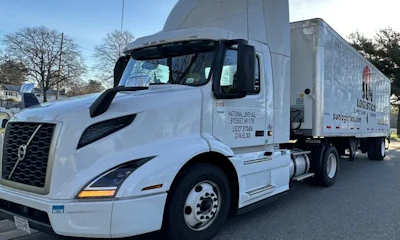
Headquartered in Maspeth, New York, the family-owned company operates a fleet of trucks, tractors, and more than 250 trailers. The less-than-truckload (LTL) and last-mile delivery carrier dispatches around 150 drivers and 50 dockworkers across the New York Tri-State area and South Florida markets.
The company handles freight for some of the largest carriers in the country that need local expertise for the boroughs, Long Island, the Hamptons, and Westchester from a facility it owns in Queens. That real estate, Klein said, represents a barrier to entry that would cost a competitor roughly $100 million to replicate.
The problem, Klein pointed out, was that like most LTL operators, Sun Logistics ran on an IBM AS/400 system—legacy mainframe technology that hadn’t fundamentally changed in decades. It functioned by processing the shipment, logging the movement, and moving on.
Klein said there was no central source of data or clean data repository that could help make data-driven decisions.
The inefficiencies weren’t obvious until you looked at the data. Delivery appointments weren’t being optimized, so volumes shifted from 400 bills one day to 800 the next. “That oscillation creates cost,” Klein said, as the company brought in staff for peak demand but burned labor costs on slow days.
Dockworkers were manually classifying freight exceptions with no consistency from one person to the next and no standardization. Freight accuracy, though initially reported at 90%, was actually running closer to 80%, Klein said.



The solution: building a brain on top of the TMS
Before revamping the system, Klein said he made targeted fixes to inefficiencies in the process. One change to outbound cutoff time discipline resulted in reducing dock labor by 40 hours a week.
Once the processes were solid, he moved the company off the AS/400, migrated everything to Microsoft Azure, and brought in Carrier Logistics as its core TMS (Transportation Management System). However, Klein said he knew the off-the-shelf TMS wasn’t going to be enough. What the company needed was a layer on top of it—a proprietary system Klein describes as “the brain.”
The brain is a custom-built data warehouse that pulls from the TMS, HR data from Paycom, and other data from a range of external sources they use. It ingests the previous day’s activity, processes exceptions, generates routing guidance, and pushes instructions back into Carrier Logistics for the next day.
“The daily functions—over 50% of what drives operations here—are driven by our own Sun Logistics brain,” Klein said.
The company also uses machine learning for demand forecasting. Since roughly 45% of freight in the New York market requires delivery appointments, Klein said the ability to predict volume a day or more is critical. With its AI's ability to forecast in hand, Sun Logistics can schedule appointments deliberately, as the AI system can identify volume swings and reduce excess labor costs.
 Used in its forecasting model, the map is a heat map to indicate freight source and destination over the last 12 months.
Besides the forecast layer, it also built AI-powered routing logic that accounts for zip-code-level pallet density, real-time traffic conditions, and historical delivery patterns. A Google Maps API also measures traffic on the company’s 10 most-traveled routes and returns an index. For example, if the Manhattan index comes back at 1.54, the system knows conditions are significantly worse than the baseline and can adjust load distribution accordingly.
Klein also replaced the company’s manual process of freight exception classification with a computer vision system built on Google’s Gemini model. Previously, dockworkers would manually determine whether damaged freight should be flagged. Now, workers can photograph the freight with their Zebra scanners. The AI analyzes the image, determines whether an exception exists, and writes a standardized exception report.
It also deployed AI to catch errors at the point of freight pickup, analyzing bill of lading data as drivers collect shipments and flagging missing data (such as piece count, weight, hazmat information, and consignee data) before the truck leaves the dock.
Its most recent addition is a GPU-powered computer vision system tied to the dock cameras. Using open-source AI models and connected to the existing camera infrastructure, the system can locate a missing pallet by description or PRO number within seconds, rather than hours of a manual search. It also detects when two pallets that arrived together are being split on the dock.
The results
Delivery returns, Klein said, dropped by more than 50% over the last two and a half years. Bills per hour on the dock increased by more than 20%—a figure Klein expects to climb another 10% as staff no longer have to type out what’s going on and the dock becomes entirely paperless. Freight accuracy is now approaching six-sigma levels, he noted.
Initially, Klein said they found that some of the data was inconsistent, mislabeled, or incomplete.
“If you have bad data, all AI will do is tell you something that sounds good, but isn’t truthful,” he pointed out. “The most important thing we’ve done over the last year is make sure all data in our system is clean.”
The human element is still important, Klein said. While the AI system handles the routine—routing logic, appointment scheduling, and exception flagging—exception handling is still managed by a person.
The CCJ Innovators program is sponsored by Comdata, Mack Trucks, and Shell Rotella.