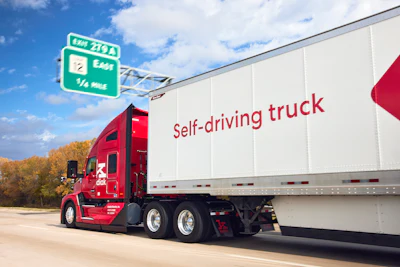
The California Department of Motor Vehicles on Tuesday adopted one of the most comprehensive autonomous vehicle regulations in the country, officially opening the state’s roadways to heavy-duty self-driving trucks and granting local officials more power to control robotaxis during emergencies.
The updated rules end a long-standing prohibition on autonomous vehicles weighing more than 10,001 pounds and clears the way for autonomous freight operations to begin testing and deployment across the state.
"The rules allow innovation to proceed, providing transparency and ensuring strong state oversight is in place," said Daniel Goff, vice president of external affairs at Kodiak AI.
Despite being home to several companies in the autonomous trucking tech industry, California had lost considerable ground to states like Texas and Arizona that already have testing and deployment rules in place.
“California continues to lead the nation in the development and adoption of AV technology," said the state's DMV Director Steve Gordon, "and these updated regulations further demonstrate the state’s commitment to public safety."
Under the new framework, manufacturers must follow a tiered permitting process. Companies must start with human safety drivers before moving to driverless testing. To reach the next phase, light-duty vehicles must log 50,000 test miles, while heavy-duty trucks are required to complete 500,000 miles.
For original deployment, a total of 1 million miles must be completed (500,000 with a driver and 500,000 driverless). Up to 400,000 miles may be accrued in other jurisdictions if the testing occurred in an operational design domain comparable to California's and is supported by equivalent safety data (e.g., crash reports, system failures). At least 100,000 miles must be driven on California public roads to ensure exposure to the state's complex environments.
Heavy-duty autonomous trucks are prohibited from operating on local roads with posted speed limits of 25 mph or less but an exception exists if they are part of a direct route—defined as the most linear and geographically logical path—between hubs, distribution centers, fueling stations, or other non-residential facilities.



The rules prohibit the transport of placarded hazardous materials as defined by federal regulations. They also prohibit bulk liquid/tank operations, oversize loads, and household mover operations initially.
The regulations also address long-standing friction between autonomous vehicle companies and city officials regarding emergency response. Key safety updates include:
- Emergency geofencing: Local officials can now issue electronic "do not enter" directives to clear autonomous vehicles from active emergency zones. Manufacturers must ensure their fleets exit these areas within two minutes.
- First responder access: Companies are now required to respond to calls from first responders within 30 seconds and provide manual override systems for their vehicles.
- Traffic citations: Law enforcement agencies gain the authority to issue "Notices of AV Noncompliance" for moving violations, ensuring companies are held accountable for traffic infractions committed by their software. Permits can be suspended if the vehicle is placed out-of-service by the Federal Motor Carrier Safety Administration (FMCSA).
The DMV is also modernizing how it tracks safety. Beyond traditional collision reports, companies must now provide data on system failures, vehicle immobilizations, and hard braking events. The department also reserved the right to impose specific restrictions on a company’s fleet size, speed, and operating weather conditions if safety concerns arise.
"The state’s updated autonomous vehicle regulations mark a decisive step forward, not just embracing autonomous trucking, but establishing a clear path to commercialization," said Earl Adams Jr., PlusAI’s vice president of public policy and regulatory affairs. "Enabling autonomous trucks to operate here is about transforming how goods move at scale, unlocking new levels of efficiency, resilience, and safety."
While heavy-duty trucks are now permitted, they remain subject to standard commercial laws, including mandatory stops at California Highway Patrol weigh stations. The rules also carve out a path for medium-duty autonomous transit vehicles, up to 14,001 pounds, to be operated by universities and public entities.
At the federal level, the Safely Ensuring Lives Future Deployment and Research in Vehicle Evolution Act of 2026 (H.R.7390), or SELF DRIVE Act, is proposed legislation aimed at accelerating autonomous vehicle (AV) deployment by establishing federal safety standards, strengthening NHTSA authority, and ensuring national cybersecurity for self-driving technology. The bill, which was forwarded to House Energy and Commerce Subcommittee on Commerce in February, prioritizes reducing human error while navigating varied state regulations.