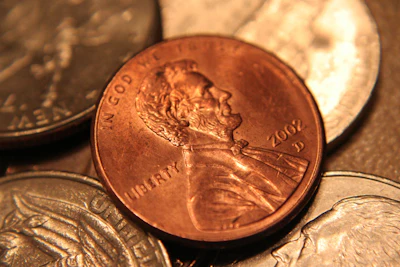
The Common Cents Act (H.R. 3074) would officially codify the end of the one-cent coin for general circulation.
- Eliminates penny production for general circulation: The bill directs the Secretary of the Treasury to stop producing one-cent coins for general circulation, though the Mint may still produce and sell them as numismatic collector items.
- Preserves pennies as legal tender: Any one-cent coins minted and issued before the enactment of the law will officially remain legal tender for all debts, public charges, taxes, and dues.
- Alters composition of the 5-Cent coin: The legislation allows the 5-cent coin to be made with an inner layer of zinc and an outer layer of nickel, and adjusts the coin's allowable weight to between 4 and 6 grams.
- Aims to reduce production costs: The bill grants the Secretary of the Treasury the authority to prescribe the specific zinc and nickel composition of the nickel, subject to testing to ensure the change reduces coin production costs.
- Standardizes rounding: The bill's title was amended from "to require cash transactions to be rounded" to "to permit cash transactions to be rounded." The rounding scheme itself is symmetric to the nearest five cents: amounts ending in 1, 2, 6, or 7 cents round down; 3, 4, 8, or 9 cents round up. Totals of one or two cents round up to a nickel.
Fuel retailers representing the nation’s truck stops and travel centers have joined the calls for the U.S. House of Representatives to pass bipartisan legislation that resolves cash-rounding headaches at highway plazas caused by the end of penny production.
The Common Cents Act (H.R. 3074), scheduled for a House floor vote this week, would officially codify the end of the one-cent coin for general circulation. For retailers, the bill establishes a uniform federal standard permitting businesses to round cash transactions to the nearest 5 cents when exact change is unavailable, shielding interstate operators from a patchwork of state laws.
The legislative push is being spearheaded by NATSO, the national trade association representing America’s travel centers and truck stops, alongside SIGMA: America's Leading Fuel Marketers. Together with a coalition of 16 other major trade organizations representing Main Street businesses, the groups sent a joint letter Monday to House Speaker Mike Johnson and Minority Leader Hakeem Jeffries urging immediate passage.
For truck stops and travel centers, which operate around the clock and serve millions of interstate travelers, commercial drivers and local cash-paying customers daily, the coin shortage has created operational hurdles since the U.S. Mint halted penny production last year. LeeAnn Goheen, senior director of government affairs for NATSO and SIGMA, said those challenges include accessing coins and pricing products for cash-paying customers.
"An absence of exact change necessitates a uniform set of rules that includes the ability to round prices to the nearest nickel without fear of being in violation of the law," Goheen said.
Although cash-versus-credit price gaps for diesel fuel typically run between 5 and 10 cents per gallon, the exact spread varies widely. Under the federal Durbin Amendment of the Dodd-Frank Act, fueling stations nationwide are prohibited from adding surcharges to debit card transactions, but they are legally permitted to offer discounts to cash-paying customers.


Without a singular federal standard, travel centers operating across state lines must navigate a complex regulatory landscape, as 19 states have already enacted conflicting laws governing cash rounding.
While most states allow retailers the discretion to round up or down to the nearest nickel on the final transaction total, Arizona has mandated a symmetric rounding model that calls for totals ending in .01, .02, .06 and .07 to round down to the nearest 5 cents, while totals ending in .03, .04, .08 and .09 round up.
The symmetric rounding rule was adopted in Canada in 2012 after the Canadian Mint stopped producing penny coins and is the method proposed by H.R. 3074 since it ensures that final prices are rounded down just as often as they are rounded up.
The lack of pennies has also created friction with federal regulations. Because truck stops and travel centers frequently house grocery sections and quick-service food options, rounding transactions for purchases under the Supplemental Nutrition Assistance Program (SNAP) risks violating federal rules that prohibit treating SNAP customers differently than other shoppers.
Additionally, many travel plazas provide financial services to professional drivers, such as payroll check cashing. Without physical pennies, operators struggle to accommodate exact check-cashing requests for drivers who rely on instant and precise cash payouts.
The bipartisan bill is sponsored by Reps. Lisa McClain, R-Mich., and Robert Garcia, D-Calif., and has received key backing from House Financial Services Committee Chairman French Hill, R-Ark., and Ranking Member Maxine Waters, D-Calif.
Other major retail groups representing highway-adjacent and local businesses also signed the letter, including the National Association of Convenience Stores, the National Restaurant Association, and the American Hotel & Lodging Association.
NATSO and its coalition partners say the legislation is urgently needed to restore certainty to everyday transactions at America’s travel plazas. Following the anticipated House vote, the association is calling on the Senate to take up the issue quickly.