










The leader of the nation’s largest trucking association gave Congress a stark ultimatum on Tuesday: modernize federal transportation laws or cede the future of supply chain technology to China.
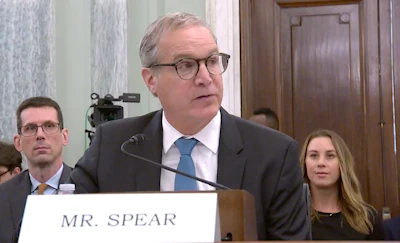
Testifying before a Senate subcommittee hearing titled "The Need for Speed: How Technological Advances are Driving Transportation Innovation," the American Trucking Associations President and CEO Chris Spear told the legislative group that clear, performance-based federal benchmarks are essential to keep the U.S. logistics supply chain secure and competitive against foreign adversaries.
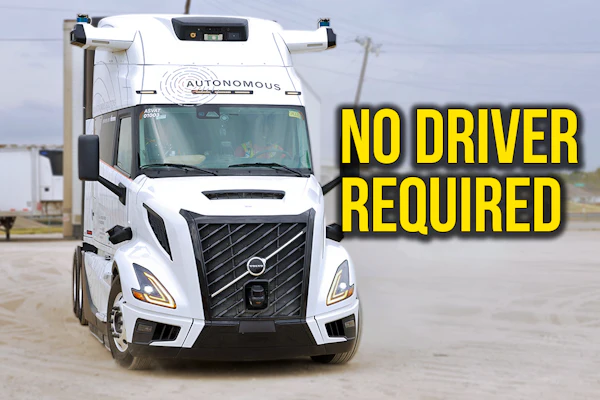
Push for a national AV Strategy
The ATA chief urged Congress to establish a comprehensive federal framework for autonomous commercial vehicles via legislation like the Build America 250 Act. While 26 states currently allow some level of autonomous truck operations, Spear noted that motor carriers do not stop at state lines, making a single standard vital for long-haul planning.
"We need a national framework," Spear said. "If you're going to invest in this technology, grow it nationally, not by state, or we're conceding this to China. They will take this technology, they will run with it, and then we will be reacting to that platform. It's that simple."
Subcommittee Chairman Todd Young (R-Ind.) echoed the concern, cautioning that if American innovation remains locked behind outdated rules or tied up in red tape, the resulting manufacturing capacity and job creation will happen overseas.
"Our adversaries won't wait for us to tie our shoes," Young said, adding that the ongoing geopolitical competition impacts the nation's long-term rate of economic growth, which ultimately funds the American way of life and the military. "We need to be using this moment in American history to optimize our system at every level so that we can outcompete anyone."
Beyond market share, officials focused heavily on the immediate national security threats posed by allowing Chinese-manufactured components into connected vehicle networks.
Cole Scandaglia, deputy director of political and legislative action for the International Brotherhood of Teamsters, expressed alarm over the vulnerability of high-tech supply chains to foreign manipulation, recalling prior congressional testimony indicating that some autonomous vehicle companies utilize remote operators stationed overseas who are capable of intervening in vehicle operations.



"The idea that you could have a driver in an automated truck and someone in China could press a button and make that truck take a turn or accelerate is really horrifying to our membership and puts our members at risk," Scandaglia said.
The Teamsters union urged Congress to prohibit any scenario in which a person outside the United States could manipulate a vehicle on American roads, while also calling for a complete ban on Chinese-connected vehicles and components.
Senator Bernie Moreno (R-Ohio) expanded on the digital threat, questioning what could go wrong if companies linked to Chinese defense contractors were permitted to sell vehicles in the U.S.. He warned that these platforms are capable of transmitting high-definition photos, videos, and location data directly back to the Chinese Communist Party.
Laura Chase, president and CEO of the Intelligent Transportation Society of America, testified that her organization is actively working with the Department of Commerce to secure domestic and allied supply chains.
"We have to make sure that we're protecting American consumers' data, that we're protecting all of our national security assets, and that we are ensuring that it's American-made technology that is in these vehicles that are driving on American roadways," Chase said.
Dismissing fears that autonomous technology would displace the workforce, Spear framed automation as an evolution that will help absorb projected tonnage increases. The industry currently moves 11.4 billion tons of freight annually—representing 73% of all domestic freight—and must scale up, he said, to handle an additional 2.7 billion tons over the next decade.
"I need more drivers, I need more trucks, and I need innovation. I need all of it," Spear insisted. He explained that autonomous deployments ranging from Level 1 to Level 4 will keep a driver in the loop while demanding an expanded support network of advanced technicians, safety inspectors, dispatchers and driver trainers.
Repealing the Federal Excise Tax
To accelerate the deployment of cutting-edge safety features—such as automatic emergency braking, lane-keep assist and digital alerting systems—Spear again called on Congress to eliminate the 12% Federal Excise Tax on heavy-duty trucks and trailers. Originally introduced in 1917 as a temporary measure to fund trench warfare during World War I, the FET remains the highest excise tax levied by the federal government.
Trucking executives and supportive lawmakers view the repeal of the tax as a mechanism to naturally accelerate the deployment of advanced driver assistance systems across the national supply chain. Newer models come factory-equipped with life-saving technologies—such as automatic emergency braking, lane-keep assist, video-based blind-spot monitoring and digital alerting tools—which older fleets lack.
"The century-old tax punishes the purchase of the very vehicles that come with the latest technologies," Spear stated. "Adding tens of thousands of dollars to the cost of new equipment discourages fleet turnover and keeps older equipment on the road longer."
With the average age of a Class 8 tractor currently hovering around 16 years, removing the tax would immediately slash roughly $24,000 off the cost of a new tractor and $6,400 off a new trailer.
Beyond introducing advanced collision-avoidance tech to the highway network, Spear emphasized that updating the national fleet with newer and more fuel-efficient trucks would yield an environmental dividend without the need for regulatory mandates.
"You want to incentivize the procurement of brand new equipment. This would do it," Spear added, noting that the financial relief would put capital back into the hands of independent owner-operators and fleet managers alike. "This is money that should go into the hands of drivers that are operating their own equipment to fleets ... putting that newer equipment out there is good for everybody."
Spear also pointed out that an influx of new equipment orders sparked by an FET repeal would directly stimulate production lines at domestic factories, securing blue-collar employment.
"Beyond safety and environmental gains, this is a jobs game," he said. "Those six manufacturers that we have ... We're here in the United States ... And this is a union job issue right here."
Crackdown on freight fraud and 'chameleon' fleets
Beyond vehicle tech, fleet management safety is increasingly threatened by sophisticated cargo theft and identity fraud, which the American Transportation Research Institute estimates costs the trucking industry more than $18 million per day, with the average value of a single stolen truck shipment exceeding $300,000.
"We've had this problem for decades and decades and I think unfortunately have just continued to throw our hands up in the air and say it's hard and it's complicated and not made progress," Scandaglia said.
A primary focus of the hearing centered on the systemic danger posed by chameleon carriers—fraudulent or unsafe motor carriers that intentionally shut down after being penalized or caught by regulators, only to immediately resurrect under a new name and corporate identity with a clean safety record.
Scandaglia emphasized that a small group of bad actors is responsible for a massive percentage of the ongoing disruption, creating severe vulnerabilities for professional truck drivers who are forced to share the highway with unverified and untrained operators.
From an operational standpoint, Spear noted that under current enforcement frameworks, authorities frequently find themselves chasing the same individuals repeatedly.
"They shouldn't get busted, go under, and then repost under a new (MC) number," Spear said. "We're enforcing the law on the same people over and over. We need to get them out of the industry. These are bad people."
Spear expressed the ATA's support for the SAFER Transport Act, which would provide the Federal Motor Carrier Safety Administration with advanced data-sharing and fraud detection tools to permanently lock bad actors out of the registry. Spear also called for the passage of the Combating Organized Retail Crime Act to bring unified federal law enforcement resources from the Department of Justice and the Department of Homeland Security to the table to target transnational crime rings.
While the Department of Transportation recently launched a modernized registration system, Motus, to patch historical identity loops, industry leaders want the technological mandates in the SAFER Transport Act made permanent to ensure long-term registry integrity. That rollout, however, has been clunky.
Additionally, the industry is pushing for the enactment of the Combating Organized Retail Crime Act (CORCA), which has already cleared the House Judiciary Committee unanimously and drawn bipartisan backing in the Senate. The bill would establish a unified federal front, bringing the DOJ and DHS to the enforcement table to dismantle foreign syndicates orchestrating these operations from overseas.
"This is going to bring the federal government—DHS, DOJ, DOT—to the table where states, localities, and our industry do not have the ability to go after transnational organizations from Eastern Europe, Russia, other parts of the world," Spear said. "The president's waiting to sign it. This can be done very quickly and would bring the federal government to the table so we can combat this."