










Michael Till was hired to cut grass at a trucking company in Houston, Texas in 1987. From there, he worked his way up to janitor before driving forklifts and trucks and eventually shifting to the back office as a dispatcher, followed by working in the accounting department and, finally, on the computer systems.
In his last six months with that company, Till said he worked with a programmer to develop a real-time LTL dispatching system that is still in use today. In 1991, he took on the role of operations manager at a different trucking company during the day and began writing trucking software at night despite knowing very little about programming after obtaining his degree in finance from the University of Houston.
Till began writing PCS Software when he was 26 years old, taking him five years to gain his first customer but eventually becoming a success in the market. Now 61, Till is bringing a new transportation management system to the trucking market after the 2019 sale of PCS Software, which is also still in operation. His non-compete having ended in September 2025, Till and the original PCS team have come together again to launch ProBuilt TMS, a cloud platform for truckload carriers and brokers that is expected to be available June 1.
Breaking the "One Page at a Time" Barrier
PCS Software operates in a Windows Terminal Server environment, which functions similar to a desktop app, allowing dispatchers to multitask with multiple forms open at one time. But Till said the industry was shifting to browser-based TMS platforms that don’t accommodate that multitasking function.
“We here call that OPAT: one page at a time, and we said we would not get back into software unless we can solve that problem,” Till said.
It’s why he sold PCS.
“There were challenges to growing the software in the way that I wanted to grow it,” he added. “The thought of starting over and putting that program in a browser with one page at a time was just not appealing to me at all.”
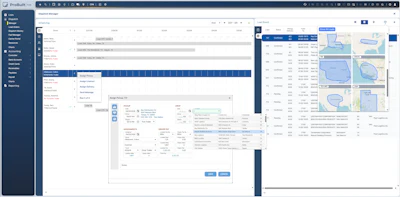
After hiring and firing a small army of software developers to explore his “multitasking in a browser” concept, Till and his team finally found the right programmers to build ProBuilt’s patent pending architecture that allows users to open and use unlimited forms in the same browser tab.


“Use any website, use any cloud application, they're all one page at a time. Every single program on Earth, the best you're going to get out of them is a pop-up form that grays out everything else. That's called a modal form,” Till said. “What I wanted was a program to allow you to open multiple non-modal forms simultaneously and have all of them live, connected to the database, connected to each other, connected to other users within the company.”
ProBuilt, which will offer electronic and automated dispatching, billing, payments, settlements, etc., does that. It also includes a fully integrated GAAP-based accounting system, as opposed to platforms that rely on third-party accounting integrations.
Additionally, an AI program builder will be embedded inside the system to allow customers to customize the platform to fit their needs. Till said ProBuilt TMS’s structure will allow its customers to create their own databases within the ProBuilt database.
“Any type of company that's in transportation would be able to take our program, and if they've got things that they do in their company that are outside the scope of our program and wanted to add those in, they'd be able to do it without being developers themselves, without hiring developers to do it,” he said.
And finally, another feature he said that will be different from other systems is ProBuilt Software’s proprietary load board design that will be embedded within the TMS.
Till said he wanted a specific design – for which the patent is also pending – after spending six hours trying to use the three most popular load boards to line out one week of work for five trucks.
Boots on the Ground: Designing for the Real World
While waiting out his non-compete with PCS, Till started an auto haul trucking company and bought another small trucking company. He sold off the flatbed company piecemeal at the end of 2023 and sold the entirety of the auto haul company at the end of 2024 before turning back to software.
But while running those companies, Till said he discovered that every load board was painful to use. Running dozens of city-to-city combinations searching for freight for his trucks inspired Till to create a load board with a feature that he likened to Zillow’s home search tool. The feature will allow users to draw a polygon on a map to search for loads that can be picked up and delivered within that defined area.
Till said he contacted a software development company in Houston to design this feature, but they couldn’t figure it out.
He said he thinks it’s because they don’t understand trucking.
In addition to his 13 years working for trucking companies and four years running his own, Till – along with his team members – has over a quarter century of experience developing transportation software.
“Programmers know how to program. They don't know how to dispatch. They don't know how to do payroll,” Till said. “We understand all those things, and our strategy is to create a system that's not only strong in what it does, but also adaptable to multiple environments while not making dispatchers do things to make them go ‘Huh?’”
Part of the problem is the technology available today isn’t developed alongside the customers’ understanding, he said, which is why he didn’t rely on his own expertise but sought input as well from the dispatchers and employees in all other roles at his trucking companies to understand their pain points and design a system to solve them.
“We’re boots on the ground kind of people here,” Till said.