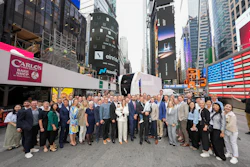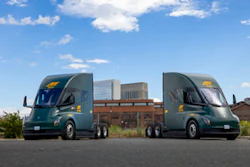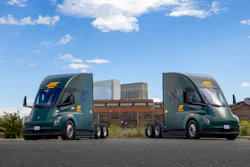











As a part of NACFE’s most recent Run on Less – Messy Middle, 14 different vehicles were evaluated including two Tesla Semis. In our Run, the Semi demonstrated 465 miles on one charge. This is close to what is stated in a recent article that indicated the Tesla battery is specified to have a “theoretical range” of 483 miles. Interesting specs such as the battery size, weight, and chemistry are in this article. While this truck has demonstrated impressive results, the vehicle is heavy, and the industry still would like more range.
This begs the question about what advanced technologies are on the horizon. Will there be a game changing technology that has no range limitations to speak of or that goes on a significant diet, reducing weight. Several technologies such as lithium-sulfur, sodium-ion, and solid-state batteries (SSB) are being explored.
SSBs seem to be promising because the energy density is significantly better than the batteries on today’s battery electric vehicles (BEVs) and they provide improved safety and charging capability.
What is an SSB battery?
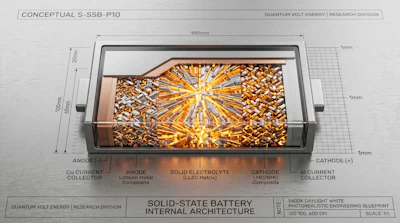
Lithium-Ion batteries consist of an anode, cathode, and separator/electrolyte. Figure 1 provides a good comparison of today’s lithium-ion (liquid based) batteries and the SSB. The electrolyte is not illustrated but it is embedded in the pores of the membrane separator for liquid-based batteries. It is the conducting material which allows ions to flow between the cathode and anode. The separator/electrolyte and the anode are different in solid-state batteries. The separator typically consists of a special ceramic-based material, which acts as the conductor of ions. No liquid is present.
Also, with SSB, the anode material is often a lithium metal (Li-metal) instead of a graphite material. Graphite is a limiting feature in energy storage, and the Li-metal can store up to 10 times the energy of graphite. There are different levels of SSB such as all-solid-state, quasi-solid or semi-solid-state. In the case of all-solid state, the electrolyte is solid; there is no liquid. Quasi-solid state batteries are mostly solid but have some gel-like components.
 Comparison of liquid-based and Solid State Batteries.Bonnen Batteries
SSB Advantages
SSB has some advantages over other types of batteries, including the following.
- Higher energy density than today’s Li-ion batteries: This translates to either longer range or less weight. The anticipated improvement in these batteries is 20% to 50% higher density over today’s batteries. In simple terms, today’s 465 mile BEV could travel nearly 700 miles on one charge with an SSB. Toyota is on record stating it initially sees a 20% improvement but up to 50% longer term. See Figure 2. Many of today’s BEVs use lithium iron phosphate (LFP) which is shown as the solid green bubble in Figure 2. As you move to the upper right, you see the emerging technologies, and Li-metal is the likely anode material that would be used with an SSB. The graphic illustrates the potential for higher density.
- Safety: Today’s liquid electrolytes are flammable. If there is a short in the battery or it overheats, there is a risk of thermal runaway. The SSB has no flammable material.
- Fast charging: SSBs can be charged about three times faster than liquid-based batteries because the metal-based anode is more efficient, has less resistance, and is more stable than graphite anodes.
 Figure 2: Energy Density Comparison (Presented at ACT Expo, 2024)
When can I order one?
It looks like we might see some cars with SSBs in small scale production in the 2027 to 2028 timeframe and wider adoption post 2030.
Toyota believes there could SSBs in the 2027 to 2028 timeframe. Watch China as it is the leader in this area. As recently as May, BYD filed a patent for a composite solid electrolyte membrane. The company says it is entering a critical breakthrough stage. The battery will be piloted in 2027. There is no mention of energy density.
A few years ago, CATL was believed to target a 2000 km (~1200 miles) range battery in mass production in 2027. However, in the fall of 2025, the company denied this and indicated it expects small scale production in 2027. It even stated that, “commercialization is still some distance away.” BMW and Mercedes target the 2030 timeframe. Interestingly, Mercedes has demonstrated a 1200 km+ mile on a prototype with a Li-metal SSB.
As for Class 7 and 8 trucks, there are no clear plans. Some of the OEMs have acknowledged this could be a future technology. Therefore, it is safe to assume that commercial vehicles will lag passenger cars by approximately three years. This could mean the 2035 timeframe before we see SSB in trucks.
SSB challenges
There are several challenges with SSBs.
- Fragile materials: In the case of liquid electrolyte there is easy flow between the cathode and anode. SSBs don’t bond as easily, and it is hard to fill the gap. Dendrites are microscopic spikes that can occur in both battery types, however, their impact is more severe with SSBs as they create cracks in the metal causing electrical shorts. Replacing a membrane with a ceramic material is challenging as ceramics are brittle.
- Manufacturing costs and scaling: SSBs have higher costs than liquid-based batteries. This is somewhat of an apples-to-oranges comparison, since we are comparing a mature technology to an emerging one. More specifically, today’s batteries have scale and therefore, they cost a lot less than SSBs. For an existing battery plant to convert to SSB, significant capital investments need to be made. In addition to this burden, there are some inherent cost drivers with solid state. Because of the metal-to-metal contact challenges, special equipment, materials, handling procedures, and tighter tolerances and control are needed. A harsh dry room is needed for SSB, which drives special equipment needs because of a lack of moisture. Like all new product introductions, the trucking industry will find a way to optimize costs. The Department of Energy believes that SSBs cost approximately $60/kWh. This estimate is based on passenger car high volume and is far off in time, but it does indicate that the cost issue might be eliminated over time.
- Cycle life: It is believed that SSB will have longer life, however, right now the demonstrated life is in the hundreds of cycles for SSB vs thousands of cycles for liquid-based batteries.
We live in exciting times with many options. In the Messy Middle, each powertrain has its own advantages and disadvantages. Technology is advancing quickly, and new battery chemistries are promising and might solve some of the key problems for battery electric vehicle adoption.