










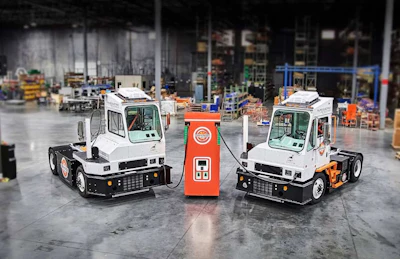
NACFE’s 2026 research indicates that while 76% of fleets experience lower operating costs with electric terminal tractors, high upfront vehicle costs and grid delays continue to slow wider adoption.
- Widespread Operational Savings: Approximately 76% of surveyed fleet operators report at least moderate operating-cost savings compared to diesel, led by reduced maintenance and lower energy expenses.
- Moving Past the Pilot Phase: More than half (54%) of fleet operators have advanced beyond initial testing into partial deployments or full standardization.
- The Yard as a Gateway: 58% of fleet operators either adopted electric terminal tractors before any other vehicle type or use them exclusively, leveraging the captive environment to avoid range anxiety.
- Persistent Growth Barriers: High upfront capital costs (averaging $250,000 to $350,000) and utility infrastructure delays remain the primary roadblocks keeping fleets from scaling further.
Four years after the North American Council for Freight Efficiency (NACFE) published its first look at electric terminal tractors, an update shows the technology has graduated from speculative pilot to proven, cost-saving operational strategy for a growing number of fleets.
Drawing on a 62-respondent survey—comprising 44 fleet operators and 18 industry partners—as well as in-depth interviews with seven major fleets, including Wegmans, Lazer Logistics, and YMX Logistics, the research showed that 76% of surveyed fleet operators report real operating-cost savings compared to diesel, driven largely by reduced maintenance and lower energy costs.
Those savings are pushing fleets to scale: 54% of fleet operators report having moved past the pilot stage into partial deployment or full standardization.
"Data from our 9-plus years of experience with battery electric terminal tractors inform our belief that the yard is the best use case for battery electrification of heavy-duty transportation today," said Chris Bennett, vice president of EV, energy, and sustainability at Lazer Logistics.
The yard as an electrification gateway
Yard tractors have the highest overall zero-emission penetration rate of any individual heavy-duty vehicle segment, reaching 3.21% of all units in operation nationwide, according to CALSTART.
More than half (58%) of fleet operators surveyed by NACFE either adopted electric terminal tractors before any other electric vehicle type or have electrified terminal tractors exclusively. Because these vehicles typically stay within facility fence lines, they allow fleets to build operational confidence without the range anxiety associated with on-road trucks.
Narrowing price gaps
While diesel units range from $55,000 (used) to $150,000 (new), electric terminal tractors command between $250,000 and $350,000 depending on battery pack size. However, this price premium has significantly dropped over the last five to six years as fleets utilize right-sized batteries and fast opportunity charging during shift breaks.
Fleets with a lot of use case data report a 50% reduction in maintenance and repair costs per operating hour compared to diesel, with savings climbing as high as 75% during an electric unit's early years.


Maintenance isn't entirely frictionless. The heavy torque and weight of battery-electric drivetrains can accelerate tire wear, and fleets note that low-voltage wiring harnesses occasionally require more complex diagnostic troubleshooting. Furthermore, a shortage of technicians trained on high-voltage systems means many operations must outsource repairs to specialized dealer networks.
The financial case lag
Despite monthly operating-cost savings, 52% of fleet operators say it is still too early to tell whether the full multi-year business case has proven out, largely because many fleets have not yet run electric units through a complete depreciation cycle.
Barriers to scale
Capital budgeting remains the primary hurdle, cited by 63% of fleet operators and 77% of industry partners due to the high upfront purchase price. Utility and grid connection delays follow closely behind.
Diverse fleet strategies
The report highlights a range of adoption paths.
Retailer Wegmans has reached nearly full standardization across three distribution centers, relying on a 5-to-6-year transition path driven by corporate sustainability values.
Meanwhile, outsourced yard-management giant Lazer Logistics operates roughly 150 electric units across its massive footprint, reporting a 50% reduction in maintenance and repair costs per operating hour compared to diesel.
Conversely, some operators remain hesitant. One large carrier interviewed for the report evaluated the technology and chose not to adopt it, citing high upfront costs and a lack of internal appetite for change rather than technical equipment failures.
To help organizations evaluate their own preparedness, NACFE’s new report includes a Terminal Tractor Electrification Readiness Tool. The tool scores fleets across seven operational and infrastructure factors to determine whether they are ready to launch a pilot.