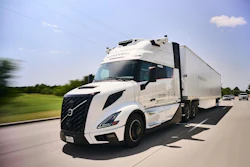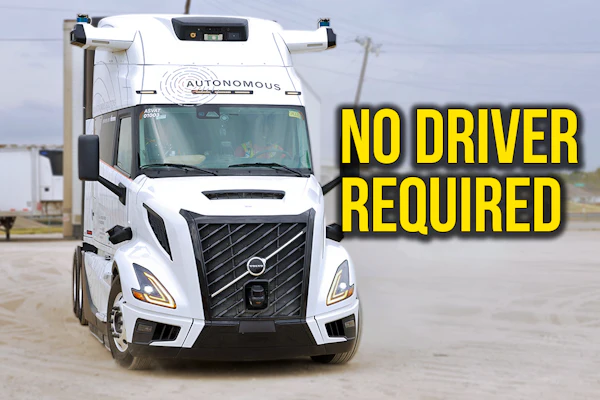











CCJ Editor Jason Cannon hit the road—or rather, the bunk—at Aurora's South Dallas terminal in Palmer, Texas, to experience an on-road drive with an autonomous Volvo VNL heavy-duty truck.
The Autonomous VNL is equipped with redundant steering, braking, computation, and power systems and it integrates the Aurora Driver software and sensor suite directly into the truck during factory assembly at Volvo’s New River Valley plant. Volvo Autonomous Solutions and Aurora's partnership focuses on developing and scaling Level 4 self-driving semi-trucks built on the flagship Volvo VNL Autonomous platform
Weighing 80,000 pounds, the truck navigated public roads entirely on its own while safety driver Harry Henry monitored systems. During the ride, the autonomous system proactively detected and steered around road debris and shoulder hazards, executing maneuvers smoothly before human occupants even noticed the obstacles.
Volvo Autonomous Solutions outlined aggressive commercialization timelines, detailing plans to launch fully driverless public highway operations in the first quarter of next year and scale to more than 300 production-integrated trucks by the end of 2027.
Contents of this video
00:00 Test Launch at Aurora's South Dallas Terminal
00:34 Inside the Cab of a Volvo VNL Autonomous
01:35 Hands Off the Wheel & Pedals
02:20 How the Sensor Suite Detects Highway Traffic
03:25 The Sensor Suite and Redundant Safety Systems
03:54 Volvo Autonomous Solutions & Aurora Driver Integration
04:32 Public Perception & Autonomous Safety Data
05:34 Volvo's 2027 Driverless Deployment Roadmap
06:00 Real-Time Hazard Avoidance
06:50 What Happens to Truck Driving Jobs?
08:42 Ride Impressions: 33 miles & 80,000 Pounds with Zero Driver Input
Speaker 1:
Missed the tire?
Speaker 2:
Yeah, you see how it went around?
Speaker 1:
It's pretty impressive. I mean, little stuff like that, it's pretty impressive. Hey everybody, CCJ Editor Jason Cannon here, and we're in a very breezy Palmer, Texas today at Aurora's South Dallas terminal. And you're in for an interesting test drive today for a couple of reasons. One, they don't even call it a drive. It's called a launch. So this is a test launch and these VNLs behind me, they're autonomous. So they're autonomous VNLs. So I'm not even going to be driving. I'm not climbing into the driver's seat. I'm climbing into the bunk. So let's hop in and let's go for a ride.
Speaker 3:
This is for the thinking and the decision making.
Speaker 2:
So you guys ready?
Speaker 1:
Yes sir, you are. So Harry, I can see your feet and I can see your hands and neither one of them look like they're doing too much. So what are you actually doing?
Speaker 2:
What I'm actually doing is monitoring and visualizing the scenery to keep the truck and you guys safe and if need to take over for any reason. But I'm not driving. My feet are not on the gas pedal or the brakes and my hand, I'm barely holding the steering wheel.
Speaker 1:
The sensor suite has obviously picked this guy up because it slowed down when he pulled out in front of us.
Speaker 2:
Right.
Speaker 1:
And it's going to make this turn and you're not going to do anything, right?
Speaker 2:
No, sir. Truck going to do all the work by itself. That was a smooth turn.
Speaker 1:
How long does it take you to get used to something like that? I mean, you're a truck driver, right? You want to drive this truck and you just sort of let the computer do it. So mentally, how long does it take you to make that adjustment to where I don't have to do anything so I'm not going to touch it?
Speaker 2:
It took me a couple of months when I first started because every time I made that turn right there across that bridge, I thought it was going to be too close to that brick wall. It took me a couple of months to get used to it and let it play out too.
Speaker 3:
But the interesting thing is if you do this a while, if you do this often, you actually start to realize that the truck is much more proactive in thinking ahead and how to respond to traffic situations. So where with the human eye, you may not see it in the same way, but the sensors are that high, they can see further, then decisions are made before you realize, oh, it's a good idea.
Speaker 2:
Right. I agree with you because there's been times that the truck made a maneuver to change lanes and I was wondering why. And it could see in front of other cars up ahead that there was a car on the shoulder. Yeah. So it changed lanes and I didn't see it. The truck saw it before I saw it.
Speaker 1:
What does this truck or the software system, in your opinion, what does it do better than what a human does?
Speaker 3:
First and foremost, think about it in this way, that this truck has modern sensor technology which can look much further than the human eye can see. And in addition, it can see in the same way during nighttime or during daytime or during rainy days, et cetera. The system has a 360 degree surveillance every split second. And in addition, of course, you have the redundancy of the truck. So you have a primary system, for example, to brake or to steer, but if that fails, you have a second one. And by that, of course you push the safety level to a completion level.
Speaker 1:
We just changed lanes to let that guy over and it made that decision, right? Yo didn't do that.
Speaker 2:
No, sir. I made that decision. The truck did.
Speaker 3:
That speaks also to the fact that Aurora and Volvo have worked for years together and we have a really deep integration, the virtual driver into the truck and this truck is purpose built, purpose design for the autonomous use case. That's what you then get also in consequence.
Speaker 2:
One of the things that the truck do when there's a vehicle on the shoulder or emergency vehicle is going to change lanes. If it don't have time to change lanes, it's going to slow down for safety.
Speaker 1:
So it didn't change lanes because this was the truck's exit?
Speaker 2:
But it slowed down.
Speaker 3:
Okay, now we come to a stop sign. Let's see. It's a four-way stop, but we are the only traffic participant.
Speaker 1:
The motoring public's kind of been conditioned to be afraid of large trucks and now it's a robot large truck. So what do you feel like is the public perception of an autonomous truck?
Speaker 3:
Let's think about autonomous technology overall. And then I would argue that Waymo has to some degree paved the way for us. They're spearheading the technology with their robo taxis. And I think as you have now Waymo operating with their service in more than 10 US cities, it actually has become something where the public is now used to the exposure to autonomous transportation and it's over a very positive experience. And you can prove now also over time with statistic that this is really a safe mode of transportation. The robo taxi business, not only Waymo, Sazoops, they have actually created also a public opinion which is favorable towards autonomous transportation overall, including then also in our business, the trucks.
Speaker 1:
So Neils, I know there's some big plans for 2027. So tell us a little bit about when we ring in the new year, what's Volvo Autonomous Solutions plans?
Speaker 3:
We have said publicly that in Q1 next year we will start operating driverlessly. That means we will have those trucks on the road without the human in the cap operating on public highway. And then we will gradually introduce more and more trucks during the year. And our objective is to have 300 plus trucks in operation by the end.
Speaker 1:
Miss the tire.
Speaker 2:
Yeah, you see how it went around? The tire shred.
Speaker 1:
It's pretty impressive. I mean little stuff like that, that's pretty impressive.
Speaker 3:
Yeah. So by end of 2027, we want to have more than 300 driverless trucks out in operations with our customers. And then the year later we will increase the scaling even further. And the important part for us is that we have really built together with Varora a development plan which allows us to scale at industrial levels. So we will be able to manufacture this truck with the Aurora driver, with the hardware integrated on our production line. And that of course allows us then to scale at industrial level. We have no real limitation when it comes to production voyages.
Speaker 1:
And Harry, you haven't checked, you haven't touched anything, right?
Speaker 2:
No sir.
Speaker 1:
Since we've left, your feet on the floor, hands are just sort of sitting there, right? Yes
Speaker 2:
Sir. So what'd you think about it?
Speaker 1:
It's pretty impressive. I mean even though I kind of work in this space and I talk to a lot of you guys all the time and I know what technology's in play and who's doing what, it's incredible that this truck can actually do all the stuff that it just did. Well, we're back. I struggle to think of words other than incredible, amazing, outstanding. It's unbelievable this kind of technology exists. This thing weighs 80,000 pounds. It basically drives itself. Harry's been a truck driver for over 10 years and he tells me that this truck drives itself about as good as he ever could have driven it. It's remarkable to think that I just got out of a piece of equipment that I am capable of driving and it didn't need me to drive it. It's mind boggling that this sort of technology is existing right now and it's only going to get better.
Now it's not raining, it's not dark, it's a little overcast, but the sun's out. So these are pretty good conditions to throw at these sensors, but this system learns as it goes. So the more things that happen to this system, the more things that it sees, the more things it learns how to do and how to react. There were a couple instances where there were vehicles on the shoulder where the truck pulled itself over into the next lane, then it got back over when it was safe to do so. There was an instance where there was a recap in our lane. The truck saw that, moved over, then moved back over to avoid hitting it. It basically did everything that I would've done. It did everything that Harry would've done and it did it about when we would've done it. Again, it's incredible to think that we all go to school, we all get our license, we all learn how to drive these things, and now you can sit in the bunk and watch a computer do it for you.
It's absolutely mind-boggling and it's really exciting to think that this sort of technology is really ready for prime time where we are knocking on the door of full driverless technologies. This is an exciting time to be in transportation and I can't wait to see where it shows up in the next couple of years. For more truck news, driverless truck and the old-fashioned driver truck, check out ccjdigital.com and subscribe to this channel to watch more videos about everything that we do.