










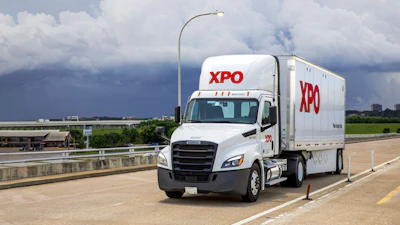
Despite weather headwinds and tariff-related demand uncertainty, less-than-truckload carriers XPO (CCJ Top 250, No. 10) and Saia (No. 18) reported improvements in their first-quarter financial findings, driven by heavy investments in capacity and artificial intelligence.
XPO delivered first-quarter revenue of $2.10 billion, up 7.3% year over year from $1.95 billion in Q1 2025. Net income was $101 million, up 46% from $69 million during the same period last year.
XPO's LTL shipments per day, excluding fuel, increased by 3% from Q1 2025, and tonnage per day increased 0.1%. Revenue per shipment, including fuel surcharges, increased 2.6%, and revenue per shipment, excluding fuel surcharges, increased 1.2%.
Operating ratio also improved by 200 basis points to 83.9%, which Chairman and CEO Mario Harik noted as significantly outperforming seasonality.
Saia reported first-quarter revenue of $806.2 million, a 2.4% increase from $787.5 million in Q1 2025, and net income of $49.9 million, essentially flat year over year.
Saia's LTL shipments per workday were up 1% and tonnage per workday was down 2.1% with revenue per hundredweight, excluding fuel surcharge revenue, up 1.9%. Revenue per shipment (excluding fuel) decreased 1.2%.
That momentum accelerated early Q2.
April 2026 shipments per workday rose 5.6% and tonnage 6.9% versus April 2025, followed by May shipments up 3.7% and tonnage up 8.4%, putting the quarter-to-date through May at shipments per workday up 4.6%, tonnage up 7.6% and weight per shipment up 2.9%.
Fuel expense rose 3.6% despite a 4% decline in company linehaul miles, as national average diesel prices surged more than 30% between February and March. Saia’s fuel surcharge updates weekly, but costs incurred in real time, resulting in an approximately $3.5 million margin headwind.
[RELATED: Old Dominion weathering LTL slump, eyes recovery]
Demand signals strengthen
In earnings calls with analysts, President and CEO Frederick Holzgrefe explained that Saia opened 70 facilities in 2017 and invested approximately $1.8 billion in network and fleet over the last 36 months.


It reported improving demand signals for legacy terminals and newer facilities because of year-over-year shipment growth for the first time in approximately five quarters. Revenue per shipment increased throughout the quarter, which Holzgrefe said was driven by contract renewals that averaged 6.7% for the quarter.
Similarly, XPO noted that both local and national channels are gaining traction with customers. Harik said contract renewals went up in the mid to high single digits.
“We do expect another strong quarter of margin performance in the second quarter,” he added.
XPO maintains over 30% excess door capacity, Harik said. It added 15% more door capacity over the last three years in historically constrained markets like Atlanta, Texas, Columbus and Nashville and has manufactured over 20,000 new trailers since the freight downturn began. Average tractor age is 3.9 years.
The carrier also significantly reduced reliance on third-party carriers to insulate against rising truckload rates and improve linehaul cost control.
“To bring down our purchase transportation costs, we’ve reduced outsourced miles to some of the lowest levels in our history,” Harik explained. “This has given us a more flexible cost structure that mitigates our exposure to rises and truckload rates. Importantly, these initiatives are driving structural improvements that will scale as volumes recover, creating further opportunities for margin expansion.”
Technology and artificial intelligence
Though Saia isn’t announcing any significant technological developments, Holzgrefe said the company is “continuously investing in core optimization tools critical to our cost structure — how we run our linehaul network and plan our city operation. These are large models or early-stage AI models we have worked on for years with continued enhancements.”
It is also deploying AI around customer service, “including track-and-trace” with Vision AI and national network pricing optimization as future opportunities.
Meanwhile, XPO reported that Q1 productivity improved 4%, well above their long-term 1.5% target. Harik said the key driver was the rollout of an AI-powered pickup and delivery route optimization tool, now deployed to about half the network.
“We’re seeing tangible efficiencies, including fewer miles and more stops per hour. We expect to have this fully implemented by the end of the year,” he said.