










CCJ Innovators profiles carriers and fleets that have found innovative ways to overcome trucking’s challenges. If you know a carrier that has displayed innovation, contact CCJ Chief Editor Jason Cannon at [email protected] or 800-633-5953.
Fuel expenses represent a significant portion of the financial challenges facing trucking companies.
Bickner Trucking is implementing strategies to reduce these costs. Owned and operated by brothers John and Todd, the Vanguard, Saskatchewan-based company operates in Western Canada and the Northwestern U.S. with 60 tractors and a mix of company-owned and leased equipment.
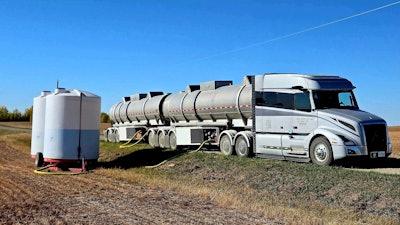
As a bulk hauler, the family-owned company transports Super-B tankers weighing 140,000 lbs.—among the heaviest loads on North American highways—yet has achieved a 24.5% to 25% improvement in fuel economy. The fleet average now stands at 7.12 MPG (U.S.) over 16 months. Their first truck, built 16 months ago, has maintained an average of 7.5 MPG (U.S.).
The company has always been focused on fuel efficiency, said John Bickner. Starting in the mid-80s, Bickner said they always kept their field books with them. “We’ve always tried to get a little better fuel mileage [than others], especially as we started buying new trucks.”
So, how did it all begin? “Research, lots of research,” said Bickner.
Years of extensive research—learning through their own trial-and-error methods and from others in the industry—have helped. Bickner also looked into several international research studies and implemented aerodynamic modifications, studying practices from Europe-based companies and several American advocates of fuel efficiency, such as truck drivers Henry Albert and Joel Morrow, to reduce drag.
One of the company's foundational strategies, initiated over 20 years ago, was slowing down its equipment, Bickner said. This led to significant improvements in fuel mileage and tire wear. For its Trans-Canada routes, the company reduced its maximum speed limit to 60 mph (compared to typical highway speeds of 65–68 mph).
Another major factor in their strategy was engine optimization. Bickner said they reduced the horsepower requirement needed to maintain highway speed to approximately 220–240 horsepower at cruise, while operating engines at low RPMs (940–980 RPM in newer trucks, within the 353–360 horsepower range).
This approach keeps engines running at about two-thirds of their maximum load capacity at 60 mph, maintaining optimal thermal efficiency and reducing pumping losses. Bickner stated, “By keeping the engine loaded in that gear, we’re keeping our emissions system warm.”
Drivetrain configuration was another factor. Bickner said they adopted lower gear ratios (around 2.47) combined with Volvo’s I-Shift automated manual transmission. This allows the trucks to maintain cruise control efficiency while still having reserve power available when needed for hills.
Customized trailers
The company partnered with Advanced Engineered Products, a tanker trailer builder, to create custom aerodynamic solutions for their operations. A significant change to the company’s trailers involved moving valve boxes, pumps, and equipment storage to underneath the trailer frame.
Bickner explained, “We lightened our equipment a bunch because we no longer needed an L-frame bracket to cradle those boxes out of the full width. We’re able to put them underneath the frame rail and then clamp-bolt them to the bottom of the frame rails, and it worked well for streamlining the airflow.”
The company used an aerodynamic system including V-cone fairings at the front and wind fairings directing air down the sides of boxes. Working with truck parts supplier FlowBelow, they installed wheel covers and an hourglass kit between axles to “keep the air flowing down the outside of the axles and not letting the air get in underneath the trailer, intertwining in the axles to reduce the drag.”
Other modifications included adding a false extension wall between dual trailers and installing 10-inch diffusers angled at 13 degrees at the trailer rear. Bickner said research showed this achieves about 78% to 80% of the benefit of longer 40-inch diffusers. As a result, the trailers became both lighter and more aerodynamically efficient than traditional specifications.

The results
Having maintained a long relationship with Volvo Trucks, Bickner said the Volvo high-torque spec delivered what they needed, while for trailers, they partnered with Advanced on tankers. Getting approval required about seven or eight meetings with the trailer manufacturer and the truck manufacturers to explain their ideas, reasoning, and why they believed it would work. The first trailer has been on the road for just under two years, and the first truck has been operating for 16 months. Bickner said they had to order the truck over a year before production, with the entire process taking considerable time.
“It was very much an untraditional spec... People aren’t doing it, and there are no used ones... A lot of people thought we were crazy. Probably some still do, but the results are showing themselves,” he said, adding that the company essentially became a test bed for these innovations.
Initially targeting a 22.5% improvement over their already-optimized first-generation specs, Bickner said they’re now achieving 24.5% to 25% better fuel economy. While the first-generation trucks were still performing well, “It’s nothing close to these next-generation trucks."
According to Bickner, as of November, year-on-year data shows improvements across the fleets, with traditional trucks achieving 51.39 L/100 km (1.95 km/L, 5.50 Imp. MPG, 4.58 U.S. MPG). Meanwhile, the 2.47 I-Torque fleet demonstrated enhanced efficiency at 33.00 L/100 km (3.03 km/L, 8.56 Imp. MPG, 7.13 U.S. MPG).
The I-Torque trucks use about 36% less fuel than the traditional trucks to cover the same distance, helping to boost cost savings and reduce environmental impact.
Bickner also shared that the average fuel efficiency numbers for the combined four Volvo VNL 2.47 I-Torque trucks over various periods demonstrate strong performance, though the results show a tapering back in fuel consumption over time. Over a 30-day period, the trucks achieved 33.52 L/100 km (2.98 km/L, 7.01 U.S. MPG, 8.43 Imp. MPG).
This improved to 32.76 L/100 km (3.05 km/L, 7.17 U.S. MPG, 8.63 Imp. MPG) over 60 days. This continued to strengthen over 90 days at 32.58 L/100 km (3.07 km/L, 7.21 U.S. MPG, 8.68 Imp. MPG) over the 120-day period.
These figures were accumulated over 470,000 km (292,000 miles), Bickner said, while operating at 60 mph and 140,000 lbs., approximately 57% loaded. “Overall, I am pleased with the strong performance,” he noted.
An obvious benefit to optimizing its engine for fuel efficiency is how it benefits drivers. Bickner said, “We’ve always built light equipment so we can max out our payload... By carrying more weight and burning less fuel, we’re also able to pay our drivers better too.”
Though the modifications have been expensive, Bickner said they’ve seen strong financial returns. For context, Bickner explained that Canadian fuel prices are significantly higher than U.S. prices, so there are substantial savings from boosting fuel efficiency.
Another unexpected benefit beyond fuel savings is reduced maintenance costs. “Anytime you run down the road for less fuel, you aren’t working as hard. And when you aren’t working as hard, your maintenance costs drop.”
The trucks’ equipment lifespan is also extended, Bickner said, citing longer tire life due to reduced power output, and extended engine and emissions system life.
The CCJ Innovators program is sponsored by Comdata, ExxonMobil, Fleetworthy and Mack Trucks.