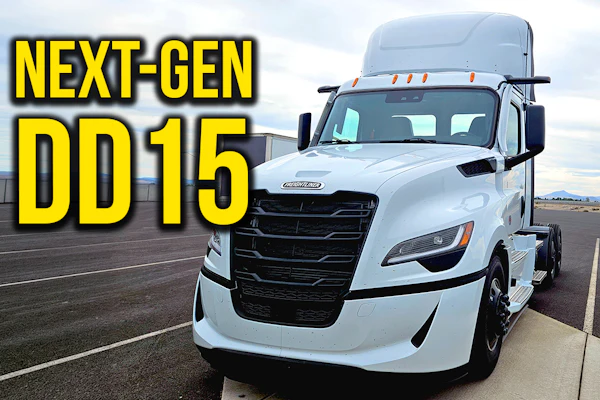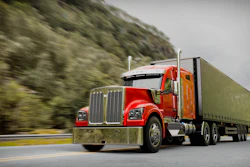











CCJ Video producer Andrew Guinn as he gets a rare, first-time-ever chance to get behind the wheel of the Gen 6 Freightliner Cascadia equipped with the next-generation DD 15 engine, ahead of its January 2027 market release.
After putting the truck through its paces on Daimler Truck’s High Desert proving grounds' 3-mile performance loop, he catches up with Steve Collins, Detroit's director of Field Sales Engineering. He breaks down what to expect under the hood of the redesigned DD 15, including rigorous testing over 9 million miles, new Detroit Assurance Safety Suite features, and up to a 3% boost in fuel efficiency.
Contents of this video
00:00 Inside DTNA’s High Desert Proving Grounds (Madras, OR)
00:33 First Drive: 2027 Detroit Gen 6 DD15 Engine on the Test Track
01:07 Walkaround: 2027 Gen 6 DD15
03:31 Updated Safety Safety Suite
05:00 Cross Traffic Assist
06:29 Active Side Guard Assist 2
07:51 Live 50 MPH Active Brake Assist 6 (ABA6) Ride-Along Demo
What's up trucking enthusiasts? I'm CCJ Video producer Andrew Guinn. Today we're taking you to a place where the mountains are purple. The skies are spacious and the speed limit is 62mph. This is Daimler Truck, North America's high desert proving grounds in Madras, Oregon. Detainees. Dedicated research and development hub where flagship platforms like the Freightliner Cascadia refined and stress tested.
CCJ was recently invited out to see what's next for the Gen six Cascadia, focusing on the updated DD 15 engine and the latest Detroit Assurance Safety Suite. While there, I had the rare chance to get behind the wheel of a Cascadia equipped with the next generation DD 15, ahead of its 2027 market release.
It was my first time driving a class A truck, but I couldn't imagine a better place to try it out.
The facility spans roughly 245 acres and features a three mile performance loop. I only got to drive two laps in the Cascadia, but it was a good preview of how much power these trucks have.
After the test drive, I caught up with Steve Collins, Detroit's director of Field Sales engineering, to get a closer look under the hood and break down what you can expect from the redesigned DD 15.
Here's what Steve had to say.
I'm Steve Collins. Today we're out here in Madras, Oregon, at our High Desert proving grounds. We have a fifth gen Cascadia with the Gen six Detroit engine inside. The Gen six engine is launching in January 2027. We've been working on this engine in preparation for 2027 and emissions changes, but at the same time working hard to deliver a lot of the customer benefits that go along with a new engine generation.
Over 9 million miles have been accumulated with this engine in development and testing and validation over 60,000 bench hours. All to get to this point in many different types of applications and validations. We're really excited about this opportunity and all the value that the Gen six engine brings to our customers. Starting next year in 2027. I think in terms of big differences between Gen five engine and Gen six engine, hopefully from a customer perspective, really, I hope they notice that there really isn't these huge changes, right, that these small optimizations along the way.
Utilizing the known proven technology and the known proven design of our heavy duty engine platform. DD 13, DD 15 and 16. Some things that they will notice when you kind of add all these things together. There's some fuel efficiency improvements, up to 3% driving fuel efficiency improvements that are driven by some of the optimizations in the fuel system, the airflow management, as well as reducing parasitic losses as much as possible.
I think the other big thing about the Gen six engine itself is, you know, all that wouldn't be possible if we didn't also have the after treatment paired with it. And I think great thing for customers and operators and fleet owners that Gen six after treatment system is really pretty much the same design as previous generation systems. We're just adding to it a simple canister that still packages in the exact same space plane as the fifth generation after treatment system, and still utilizing that known proven technology of SCR systems.
So again, from an operation perspective, from a technician and parts perspective, a lot of commonality and familiarity, and we hope that fleets and drivers will really appreciate that commonness between the two generation five and generation six for 2027.
If you want an even deeper dive into the new DD 15. Check out our full coverage from the official reveal, linked in the description below. And don't forget to subscribe so you don't miss any of our test drives and breakdowns of the next generation of commercial powertrains.
Next up, it's time to meet the bobs. The bobs are the full time and often hapless residents. The high desert proving grounds.
as crash test targets, they play a crucial role out here,
putting their phone, bodies and family car on the lines
so engineers can calibrate the radars, cameras and braking algorithms that prevent real world highway crashes during the live track demonstrations of the Detroit Assurance Safety Suite.
I spoke with Greg Treinen, vice president of on highway Market development at Daimler Truck North America, to break down what's new with the system and how it responds in real time scenarios.
what he had to say.
We are out here talking about the latest in active safety, Detroit Assurance with ABA six and then new features for 2027, cross traffic Assist and Active Side Guard Assist. Two. So with Active Brake Assist six, we introduced that with the Freightliner fifth generation Cascadia about a year and a half ago in early 2025, brought forth all new scenarios for active braking for emergency braking, so full braking on curves, full braking on stationary pedestrians, multi-lane braking scenarios.
The new system is really hitched to a new electrical architecture on the Cascadia, so it's able to process more data faster. Updated sensors, cameras. So now it's able to process more scenarios. So for 2027 we've added a couple new features. So the two new features cross traffic assist. So that's what a truck is heading towards an intersection. The system is tracking vehicles kind of coming from the driver's side and the passenger side as well.
And kind of making that calculation, that evaluation about whether it's going to need a perform an active braking action. So what it will do is if it's approaching that intersection, it feels like there could be the possibility of an accident. It'll engage in in audible and visual warnings for the driver. So the driver has an opportunity to mitigate the situation.
If that doesn't happen, active braking emergency braking will apply as the truck is entering that intersection to try to avoid to try to mitigate that accident scenario. So you know where there was a tap there on the rear end. Our systems are really, again, designed to mitigate serious collisions, right. And trying to reduce those types of situations. So even though there was a little bit of a bump, the system did engage and did still apply active braking, emergency braking to mitigate what would have could have been a more serious collision situation there.
So it avoided that situation or mitigated that situation where it might have not there might not have been a breaking what might have T-boned that vehicle. So it's really that's what we're trying to avoid. And so in that scenario, it might have mitigated a more serious accident. The system in the truck performed as as it was supposed to.
And again, it's really designed to again mitigate that. The seriousness of the potential impact that it's coming across. So that's cross-traffic assist, active side guard assist two builds on an existing feature, which originally was designed to apply active braking in a right hand turn scenario. So mitigating collisions with pedestrians and bicyclists with Asghar two with active SunGard Assist two.
Now we're looking at driver's side turn actions and accident mitigation. So that system is tracking oncoming vehicles. And so if you have your left hand turn signal on and it looks like you're going to make a turn and there's a vehicle oncoming, it'll give the driver audible and visual warnings. And then we'll apply active braking depending on whether the system thinks it's going to, there could be a potential for a collision.
So again, a couple new scenarios really. You know, it's it's looking at the accident data that's just kind of the next wave. You know, that cross path type of accident that we're working to try to mitigate in addition to our active breaking the rear collisions, you know, the side swiping with active lane assist in other scenarios. So again, continuing to evolve our emergency braking, our active braking capabilities at Daimler Truck North America.
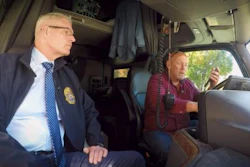
To wrap up my time at the Proving Grounds, I hopped in the passenger seat for a live demonstration of Active Brake Assist six. Seeing the truck detect a stop target and initiate emergency braking at 50mph proves
critical these reaction times are for highway safety. Here's a look at the system in action.
Well, let me give you a little heads up so you kind of know what's coming. All right. It's going to be a three stage. We call it a cascade, where it starts with a optic acoustic warning, and that's to allow the driver to take control. And then if the driver doesn't do anything, then, then the cascade will go to partial braking.
And if the driver still doesn't do anything, it'll go into emergency braking. Okay. Should we should we start with a 50 and then.
Or do we end with a 50. Let's start with. Yeah. Right. Yeah. I guess you get the vote.
Just a warning, Andrew. Especially if we're going to be doing a high speed braking event. It will be dramatic and it will probably throw you around a little bit. So you're going to have to work against that. Okay. So. No problem.
That was still smoother than the landing on my flight last night. Yeah. Oh, man. That's been a rough landing. There it was. Yeah. That's it. Had the.
Well, that's a wrap on my time in Madras, Oregon. I hope you enjoyed writing along as much as I enjoyed being out there. Don't forget to subscribe for more from CC. And thanks for watching!