










Trucking news and briefs for Tuesday, July 21, 2026:
Volvo recalls 3,800 trucks for steering issue
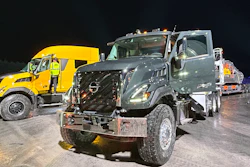
Volvo Trucks North America is recalling nearly 3,800 trucks due to an issue in the steering assembly, according to National Highway Traffic Safety Administration documents.
In the affected units, the steering knuckles may have been manufactured with insufficiently tightened steering arms, which can result in a loss of vehicle steering control.
The recall includes approximately 3,794 model-year 2026 Volvo VNL, VNR, VN, VAH and VHD units manufactured between Feb. 3 and July 24, 2025.
Dealers will inspect and tighten the fasteners between the steering arm and steering knuckle, as necessary, free of charge. Owner notification letters are expected to be mailed Sept. 7. Owners may contact Volvo Trucks' customer service at 800-528-6586 with recall number RVXX2607. NHTSA’s recall number is 26V-444.
Port of LA offering battery-electric truck purchase incentives
Fleets registered in the Port of Los Angeles’s Port Drayage Truck Registry can now apply for funding to purchase new electric trucks.
The port is seeking proposals for its Zero-Emission Truck Purchasing Incentive Project – eligible to all Licensed Motor Carriers (LMCs) currently registered in the Port Drayage Truck Registry – for the purchase of at least 10 battery-electric, Class 8 drayage trucks.
The purchasing incentive will provide up to $300,000 per battery-electric truck, with a maximum award of $24 million per LMC.
A total of $75 million in funding is available, with $50 million from the U.S. Environmental Protection Agency’s Clean Ports Program grant award and $25 million from the Port’s Clean Truck Fund Rate, has been earmarked to fund the program.
Interested applicants can find the RFP and additional details here. Proposals are due by 3 p.m., Thursday, Dec. 3.
Fleet requests ‘yard move’ exemption for short runs on public roads between company facilities
A 128-truck fleet based in Conway, Arkansas, is petitioning the Federal Motor Carrier Safety Administration for an exemption that would allow its drivers to log 1.3-mile moves on public roads between two adjacent properties as yard moves.
CCS Transportation Inc.’s request would allow short-distance moves to be logged as on-duty (not driving) yard moves on its drivers’ ELDs during brief travel on local public roadways separating two CCS facilities.


CCS noted the movements “do not involve interstate travel, highway speed operation, or linehaul transportation.”
CCS argues that current rules requiring the short, operationally necessary moves as driving time “inaccurately represent the nature of the work and consumes hours of service (HOS) in a manner inconsistent with the intent of those regulations.”
The exemption, CCS said, “would allow accurate HOS duty status recording for movements that are functionally identical to yard jockey activity and confined terminal operations.”
The company added that a denial of the request “would result in continued misclassification of yard-type movements as driving time, inefficient use of driver hours, increased administrative burden, and reduced operational flexibility -- without a corresponding safety benefit.”
FMCSA is accepting public comment on the request here through Aug. 17.
U.S. highway in Pennsylvania becoming I-99 next week
A 62-mile section of U.S. Highway 15 in Pennsylvania between the I-180 interchange in Williamsport and the New York/Pennsylvania state line will be redesignated as I-99 beginning July 27.
For truck drivers who haul overweight permitted loads in the Keystone State, the interstate designation also puts an end to overweight hauls on the route.
Currently on U.S. 15, hauling permits can be issued for divisible loads of certain commodities up to 95,000 pounds. After designation as an interstate, per federal law, the maximum weight will be reduced to 80,000 pounds for divisible loads if there is no federal exemption for the commodity. The Pennsylvania DOT noted that milk haulers are permitted under federal law to operate overweight on interstates including the future I-99 corridor. Permits for non-divisible oversize or overweight loads will continue to be issued and remain valid for travel along I-99.
Haulers will be required to comply with the weight limits or reroute using alternate, approved state routes under their current Annual Network permits. After the designation is finalized, the Automated Permit Routing and Analysis System (APRAS) will prevent the issuance of new divisible overweight permits for this corridor.
The change from being a U.S. highway to an interstate, Pennsylvania DOT said, will improve highway consistency and driver clarity in the region, enhance economic opportunity for the region, and strengthen freight movement safety and compliance.
“This designation from U.S. 15 to I‑99 reflects decades of planning and hard work to make a significant investment in our future,” said PennDOT Secretary Mike Carroll. “I‑99 strengthens the region’s transportation network by enhancing long-term safety, mobility, and economic opportunity throughout the region.”