










Rising truckload rates due to high fuel prices and tightening carrier capacity could trigger shipper customers to shift their freight movements to rail, but a key benefit that rail often lacks gives trucking a leg up in the competition: visibility.
Eighty-four percent would increase rail use if visibility into goods in transit improved, according to a recent survey of 500 U.S. logistics, transportation and supply chain decision makers commissioned by global security technology company Giesecke+Devrient (G+D).
Survey respondents highlighted limited visibility as their top frustration when using rail. Only 23% said they have continuous real-time location tracking for goods shipped via rail.
Visibility is a core competitive advantage for trucking because it gives shippers control, said Erin Cave, global vice president of product management at Verizon Connect, which provides tractor and trailer tracking solutions.
“If you know a truck is stuck in a multi-hour traffic delay, you can alert the receiving dock, adjust staffing, or even re-route another shipment. If you don't find out until the missed delivery window, you are already behind, reacting to a problem,” Cave said. “If rail is able to bridge this visibility gap and offer reliable, granular tracking, it will absolutely shift volume away from long-haul trucking.”
Rail gains ground despite visibility concerns
Despite the visibility hurdle, freight has shifted to rail.
Overall rail traffic for the U.S. was up 2.7% year over year through the beginning of October, according to the Association of American Railroads.
That growth is stronger than it sounds because coal volume, which accounts for the most rail carloads by far, was down 1.8% as of early October, said Avery Vise, vice president of trucking at FTR Transportation Intelligence. The only other commodity group that was negative year over year, he added, was motor vehicles and parts, and that deficit was less than 1%.
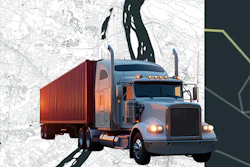
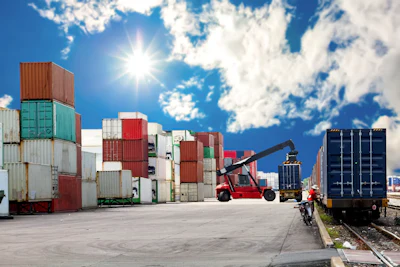
Vise said the rail traffic most relevant to trucking is intermodal, and U.S. intermodal traffic was up 4.2% year over year in early October. Rather than because of container imports, he said most of that growth was due to domestic traffic.


“The surge in diesel prices and higher dry van spot rates in general almost certainly have been the principal driver of intermodal volume growth this year,” Vise said, highlighting the timeline when growth spiked.
Weekly intermodal volume was running basically in line with comparable 2025 levels until around April, he said, noting that absolute volume has since increased to the highest level since late 2021. The year-over-year improvement is even greater, he added, but much of that has to do with import weakness in the second quarter of last year following the pull-forward of imports to avoid tariffs.
Rail’s advantage is clear: hauling commodities like coal and grain, for example, that cannot be transported economically by truck regardless of fuel prices, Vise said. Outside of visibility, which Vise admitted he wasn’t familiar with, trucking’s advantage is better transit times, with the absence of drayage transfers and the ability to move directly from point A to point B.
“Of course, as costs in trucking – i.e., diesel – surge, many shippers are willing to be flexible on transit times and choose intermodal instead. That decision will be specific to the type of freight and how lean or flush inventory levels are at warehouses and distribution centers,” Vise said. “It’s a fair assumption, though, that the availability of real-time tracking would make intermodal more competitive in those situations.”
Trucking still holds the technology advantage
Cave noted that shippers want to use rail because it is cheaper and far better for their sustainability goals, so it would be a much more attractive alternative to long-haul if visibility were to improve.
Luckily for carriers, Cave said cheap freight doesn’t matter if it arrives three days late and shuts down an assembly line or leaves store shelves empty. Trucking is way ahead of the curve when it comes to real-time visibility, he said.
That’s primarily because of power and infrastructure.
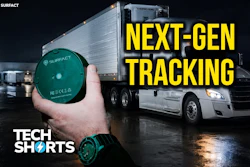
“Every tractor on the road has a continuous power source. That means we can run heavy-duty telematics, smart dashcams and mobile devices that ping location, vehicle health and driver status near-instantly — sometimes every few seconds,” Cave said. “Rail has a much tougher physics and logistics problem, including power and battery constraints. A boxcar or container sitting on a track doesn’t have an engine generating electricity so any tracking hardware attached to a railcar relies on solar or internal batteries, so to make those devices last, they ping far less frequently.”
Those pings turn location tracking into actionable risk mitigation.
G+D noted that visibility isn’t just about knowing where freight is anymore. It is increasingly about having access to reliable data from connected assets that can support faster decisions, stronger accountability and more resilient supply chain operations.
The primary reason survey respondents (45%) said they want greater visibility over goods during rail transit is because it enables them to plan and optimize downstream operations.
“When shippers don't know exactly where their cargo is or when it will arrive, they have to compensate. Most keep extra ‘safety stock’ in warehouses, which ties up massive amounts of capital,” Cave said. “Their warehouse teams often sit idle waiting for a load or double up on overtime when three trains show up at once. More often than not, they miss delivery windows with major retailers, incurring heavy fines. If you can’t predict arrival, the lower shipping cost gets wiped out by operational chaos.”