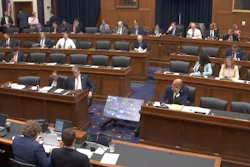











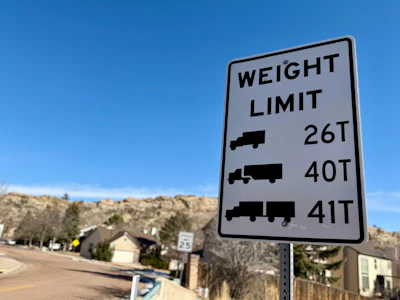
An amendment was added to the BUILD America 250 Act during the House Committee on Transportation and Infrastructure’s markup Thursday night that would establish a voluntary pilot program allowing states to raise gross vehicle weight limits on federal interstates.
Introduced by Representative Dusty Johnson (R-SD), the proposal aims to modernize a federal weight standard that has been untouched since 1982. Under the pilot program, participating states could opt to increase the maximum allowable truck weight from 80,000 pounds to 91,000 pounds. However, there's a catch: any truck operating at the higher weight limit must be equipped with a sixth axle to redistribute the load.
The amendment narrowly advanced 35-29. Since the program would be a voluntary opt-in pilot for states, it will not require changes for jurisdictions wanting to maintain the 80,000-pound ceiling.
Tech and infrastructure are ready
Backers of the pilot program argued that the farming, manufacturing, and logistics sectors are being strangled by decades-old regulations that ignore the benefits of modern technology.
"Our supply chains are susceptible to strain and disruption, which places real costs on the system—costs that fall on real families," Rep. Dusty Johnson argued during the session. He pointed out that 40 states already allow weight limit variances on non-federal roads, creating an inefficient patchwork that forces heavy trucks off straight interstates and onto local municipal routes.
According to data cited by supporters, the economic relief could be substantial. A modernized weight standard could eliminate an estimated 105,000 annual truck trips for dairy manufacturers alone. For livestock haulers, the capacity boost means moving the same amount of cattle using four trucks instead of five.
Representative Eric Burlison (R-MO) framed the amendment as a weapon against inflation.
"There are very few things we can do about [inflation]. This is one of them. This is the one thing that this committee can do to address the rising costs of everything that you and I buy that goes on the shelves," he said.

Mike Collins (R-GA) argued that the capabilities of safety technologies, like anti-lock braking systems, automatic anti-rollover devices, and disc brakes, far outpace the outdated limits that were placed on commercial vehicles more than 40 years ago.
"We are advancing in technology. Trucks are safe," said Rep. Collins, who owns and operates Jackson, Georgia-based Collins Trucking Company. "The majority of the accidents that are out there are caused not by the tractor-trailer. They're caused by the four-wheelers out there."
Rep. Dusty Johnson cited a Minnesota Department of Transportation study showing that the addition of a sixth axle actually yields a 37% reduction in road wear, while a federal study concluded that the extra axle allows a 91,000-pound truck to stop a foot shorter than a standard 80,000-pound configuration.
No to '91,000-pound missiles'
Opponents, including several Democratic committee members, are fiercely resisting the program, calling the pilot a gamble with public safety.
"Increasing truck weight limits raises serious concerns," countered Representative Salud Carbajal (D-CA), who listed more severe crash impacts and greater risk for passenger vehicles sharing the road as consequences.
Representative Hank Johnson (D-GA) rejected the idea of using the traveling public as "test subjects" to gather real-world data.
"You allow these 91,000-pound missiles onto the highways, and then it will be unstoppable," Rep. Hank Johnson warned, citing a Washington State study that found 91,000-pound trucks were 47% more likely to be involved in a crash than standard loads.
"Crash severity is driven by mass and speed," Rep. Hank Johnson noted. "When the weight goes up, the force of a crash goes up and so does the likelihood of serious injury or death."
History of industry pushback
Legislative efforts to increase commercial truck weight limits have popped up in recent history and have traditionally been opposed by most trucking stakeholders. The Owner-Operator Independent Drivers Association (OOIDA), Truckload Carriers Association (TCA), and the industry's largest labor union, the Teamsters, in 2023 opposed H.R. 3372, which would have established a 10-year pilot program allowing a gross weight of up to 91,000 pounds for certain six-axle trucks, or the maximum permitted by bridge formulas. States, even those that already allow gross weights of more than 80,000 pounds, had the ability to opt in or out of the program, but the measure never advanced past the House.
More than 2,200 local government leaders countrywide last year pressed congressional lawmakers to oppose increases in commercial truck size and/or weight, including heavier single-trailer trucks.
A joint letter, organized by the Coalition Against Bigger Trucks (CABT) and delivered to congressional leaders in Septemeber, was co-signed by county and municipal officials as well as public works directors and county engineers from all 50 states.