










Absent a clutch, a vehicle needs only two pedals to move and stop—but federal rulemaking initiated last week could soon eliminate one of those pedals entirely for vehicles operated by fully automated systems.
National Highway Traffic Safety Administration's proposal is part of the Department of Transportation’s new Automated Vehicle Framework and is the fifth update to the Federal Motor Vehicle Safety Standards (FMVSS) aimed at adapting rules for self-driving.
Under the proposed rule, vehicles designed exclusively to be driven by an Automated Driving System would no longer be mandated to have hand- or foot-operated brake controls. However, vehicles equipped with automated systems that still allow for human driving must retain all existing manual controls.
NHTSA confirmed for CCJ that there is no requirement for an accelerator pedal in FMVSS.
NHTSA emphasized that while physical brake pedals may be removed, braking performance requirements — including strict stopping distance standards — will remain in place through alternative testing procedures.
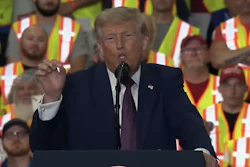
"We are at the cusp of the greatest technological revolution in vehicle technology since the innovation of the Model T," NHTSA Administrator Jonathan Morrison said. "If we want America to lead the way, we have to reimagine our regulatory framework."
Morrison said that under Transportation Secretary Sean Duffy’s framework, the agency aims to remove "pointless barriers to innovative designs" while maintaining safety standards and holding autonomous vehicle developers accountable.
The rule change targeting FMVSS No. 135 is part of a broader push by the Trump administration to modernize safety standards for equipment that may become obsolete in fully autonomous vehicles, such as windshield wipers, rearview mirrors, and transmission shifting controls.
In addition to the hardware changes, NHTSA is separately developing safety performance requirements for automated vehicles in real-world driving scenarios and is drafting the first major federal safety guidance for autonomous vehicle developers since 2017.


The agency noted it will continue to use its defect enforcement authority to investigate unsafe autonomous vehicle behavior and oversee recalls.