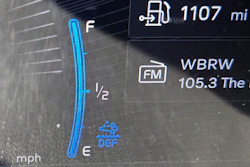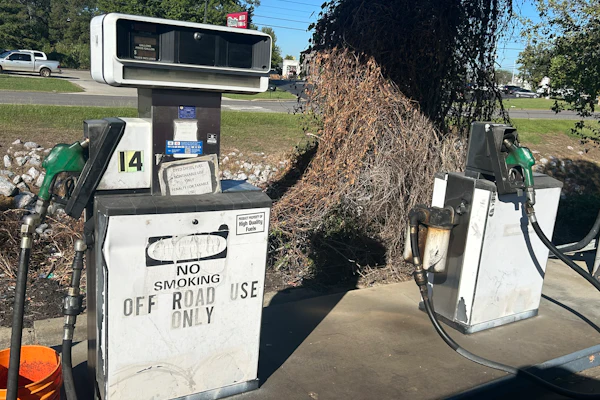











The U.S. Environmental Protection Agency (EPA) last week issued guidance that drops the requirement for Diesel Exhaust Fluid (DEF) sensors as part of a truck's aftertreatment system and allows truck manufacturers to bypass sensors that monitor DEF quality.
The EPA clarified that manufacturers are not required to use Urea Quality Sensors (UQS) and are encouraged to use alternative methods, such as nitrogen oxide NOx sensors, to meet adjustable parameter regulations. The EPA is encouraging manufacturers to return to or adopt NOx sensor-based strategies to improve system robustness and reduce failures associated with UQS, but OEMs are largely left to interpret the proposed guidance and plan their own response.
Truck and engine manufactures contacted by CCJ have had less than a week to digest the 5-page EPA guidance and the text of the Diesel Truck Liberation Act, a bill working its way through both the House and Senate that seeks to codify recent deregulation efforts by EPA Administrator Lee Zeldin and would prohibit federal agencies from requiring manufacturers to install emissions control devices or onboard diagnostic systems.
A spokesperson for International told CCJ that the company is "assessing the guidance and determining the next best steps," adding that while DEF sensors may no longer be required, "it is our understanding that something must replace them to monitor for fluid quality. We are evaluating all possible options to ensure our customers continue to experience the reliable, quality products and support they expect from International."
Updated systems should be designed, the EPA said, to only make fluid quality determinations under conditions that ensure accuracy. If an accurate decision cannot be made within an hour, the system should continue monitoring rather than automatically triggering a derate. Manufacturers will have to describe their DEF quality monitoring strategy in their application for certification or when incorporating updates to their software in running changes or field fixes.


The Truck and Engine Manufacturers Association (EMA) identified UQS as having some of the highest failure rates among Selective Catalytic Reduction (SCR) components. The EPA's own data supports that these failures are a significant source of warranty claims. Under the new approach, manufacturers can monitor a truck’s actual emissions output rather than relying on a specific DEF quality sensor , allowing the vehicle to remain fully functional as long as it meets environmental standards.
"We appreciate the EPA’s flexibility in enabling solutions that reduce customer burden," Daimler Truck North America (DTNA) told CCJ. "As with any new regulatory option, it will take time to develop and validate an approach that meets all requirements and supports reliable vehicle operation. We will continue working closely with the EPA to ensure a solution that maintains system integrity."
In the guidance issued Friday, the EPA said NOx sensors have been able to detect poor DEF quality for many DEF dilution scenarios in most applications. While DEF sensors were favored for the speed with which they can detect dilution, the EPA, in its new guidance, now acknowledges that NOx sensors can provide an adequate restraint on adjustability if the range of noncompliant operation is small enough that operators are unlikely to target it.
"We believe this is a common-sense path forward: customers are not in the business of tampering with emissions systems, and the updated approach allows for effective detection of tampering without requiring additional hardware," DTNA added.
When certifying engines, the EPA assesses DEF quality across a specific adjustable range. The compliant range is the span between unadulterated DEF (32.5% urea) and the point where the engine can no longer meet NOx standards.
The updated EPA guidance allows manufacturers to develop compliant solutions that do not rely on a DEF quality sensor. However, "it is not as simple as removing or disconnecting a sensor, which will trigger diagnostic fault codes," Daimler Truck North America noted to CCJ. "Any new approach would require updated software and calibrations to be developed and validated. We are currently evaluating our options and will determine the most appropriate approach based on the guidance."
Software updates on existing diesel products that replace or augment UQS-based systems with alternative technologies, the EPA said, would not be considered tampering under the Clean Air Act. However, as truck and engine manufacturers figure out their next steps, Volvo Group cautioned fleets and drivers from taking matters into their own hands.
"Aftermarket or do‑it‑yourself modifications that bypass emissions systems are not allowed and may have regulatory and warranty implications," the parent company of Volvo and Mack Trucks told CCJ. "The EPA guidance does not authorize or enable those kinds of modifications."
The Diesel Truck Liberation Act, should it pass, would retroactively protect individuals from prosecution or lawsuits related to tampering with emissions equipment.
Kenworth and Peterbilt parent PACCAR declined to comment.