










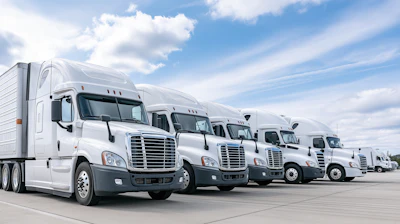
A bipartisan duo of U.S. senators has re-introduced legislation to repeal a century-old tax on heavy trucks and trailers, arguing that the tax creates financial barriers preventing trucking fleets from adopting cleaner, safer and more fuel-efficient vehicles.
The Modern, Clean, and Safe Trucks Act, which seeks to eliminate the 12% Federal retail excise tax (FET) from the Internal Revenue Code of 1986, was introduced in the Senate by Todd Young (R-IN) and Angela Alsobrooks (D-MD).
“This outdated tax incentivizes using older, less efficient trucks," said Senator Alsobrooks. "Our bill supports a modern trucking industry allowing for the adoption of newer trucks that are safer and more fuel-efficient. In doing so, the bill supports small businesses, independent truckers, and our environmental goals–it just makes sense.”
Efforts to repeal the FET has surfaced numerous times in the past but have historically died before ever getting close to the finish line.
A House companion to the Modern, Clean, and Safe Trucks Act was introduced last year by a bipartisan coalition of Congressmen. The Modern, Clean, and Safe Trucks Act has been introduced four times: 2019 (116th Congress), 2022 (117th Congress), 2023 (118th Congress), and 2025 (the current 119th Congress).
First enacted by Congress in 1917 to help finance the United States’ entry into World War I, the 12% levy is the highest percentage rate of any federal ad valorem excise tax currently on the books, accounting for a $6 billion annual burden on the trucking industry, according to American Trucking Associations President & CEO Chris Spear.
According to congressional findings outlined in the bill, the tax places an upfront burden on the commercial transportation sector, tacking on an extra $7,000 or more to the price of a standard trailer, at least $20,000 for new clean diesel trucks, and as much as $50,000 for advanced zero-emission or alternative-fueled models.
That has priced some many smaller fleets and operators out of the newest and safest tractors available. Nearly 34% of Class 8 trucks currently operating on U.S. roads were manufactured before 2010, meaning they lack more than a decade of fuel efficiency and safety advancements.


"Keeping this antiquated tax on the books imposes an enormous hardship—particularly for the family businesses and independent truckers who make up the overwhelming majority of trucking," Spear said. "Removing this burden will allow motor carriers to replace their trucks and trailers with modern, safer, and cleaner equipment, which will in turn provide a boost to U.S. manufacturing jobs."
Supporters emphasize that modernizing the nation's logistics fleet offers massive environmental payoffs. Truck manufacturing advancements between 2007 and 2020 successfully averted 202 million tons of carbon dioxide emissions and 27 million tons of nitrogen oxide emissions, while conserving 20 billion gallons of diesel fuel. On an individual scale, a single Class 8 vehicle operating with the latest clean diesel configuration saves roughly 2,200 gallons of fuel annually compared to previous models.
The tax has also drawn sharp criticism for counteracting public policy goals regarding green technology. Because electric and alternative-fueled commercial vehicles carry significantly higher initial manufacturing price tags, the percentage-based excise tax hits them the hardest.
The bill points out, too, that revenue generated by the tax fluctuates significantly because it is tied directly to volatile annual truck sales. Because these funds are deposited into the Highway Trust Fund, the legislation urges Congress to establish a more reliable and consistent alternative revenue mechanism to finance U.S. infrastructure.
The bill has been read twice and referred to committee for further consideration.