










Samsara's new connected asset maintenance features
- Samsara unveils AI-driven maintenance Tool: At its Beyond conference in Las Vegas, Samsara introduced a connected asset maintenance feature that pulls vehicle diagnostics to create a prioritized list of trucks needing attention.
- Rapid fault diagnosis and repair logistics: The AI maintenance agent interprets vehicle fault codes using service manuals, estimates repair costs, predicts future component failures based on network data, checks warranty coverage, and drafts work orders—reducing a two-hour manual process to two minutes.
- Launch of agent studio for custom automation: Samsara launched "Agent Studio" in open beta, allowing fleet managers to build and deploy custom AI agents using plain language to automate administrative tasks and analyze massive data pools without needing technical IT expertise.
- Pre-built templates for safety and efficiency: The platform includes over 15 pre-built templates, such as automated weekly KPI reporting and geofenced voice alerts that guide drivers to specific delivery docks or warn them of high-accident hotspots.
Sanjit Biswas clicked the wrench icon in the Samsara dashboard during a presentation of the technology provider’s new connected asset maintenance feature Wednesday on stage at its Beyond conference.
The feature provides insight for maintenance technicians into the status of fleet vehicles with AI creating a prioritized list of vehicles that are in most need of attention. That information is fed into the dashboard through the Samsara Gateway that is plugged into the diagnostic port and allows the system to identify check engine lights or fault codes.
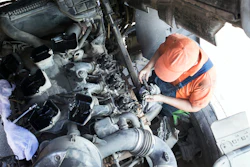
Biswas, Samsara’s co-founder and CEO, demonstrated how the company’s AI recognized a fault code on a Freightliner Cascadia, determined and explained exactly what the code was related to based on the service manual and recommended actions to remedy the problem. The system also provided statistics that gave insight into how important the fault code was based on Samsara data accumulated across the millions of vehicles in its network.
“This is telling us that this fault is a sensor issue and would cost somewhere between $100 and $800 to repair, and if we don't do anything about it, about 22% of the time this turns into the next fault code in 500 miles,” Biswas said. “That's exactly what I need to know. I can send that driver out. They can run their route. They can come back, and I'll swap their truck out at the end of the day.”
The connected asset maintenance feature is just one of the new agentic AI tools Samsara unveiled at its annual user conference this week, held this year in Las Vegas.
Behind the feature is an AI maintenance agent that can then search within a company’s uploaded warranty documents to determine if the repair will be covered and even draft a work order or provide a checklist of items needed to submit a work order.
“You'd have to have a diesel mechanic, an expert who could crack the service manual, figure out what that fault code is. You'd have to make the decision of whether to repair or not, and if you did, you'd have to go look through all that warranty program documentation,” Biswas said. “That whole thing might have been two hours or more. That's two hours nobody has in their day, and the system just did it for us in about two minutes.”


Integrating AI into operations
The same data that feeds the new connected maintenance feature and maintenance agent powers Samsara’s new Agent Studio, which is currently available for customers to test in open beta. Biswas called it a workshop that enables fleets to experiment with AI agents. Customers can use templates or build their own agents from scratch to manage tasks like paperwork or driver communications, and they can do it in plain language.
“In 2025 alone, we captured 25 trillion data points across the Samsara Network across vehicles, equipment, worksites and operations,” said Samsara Chief Product Officer Johan Land. “Now, customers can act on this insight by leveraging Samsara’s platform to fully automate workflows without extensive IT expertise.”
Dylan Sellberg, Samsara’s senior director of product management and head of AI agents, told CCJ that customers can use it similarly to how they would ChatGPT.
“I often tell our customers … once they’re ready to build it, just imagine you’re coaching an intern and describe to them what you want,” Sellberg said. “It’s very hard to overload an agent, so I’ll tell a customer, just put your mind on speakerphone; just blab at the thing. Tell it all the things you want. Tell it how you want it, what format, what style, how often, where you want it to look.”
He said it’s harder for customers to decide what they want to build than it is to build the agent.
That’s why Samsara created over 15 templates across safety and maintenance. Sellberg said he sees the potential for the template roster to grow beyond 40 very quickly.
One of the pre-built agents available in the template menu is geofence alert: an agent that provides voice alerts to drivers when they enter a geofenced area. These are a couple of good use cases for the trucking sector, Sellberg said: it can share with the driver details like which gate or dock to go to at a customer site or give a heads up about a hotspot where minor accidents are prevalent.
Another template is the weekly KPI report, a chat agent that provides analysis of a company’s data, freeing staff from hours of manual work each week.
Within the studio, builders can also toggle capabilities on or off, set permissions, monitor usage, and configure settings. Customers can integrate their company’s policies and documents into Agent Studio as a knowledge base, preview behaviors before deployment, and track outcomes through a performance dashboard.
“We can now automate away the grind,” Biswas said.