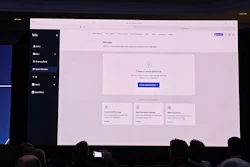
Fleet management and driver safety platform Motive rolled out an AI-powered tool last year that gave fleet managers and operations teams the ability to query their data using natural language. Motive Staff Product Manager Emily Parsons said during the opening session at Motive Vision 26 that the AI Answers platform has generated hundreds of thousands of queries since its launch, but customers wanted more.
In response, Motive introduced its new AI-powered assistant that’s built into every part of its platform. Called Atlas, the assistant goes beyond analytics, understanding fleet data, drivers, workflows and more, while remembering context and executing actions.
For example, the assistant can offer a morning brief that surfaces the most important details they need to know in that moment across safety, compliance, operations, fuel, etc. It identifies action needed based on context from policies or even a coaching plan the company implemented a week prior. It can then take action, drafting a personalized message to specific drivers who need intervention based on their number of safety events, such as excessive cellphone use behind the wheel.
“An atlas is what you reach for when you need to find your way. That’s what this is for your team across everything they do,” Parsons said.
Atlas is just one part of Motive’s expansion to its platform. The company also introduced new integrated hardware and additional AI tools that aim to reduce manual workload.
New AI camera capabilities
Disparate platforms and fragmented tools create data silos and place limits on AI’s abilities, but that’s not just a software issue. Motive Co-Founder and CEO Shoaib Makani said this leads to operational complexity and excess manual work, dragging down productivity.
“The solution to these two universal challenges is integration and automation. This year, we took integration beyond software into the world of hardware,” he said. “The standard paradigm in this industry has been a telematics device for fleet management and a dashcam for driver safety, and that made sense in a world where dashcams were optional, but today they are essential. This is why we've built the AI Dashcam Plus. We combined telematics and cameras into one device.”

Motive announced the launch of multiple new capabilities for AI Dashcam Plus Wednesday at its annual user conference.
• Collision avoidance: Two road-facing lenses and a Qualcomm AI processor that not only tracks everything on the road, including cars, bikes, animals and pedestrians, but also predicts where those things are going, enabling faster driver alerts that can help prevent collisions.
“Most cameras rely on a single road-facing lens … They detect objects but struggle to estimate distance, speed and motion,” said Motive Vice President of Product Nihar Gupta. “Instead of measuring distance frame by frame, we model how every object is moving through space. The camera sees one vehicle; our AI sees multiple possible future trajectories in real time. We reason about which trajectory puts your driver at risk, and we alert seconds earlier while there’s still time to act.”
• Automated License Plate Recognition (ALPR): A 1440p zoom lens with a narrow field of view captures license plates while a vehicle is in motion, delivering essential evidence, including make, model and color, for hit and runs, road rage, theft and other incidents to speed investigations and exonerate drivers.
• AI-powered speed sign detection: Advanced computer vision reads speed limit signs directly off the road instead of relying on often outdated map databases. By tracking signs in real time, it ensures drivers are only alerted when they are actually speeding, eliminating false alerts, building driver trust and enabling more effective coaching.
• Live two-way calling: Motive has added noise-canceling microphones and a speaker to enable direct, hands-free communication between drivers and managers through the device. Managers can check in with drivers about issues such as fatigue or severe weather. Drivers can connect with managers instantly for updates without relying on mobile phones, reducing distraction and enabling faster response.
Motive also introduced AI Omnicam Plus, a new camera system that provides 360-degree visibility around the vehicle with an in-cab monitor that alerts drivers to road hazards. Built on the AI Dashcam Plus platform and powered by the Qualcomm Dragonwing QCS6490 processor, it can run more than 30 AI models simultaneously.
Automating the manual workload
Integration is the solution to fragmented tools, while automation is the solution to manual work. Makani said Motive consistently hears from its customers that there is too much manual work in their operations.
He said that’s where Motive AI shows up in three key ways across the platform: delivering insights that help make sense of raw data, powering intelligent assistants like Atlas, and powering AI agents to do the work autonomously.
“The real problem isn't the time that (manual work) consumes. It's that, today, some of your most important work only happens when a person becomes aware of an issue,” Makani said. “Someone has to get an alert, make sense of it and then act, so the things that matter most – a fatigued driver, a critical fault code, a major service issue – get addressed only as fast as a manager can get to them.
Performance is capped by the limits of human attention, he said, adding that automation breaks that ceiling.
Motive introduced Automations at its user conference in Nashville.
Automations trigger immediate action based on real-time signals. For example, if a vehicle reports a critical fault code, Motive can immediately contact the driver and instruct them to pull over before the driver or manager notices the issue.
Managers can apply Automations across safety, maintenance and operations to do things like detect excessive idling and prompt drivers to shut off the engine; flag hours of service and compliance risks; trigger Atlas to contact drivers when something is detected, like fatigue; and automatically assign and instantly push a Motive Card to a new driver’s digital wallet.
“The right action happens at the right moment, whether or not anyone is watching,” Makani said.
Atlas
Those who want more control over actions can use Atlas. Also powered by Motive AI, it surfaces insights – from vehicle health and driver safety events to compliance – instantly from across the platform, reducing the need to search multiple systems or rely on static reports.
Atlas also works with Motive Voice Assistant. Just as managers can set up Automations that trigger Atlas to contact the driver, the driver can give Motive Voice Assistant simple commands that trigger Atlas to do things like contact dispatch, for example.
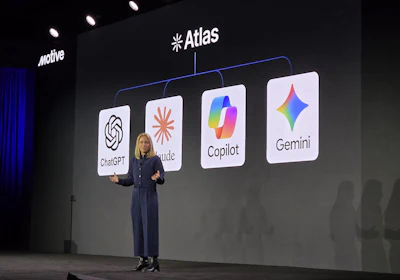
And finally, Atlas extends beyond the Motive Dashboard into third-party AI tools, such as Claude or ChatGPT, via Motive’s model context protocol, enabling teams to connect their Motive data to the other AI tools they use. This allows Atlas to automate complex strategic tasks, like benchmarking insurance rates and generating data-backed renegotiation proposals.
“Insurance is just one example here,” Parsons said. “Complex questions that no single system could answer alone are now just a simple prompt away.”