What happens when you take a legacy truck platform and inject it with one of the most advanced, future-ready powertrains on the market? CCJ Editor Jason Cannon heads to Southland International Trucks in Tuscaloosa, Alabama, to find out. He’s taking the 2026 International LT on a 100-mile round-trip test drive to Birmingham, but this isn't a standard review. The real story is hidden under the hood: International's S13 Integrated Powertrain.
Before hitting the highway, strategic account manager Josh Wood takes us inside the spacious 73-inch high-rise sleeper cab. Designed with driver comfort and fleet efficiency in mind, the cab features:
- A fully customizable LCD digital gauge display with advanced driver assistance systems (ADAS).
- A unique low-speed maneuverability mode for effortless docking and tight lot control.
- The My International connectivity portal for real-time fleet troubleshooting.
A masterclass in efficiency
Once on the road, the S13 truly shines. International’s Vice President of Integrated Technologies, David Hillman, breaks down the brilliant engineering making this system the least disruptive path to meeting the upcoming 2027 EPA emissions regulations. By entirely eliminating the troublesome EGR cooler, the engine burns fuel so cleanly that it produces virtually no soot, effectively doubling the typical lifespan of the Diesel Particulate Filter (DPF).
Power is delivered seamlessly through the proprietary T14 14-speed automated manual transmission. Operating on an isolated 24-volt circuit to eliminate weekend battery drains, the T14 offers a 50% mechanical advantage at low speeds, letting drivers accelerate smoothly from a dead stop even under heavy loads.
Want to see how the S13 handles the highway yourself? Watch the full test drive now!
Contents of this video
00:00 Intro to the International LT and S13 Integrated Powertrain
00:51 Interior Features: LCD Display, My International & More
03:20 73-Inch High-Rise Sleeper Cab Tour
06:05 Test Driving the International LT
12:19 Inside the 2027-Ready S13 Hardware
12:42 S13 13-liter Displacement Engine
17:26 Dual-Stage Aftertreatment System
21:22 The T14 Transmission: 14 Speeds & 8 Reverse Speeds Explained
26:27 Test Drive Wrap-Up: Is the LT the Smartest Truck on the Road?
Speaker 1:
Hey everybody. CCJ Editor, Jason Cannon here, and today we are at Southland International Trucks in Tuscaloosa, Alabama. We're going to test drive this international LT. I know what you're thinking. Test driving an LT LT's been around forever. Well, it's been around for about 10 years, but the real story we're going to tell on this trip is on the S13 powertrain. That's only been available in this truck for a little over a year, close to two years. This will be a good opportunity to take this truck from Tuscaloosa to Southland's International Dealership in Birmingham, which is going to be 50-ish plus miles and then we're going to bring it right back here. But before we take the truck out on the road, we want to get in the cab and take a little tour of what's going on inside this 73-inch sleeper. So I'm going to invite Josh Wood, who's a strategic account manager for Southland International to lead that tour.
Speaker 2:
So we're going to look at some of the interior features of this 2026 International LT. We're going to start with the LCD display up on the dash. So the LCD display is a little bit newer to the LT sleepers. We have our display up top that gives it all of our digital gauges as well as we can go into these gauges and see all of our gauge layouts, vehicle alerts from engine, vehicle ABS transmission alerts. We can set up the display however we like. And also we have our ADAS, which is our collision mitigation system, so our driver asistance center. So that's in our LCD display. Also outside of our LCD screen, we have our tachometer in our speed gauge. We have our oil pressure, deaf gauges, primary and secondary air gauges and fuel gauge. Those are all of our primary gauges that the driver needs to interact.
With the International LT, we have a full range of additional gauge packages as we can see here on the right. We can go up to six additional analog gauges as well as a whole host of digital gauges within our LCD display. We have three different banks of additional switches as well. Each bank holds up to six different switches, so we have 18 different options that we can choose from. So this is our switchback, pretty universal across all trucks. One thing that is unique to an international LT, specifically an S13 powertrain is this button right here. It's a low speed maneuverability mode. It really gives the driver the ability to maintain a low speed maneuvering within a lot. So it helps a lot with off-road delivery sites. When they're backing into a dock, it gives them instantaneous throttle control and allows them to maneuver the truck easily at low speeds.
Like most of the industry, we've moved a lot of our controls actually on the steering wheel to allow the driver to have his hands on the wheel at all time, he can operate his cruise control, his lights, his radio, even pick up the phone from right here on the steering wheel. He doesn't take his hands off the wheel at all. So we have My International, which is our connectivity and this is our signal box a little bit up here. My International is a portal that allows the fleets to log in and see real time faults driving activity, fuel economy on their trucks. It also allows them to do some troubleshooting if there are fault codes. The 5G modem that's equipped in each truck is mounted just above the CB radio. As we move into the back of this 2026 LT Sleeper, this is a 73-inch high-rise sleeper.
So as we can see, there's plenty of headroom to stand up. We also have this sleeper available in a Skyrise model, which is even taller to accommodate a double-bunk setup. So in the back of this high-rise sleeper, we have plenty of cabinet space. As we can see, we have a tall cabinet here. There is a hanging rod for hanging clothes on the inside. We have plenty of storage up top that's accessible with the doors open or closed. And in certain applications, we can remove the rearmost cabinet and we can add a double bunk feature if you do have a situation that calls for a high-rise sleeper, but you're running a team operation. So in the back, we do have all of your controls to run your AC in the rear of the sleeper. You also have your regular controls. This unit is equipped with an Eaten 1800 watt Pure Sign inverter, which makes power accessible for microwaves, refrigerators, CPAP machines, any other accessories that a driver may need when they're out on the road.
So as we move over to the passenger side, we have storage behind the passenger seat. This setup has a little pullout storage drawer and also has a built-in refrigerator as we can see here. Another option that's become very popular amongst fleets and drivers is a refrigerator prep kit. So this cabinet is actually removed and we have a baseplate, straps, and power outlet so drivers can actually provide their own refrigerator. One of the common issues we hear are the refrigerators that are built into trucks are too small for a driver's needs over the road. So the refrigerator prep kit that International now offers allows the driver to put in their own size refrigerator, much like you would se in a college dorm that stands a little bit taller, has more capacity. So that's become a very popular feature for drivers and fleets as the refrigerator prep kit.
As we can se, we still have plenty of storage over on the passenger side and we even have a flat screen TV mount for the drivers so they can have their TV be able to move it where they need to go and then stow it out of the way when it's not in use. So to really maximize the most space and storage space for the LT sleeper, we have a full underbunk storage unit. So it is partitioned. So we have a left, a center, and a right storage so we can separate if you have liquids in one closing in another, we can really keep them separate from each other.
Speaker 1:
Thanks Josh. Appreciate the great tour. Josh had mentioned the My International platform, which is relatively new. If you'd like to learn more about that, you can click on the video that's on your screen right now. Josh, you ready to hop in this truck and take it to Birmingham?
Speaker 2:
Let's do it.
Speaker 1:
Let's go. So this engine replaced the A26, which was sort of the new international engine at the time. How is the S13 different from what the A26 was?
Speaker 2:
Yeah, so the S13, when it came into play it did. It took the place of the A26. Not there was anything wrong with the A26, but with the calendar year 2027 emissions that are going into play in January, there were lots of things that were going to need to be changed on the engine and after treatment platforms and that's affecting all OEs. So International Motors went ahead and adopted the S13 because it really truly is already set up for all the emissions regulations coming in January of 2027. So that was the reason for the changeover. Again, nothing against A26, just we knew we were going to have to make a change, so we went ahead and introduced this engine early.
Speaker 1:
The T14 was sort of international's first foray into its own transmision. What sort of benefits come from having the engine and the transmission and the aftertreatment system for that matter manufactured by the same OEM?
Speaker 2:
Absolutely. So our engine transmission and aftertreatment are all proprietary to international. It allows them to communicate a little bit better. Not to say other platforms with different manufacturers of engine transmission don't perform well, but when all three platforms have the same common electrical architecture, they're all communicating on the same channels along with the same engineers, you have a little less complexity involved in putting it together. Then again, having everything vertically aligned across one OE just allows for a smoother transition and easier work process for our mechanics.
Speaker 1:
When I'm walking to an international dealership and I want to buy an LT or I want to spec an LT, I've got a couple of options for powertrains, right? So when I come to you and I say, Josh, I'm trying to get an LT, but I don't know which powertrain to go to, what's the conversation sound like when you think for my application the S - 13's the better alternative?
Speaker 2:
We definitely don't hide that we sell other products. So when we're working with a customer in the beginning, we definitely give all the options that are available. We like to give real life experiences and feedback that we get from our customers. Again, right now that has been leading more towards the integrated powertrain of the S13 T14 and our dual stage aftertreatment device. So again, we've been talking a lot more about the S13 and the T14, but again, we have our own aftertreatment device now as well. It's a dual stage aftertreatment device. Again, and it's pretty well set up to when we have to make some changes come January 2027, there won't have to be a whole lot of changes to be made. We're pretty much already set up for all those changes.
Speaker 1:
So if I'm a truck driver and you just helicopter me into this truck, I can't look at the badging on the steering wheel. All I can see is the road and I can drive. How does the S13 feel any different than any other comparable option on the highway? What does it do better? What does it do differently?
Speaker 2:
So the S-13's going to run a little bit quieter. We are actually generating peak torque at 900 RPMs. So traditionally when a driver was trying to hit a peak torque of hitting their peak torque would traditionally be 950, 1,000, 1,050, or even 1,100 RPMs, you're getting higher RPMs, you're getting a little bit louder engine because you're having to get those RPMs up to maximize your peak torque. We're going to hit our peak torque and pulling power at 900 RPMs. So it allows us to run the truck not as high on RPM, so it allows it to be a little bit quieter. We'll also notice with the T14 transmission, the tighter gap on our gears allows for a smoother shift and we would not have as much of a power loss moving from gear two to three, three to four, four to five and so on.
The S13 will go on the low side with downsped engines at 400 horsepower and 1750, 1850 foot pounds of torque. But it also runs not only as an on highway engine, but a vocational engine as well. And we can go up to the higher horsepowers into the low 500 horsepowers and 1850 foot pounds of torque. So this engine is really set up for not only on highway tractors, but also in vocational trucks. We've got quite a few of these engines that are running in mixer applications, roll-offs, dump trucks, a lot of the heavier vocational trucks.
Speaker 1:
Yeah. International in the last handful of months, I don't remember exactly when it first rolled out, it's sort of rebranded itself. New looking logo, International Motors, Navistar No More kind of deal. Where do you see International's trucks slotted in the transportation industry? I asked that question because we've got OEMs that are sort of at the premium end. We've got the owner-operator focus, the fleet spec focus. Where do you feel like International fits?
Speaker 2:
The great thing about International is it can actually check all those boxes. We do have the setup for that owner-operator individual. This truck is probably a little bit more set up with it. It does have our diamond level interior. With the diamond level interior it gives a little bit more of some creature comforts to the driver. Even the base level interiors are still nice interiors for the fleets. So we can really check all of those boxes where we're not just going after one market. We're available for the owner-operator for the fleets and even for that specialized haul as well. It is a jack of all trades.
Speaker 1:
We're at the middle point of our drive and now's as good a time as any to talk about the powertrain itself. There's three really important components to make this thing up. It's the engine, it's the aftertreatment, and it's the transmission. I recently caught up with David Hillman, who's international's vice president of Integrated Technologies, and he gave us a deep dive on all those pieces. So I'm going to turn it over to David right now.
Speaker 3:
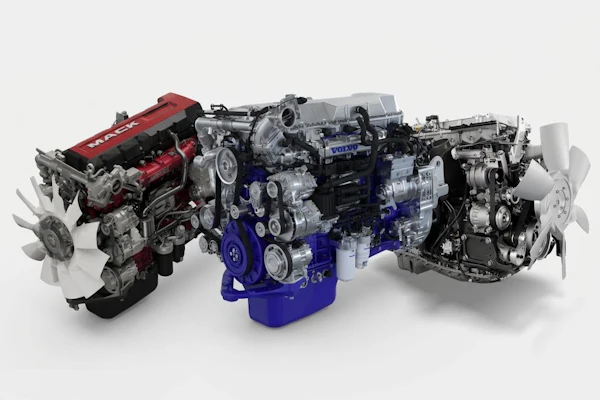
What we have here in the booth with us today is the 2027 hardware set for the International S13 integrated powertrain. With a name like S13 as you may expect, it's a 13 liter displacement engine. The hardware we have here, if you're familiar with our current generation of the S13 that we launched in production in our Huntsville, Alabama assembly plant in late 2023, 90% of the hardware carries over to what we're going to have for the 2027 regulations. So I'm going to touch a little bit on the foundational aspect of the engine and I'll try to highlight the differences that we've got going into the 2027 regulations, which again, despite what you've heard or maybe speculated on or talked to with a buddy over, the low Knox EPA regulations are hitting the US and Canada on January 1st of 2027. So I like to start by saying our S13 is the least disruptive technology path to meeting those regulations.
And a lot of that is because 90% of the hardware does carry over. It's no longer a new engine. We've been in production almost three years now. And the big thing that gets a lot of attention from most fleet operators when we start talking about the S13 is what it doesn't have. It does not have an EGR cooler. We don't ask the engine to clean up its own mess because EGR is a form of emissions control used to reduce NOx in cylinder, but it tends to be a weak link in the design. So we designed the weakest link out. That has the benefit of every combustion cycle containing oxygenated air. So it's burning very cleanly. It also means NOX goes very high, but there are two things that we are obligated to control via the EPA regulations. Knox is one of them. Particulate matter is the second.
And those two things, think of them as being on a teeter totter. If one's going up, the other is going down. Because Knox is going very high, particulate matter is very low. Because another word for particulate matter is soot, which is effectively unburned diesel fuel. And since we're not trying to constrain Knox and cylinder, the Knox is burning the fuel very completely, which is why there's very little soot produced. And that matters not only in the engine itself, but when we talk to the aftertreatment module next. Another benefit by having no EGR cooler on the engine is that 100% of the exhaust energy flows into the turbocharger. This allowed us to simplify the turbocharger design, replacing the industry's typical variable nozzle technology with a simple waste-gated fixed geometry turbo. So we've simplified the hot side of the engine significantly with our design. What's new for 2027 is our first dosage of DEF is in the turbine housing itself.
But it's important to note it's not spraying DEF onto the turbine wheel. You can kind of see it right under here. There is a DEF injection just after the turbine into the exhaust flow right out of the turbocharger. That's intentional. That location for the first dose of drug deaf is where the exhaust is the hottest and the speed is the highest coming out of the turbocharger. That helps make it a very efficient form of mixing the DEF in the exhaust stream. Because again, the engine is making a lot of knocks, so we have to take care of the NOCs. We do that first with the DEF dose here in the turbine housing, and then it goes into the aftertreatment. But before I leave the engine, I also want to highlight another thing that's a little perhaps hard to tell from just the engine here on the stand.
And that's that our powertrain for 2027 is going to operate on a 24 volt electrical circuit. It's still going to be in a 12 volt chassis. So fleet operators that use third-party telematics or camera systems, or if you think about your seven-way connecting to a trailer, all of the chassis electrics are going to be on the 12-volt circuit. But we take two of today's type 31 12-volt batteries and link them in series. So we have 12 plus 12 to be 24 just for the engine after treatment and transmission to operate on a dedicated 24-volt circuit. That's really about getting additional efficiency and speed of operation. It has nothing to do with putting extra heat into an aftertreatment module. You'll hear in the industry quite a bit about grid heaters or 48 volt systems using to generate heat in the aftertreatment. That's not what our S13 does.
We don't need to do that. So we have simplified the engine by reducing hardware. We have added a deaf dosing right after the turbocharger. We're operating on a 24-volt circuit. And then after the exhaust flows out of the turbo, then it comes into the aftertreatment. So we're going to walk over here next. Our S13 engine can only be certified with our dual stage aftertreatment device. This was designed to handle the Knox load that the engine doesn't clean up because we're not asking the engine to clean up its own mess. We're telling the engine to do what engines love to do, make power. But you have to handle the Knox load, which is why it has to be coupled with the aftertreatment module that was designed by the same team to operate as a package. This aftertreatment module takes the output from the turbocharger into the inlet pipe.
It goes through the first catalyst and then it hits the DPF. So the DPF is the diesel particulate filter and our experience thus far with the current design is that we've about doubled the industry average for DPF life. And I get a lot of questions as to how can that be? Well, what's the purpose of a DPF? It is to catch the diesel particulate that is emitted from the combustion cycle, but diesel particulate is also called soot and we're not generating soot in cylinder nearly as much as an EGR engine. So we've got very little soot production. So there's very little soot that makes it all through the exhaust system, which is why our DPF is able to last. Again, your results will vary based on application, but about double the industry norm. After it flows through the DPF, then the exhaust comes to our supplemental DEF doser, which is located right down here.
I emphasize supplemental because it does not operate with every cycle. It only operates when the secondary NOC sensor says there's a little bit of residual NOX that we need to have an additional squared of DEF. So when people ask me, "Hey, if it's two DEF dosers, does that mean you're double the DEF consumption?" It does not. We typically find about a 30 to 40% higher DEF consumption rate maybe than the industry norm, but every fleet that we talk to is your DEF pricing is significantly lower than diesel pricing, especially when diesel prices are quite high. So after it flows through the supplemental doser, if it needs it, there are two other catalysts here and then it either exits vertically in a vocational application, like a dump truck or a concrete mixer or horizontally in the case of a tractor. One thing to note, it's a little hard when it's just here in a booth on a stick, but this aftertreatment module mounts in the chassis where this would be the front of the vehicle.
So this is curbside. So this is a simple serviceable thing that's either behind the steps or a skirt when it's mounted onto our chassis. Before I leave the aftertreatment device, I want to highlight a couple things that we don't have. We don't have a diesel oxidation catalyst in our aftertreatment module, and that's because we also don't have a seventh injector or any diesel that goes into our aftertreatment module. The reason we don't is because those features function as you'll hear people talk about it as the easy bake oven or something that cooks out the particulate matter from the DPF to extend service intervals, but it's cooking out the soot that again, we don't generate as much in cylinder so we don't need to put any diesel in the aftertreatment module. We're not baking anything out. This is another way that we gain so much efficiency out of the S13 integrated powertrain.
The only place we put diesel is in cylinder to make power. So the module itself is also simpler that it doesn't have a DOC and it doesn't have any diesel injection taking place here. It's also not changing form factor position or weight from the 2024 solution. So the same metal stampings that we've been using since we introduced it in late 2023 are the same ones we're going to have for our aftertreatment module going into 2027 and beyond. So we're not physically changing the hardware set. This is important because a lot of other solutions that are going to be coming to the market from our competitors are going to ad a lot of length and weight or height. So the fact that we've got the same form factor is important to a lot of our fleets. So the engine makes the power, the aftertreatment module handles the Knox load.
Now we have to put the power to the pavement and that's where the T14 transmission comes in. So many of you might be familiar with our T14 transmission, but for those that may not be, I'll just recap. The hardware set is unchanged from our current solution going into 2027. And that's a good thing because it is the driver's best friend. My team gets feedback every day from drivers who love the way it performs. I'll be the first to admit that I didn't appreciate what the two extra gears mean because as you'd expect out of something we call the T14, it has a 14 forward speed configuration, but it's very short and compact and that's because all of the reverse speeds are handled in the planetary gear set. We don't have any traditional bevel gears for reverse speeds. It's all handled through the planetary. That has several benefits, one of which is that it makes it a very short packaging envelope.
It saves weight and it allows us to unlock up to eight reverse speeds, which I don't recommend in tractor applications, but it's very useful if you have vocational applications such as a dump truck and a paving application or the real common one is for high rail usage. When you're on a railroad and you really can't turn around, being able to have up to eight reverse speeds very useful in those applications. But I said I didn't really appreciate the difference between a 14 speed and a 12 speed, but I describe it like this. The industry norm is a 12 speed configuration. The extra two forward speeds plays out in the fact, if you think about it, we end up at the same spot in an overdrive configuration. So the ratios tend to be fairly common in the industry for their 12 speed or our 14 speed.
But when you go to the lower speeds, we've got about a 50% mechanical advantage, which the drivers really may not understand or care about the math, but what they'll feel is the ability to accelerate very quickly and smoothly when loaded from a stop. It's just a lot easier to get moving when you're in the lower gears and that's where the extra two gears of the T14 really come to play. A few other features about the T14, we have a standard integrated heat exchanger here that comes with everyone we build. This allows us to cool down the trans fluid in hot ambient conditions. It also helps warm up the trans fluid in cold ambient conditions to help with the efficiency. And I say it's a heat exchanger, but there's no interface between the trans oil and the engine coolant that goes through. So the engine coolant comes off there and it circulates through this heat exchanger, but it's not a leak point for the trans fluid.
The other thing that we offer and has been a very popular addition is we now have factory installed PTOs, power takeoffs available from international that carry the same warranty as the transmission. So in a highway application that's five years. In most vocational applications, it's three years. But when you get it from the factory, it comes with the same warranty. So when we kind of summarize the new 2027 version, 90% of the parts carry over. We are ready for the 2027 emissions. We also have a benefit about the 24 volt that I like to kind of close with. And that's the fact that by having those two batteries that I mentioned just dedicated to the starting, so we've got a 24 volt starter and a 24 volt alternator, those two batteries are isolated. So if you happen to have a short on the chassis or for example, if a driver may be well-intended but leaves the refrigerator on over the weekend, there are a thousand different reasons why a chassis can drain power over a weekend.
We expect to fundamentally reduce, dramatically reduce no start conditions because if you've got a chassis load that drains over a weekend, it's not impacting those two separate batteries that are dedicated to the starting circuit. And because it's a 24 volt starter motor, it's a little lighter weight. It's got a lot longer life and it's got better cold cranking performance. So we see a lot of benefits coming to the customers with our 24 volt powertrain solution for 2027. We also don't expect a meaningful increase in depth consumption, maybe about a point or so, but again, you're consuming a bit more of the less expensive fluid and it's going to be weight neutral, which gives me confidence that we will still maintain our position as the lightest weight 13 liter powertrain in the industry.
Speaker 1:
How about power ratings? What are my options? What am I looking at? Power and torque.
Speaker 3:
So the power ratings going into 2027 are unchanged from today. So probably one of our most popular ones is a 400 horsepower 1850 torque, which matches well with down sped applications where you've got rear axle ratios 215, 226, kind of in that range. That really is where we see some of the best fuel economy performance. And it goes up to the 515 horsepower 1850 torque as well. That's very common in vocational applications because that power, it's the highest rating we have, but all of our ratings generate peak torque at 900 RPNs. With this 14 speed transmission, it puts the power down really well and we find it to be a wonderful solution for the fleets. So the ratings are unchanged from 2024 into 2027. So thank you for paying attention to our overview of the International S13 integrated powertrain.
Speaker 1:
So we're back in Tuscaloosa at Southland International. Just wrapped up a drive from Tuscaloosa to Birmingham, back to Tuscaloosa. Had a really good drive. It's about 50, 55 minutes to Birmingham and back. So a couple hours in this truck, really good test drive. If you've not been in an international truck in about a decade and your reference point is the ProStar, this truck couldn't be a lot different than the ProStar. Yes, it doesn't really look too dissimilar in a lot of ways, but it couldn't feel a lot more different. The S13 powertrain really stands out. This truck is exceptionally quiet. The T14 powertrain and the way it shifts sort of staying in the lower end of that power band as it relates to RPM, keeps the engine a little quieter, keeps the cab a lot quieter, handles really well. It shifts really smartly. This is a really smart truck to my international capabilities that integrate with the back office, with the fleet and with the dealer, that's a layer of maintenance that just simplifies matters for all concerned parties.
This truck is about 10 years old, so this is the older kid in the class, but I think we've seen it jump exponentially in technology and capability over the prior generation. Again, using the ProStar as a reference point. Excited to see what this is going to do as it stays in the market a little bit longer. We've only been in the market in the ELT for close to two years. So I feel like there's a lot of growth opportunity here for International. This is an exceptional truck and this is an exceptional powertrain. It's the most fuel efficient engine that International has ever built and it's strapped to one of the best transmissions in the market. So what did we learn? We learned we've hit 2027 EPA compliance. We learned that it comes with no sacrifice to power and no sacrifice to fuel economy. That sounds like a big win-win to me, right?
If you like trucks as much as I do and you want more test drives, check out our playlist on YouTube. Check out ccjdigital.com and subscribe to our newsletter in the description below.