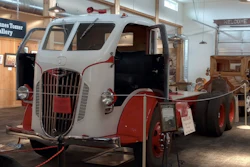
I came across one of Henry Ford’s first commercial delivery trucks inside a pizza restaurant in Fort Collins, Colorado. The truck is a Ford TT. Three were built in 1917, with many thousands more built from 1918 through 1927.
I’ve worked with some of the trucking industry’s best ergonomics experts and industrial designers in my career. Ergonomics likely was not a high priority in 1917. Neither was the human-machine interface much of a consideration—or styling. The “dashboard” was literally a board with one switch, one gauge (amps), and a choke.
 Ford Model TT truck interior Rick Mihelic
Contrast that with a 1939 Autocar truck interior I found recently in a museum. While the innovative triangular dash is still a flat piece, it now has six gauges and a few more switches. Still pretty spartan.
 1939 Autocar interiorRick Mihelic
Now contrast the 1917 Ford TT and the 1939 Autocar against a recent Peterbilt Model interior gallery photo.
 Peterbilt Motors
As the advertising jingle goes, “You’ve come a long way, baby.”
But while truck interiors have vastly evolved, drivers haven’t really changed much. Two images from the Library of Congress capture drivers back in the day. They still have legs, feet, arms, eyes, hands, torsos, and heads. An ergonomist might be able to tell you that average driver weight and height have probably shifted a bit since 1917 or 1939. Eyesight may have drifted a bit as the average age of drivers has increased over time. Diversity in nationality and gender has added some new twists to the physical attributes cab designers have to deal with. But the Mark I human driver is still pretty much in the same configuration.
 Library of Congress (ID: fsa 8b38170 //hdl.loc.gov/loc.pnp/fsa.8b38170)
 Library of Congress (ID: fsa 8d16345 //hdl.loc.gov/loc.pnp/fsa.8d16345)
What has changed is drivers’ expectations about interiors. In the 1990s, I got to see expectations changing in real time. As pickup truck interiors began to compete with higher-end sedans, semi-truck drivers began expecting similar improvements in their big rigs. Ergonomics began to rule. Soft-touch paint became a thing. Cup holders became a requirement. Automatic door switches and mirror controls became critical selling features.

Still, that 1990s driver wanted gauges and switches. The more, the better. The 1990s driver wanted to feel like they were in a 1960s commercial airplane cockpit. By all rights, the job of driving a semi-truck was equivalent to piloting an old DC-8 cargo airplane—just as important and just as complex.
Rocker switches were crucial to that airplane feel, as were round, analog gauges with needles. Lots of gauges. It was common to see 15 to 20 gauges on a dash, and just as many switches. Throw in a CB radio on top of the dash, an AM/FM multiband radio in the dash, HVAC control knobs, air brake knobs, and more, and real estate on the dash became as hard to find as coastal property in California.
Then, some 20 years later, digital dashes emerged: touchscreens, monitors the size of library reference books, and more and more optional equipment and sensors. Vietnam fighter pilots called it “information overload”—too many bells and whistles while trying to fly a plane in combat situations. Modern truck drivers probably feel that way: too much information, TMI.
But those new dashes sure look great, don’t they?
Here’s the rub, though. It doesn’t really matter whether the human truck driver’s body changes or stays the same, or that their desire for more car-like truck interiors has created modern works of art in the truck cab. The future truck may not even have a dash at all—or a cab. Take a look at Einride’s autonomous truck.
 Einride’s AV at GE Appliances’ Selmer, TN, facility in 2023Einride
The dash in the Einride is even simpler than the one in Ford’s 1917 Model TT. Trucking dashes have come full circle.
Where will the future take us in dash design? Beyond questions of knobs versus touchscreens, the focus, I think, will be on simplifying driving and making it safer through the integration of ADAS, AI, and AV systems. Recruiting younger, new drivers may also require these technological advances to streamline training and improve driving quality. Just as automated manual transmissions (AMTs) have grown in fleet popularity, so too will vastly simplified driving innovations and the human-machine interfaces captured in vehicle dashboards.