










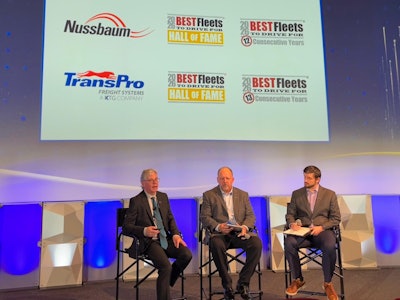
There’s a common friction between a fleet’s safety department and operations department. However, for a strong workplace culture, the safety department can’t function in isolation from operations, panelists said Monday at the Best Fleets to Drive For education and awards conference in Charlotte, North Carolina.
Senior director of HR and safety at Illinois-based Nussbaum Transportation (CCJ Top 250, No. 145) Rick Schmidt explained that new hires spend time shadowing operations. Driver managers are trained to understand what operation team members deal with and are also trained on logs compliance and basic maintenance questions so they can flag issues before they escalate. This results in having a shared language, Schmidt said.
Michael Frolick, director of safety and compliance at Ontario-based TransPro Freight Systems, said they created a dedicated fleet support team to handle driver communication so dispatchers can focus on dispatch. Drivers get faster responses, frustration drops, and the correlation to safety outcomes improves, Frolick said.
That tone at TransPro was set more than a decade ago when Kriska Transportation Group (No. 250) acquired the company and CEO Mark Seymour made the standard clear: “We either have a safety program or we don’t; we don’t do it halfway.”
That culture of accountability is a two-way street. Frolick once walked outside without his high-visibility vest and a driver called him out. This, he said, illustrated another outcome of their culture: drivers felt safe enough to call out their own safety director.
Measuring what matters
How can a fleet gauge whether their safety programs are working?
Schmidt uses Nussbaum’s Certified Red Program, a voluntary, tiered driver development track to milestones every 100,000 miles, covering inspection, proficiency, fuel efficiency, and backing technique. Driver managers are assessed based on their drivers' active engagement.
Frolick said TransPro uses driver surveys (anonymous and named) and driver committees, followed by posting the findings on the bulletin board for everyone to see. Monthly performance reviews replaced the previous semi-annual cadence.

“The faster the feedback, whether good or bad, helps the driver improves faster,” he said.
Both fleets track telematics data, collision trends and turnover. TransPro uses a driver safety and performance platform called SpeedGauge, which inspired some drivers to voluntarily compete against each other. The company uses the platform to show its owner-operator drivers the cost savings benefits of safety performance.
“Take $100 off their paycheck, they’ll understand you,” Frolick said.
Schmidt said Nussbaum produces monthly CSA video updates and makes the data available for everyone, but a more impactful tool was a video featuring a driver who had been in a major accident three years prior.
“They don’t want to hear me,” Schmidt said. “When you start focusing on CSA and last run [data], it can send you down the wrong path. You’re not focusing on the right things, when the reality is, if we focus on the right things, the results will come.”
Nussbaum also sends drivers a weekly scorecard with various categories (such as, smooth throttle, speed limit, spacing and speed management) on a one to 10 scale, plus a monthly score incorporating operations, training and safety.
Drivers can see their fleet ranking, though Schmidt noted it is easy to become overwhelmed with the complexity of telematics data.
[RELATED: Surveys highlight the power of AI in safety]
Coaching and online training
As telematics generate more data than ever, people need to learn to use it well.
Schmidt said performance supervisors at Nussbaum have CDL experience, ride with drivers, run MPG comparison tests, and put drivers through hands-on backing drills. They’re also trained to have crucial conversations to be able to navigate tough issues and have a respectful, honest dialog, versus of a back-and-forth.
Frolick conducts road evaluations for incoming drivers at TransPro and is candid that they tend to become more of a training session. Frolick screens potential mentors not on tenure but on teaching ability.
“It’s not just ‘I drove for 22 years, I know what I’m doing,’” Frolick said. “Can they teach? Can they explain it? Can they stay on script?”
Mentors have to be certified through a three-day IHS Fleet Driver Trainer program before being assigned.
[RELATED: What to look for in an online training provider]
Both execs cautioned against over-reliance on online training. Schmidt said Nussbaum’s entry-level drivers spend four weeks with a trainer before digital modules are offered. Some hands-on sessions include defect identification exercises using a trailer fitted with missing or damaged components.
Frolick pointed out one of his well-received methods, which included inviting Ontario Ministry of Transportation officers into the TransPro yard. He then has mechanics load trailers with defects and lets drivers find them before the officers score the results.
Frolick also noted that carriers shouldn’t rely on online training as a disciplinary tool.
“Don’t assign online training as a punishment," he said. "Nobody should ever be afraid to learn."