The largest known deployment of Class 8 zero-emission trucks is set for Texas, thanks to a pilot procurement project that will also enable associated charging infrastructure.
The Center for Green Market Activation (GMA) and Smart Freight Centre (SFC) co-led initiative leverages the collective buying power of global giants Amazon, Meta, eBay, and Etsy to establish a high-volume, all-electric freight corridor between Houston and Dallas.
Pooling demand across several buyers sends a larger demand signal, said GMA Managing Director Andre de Fontaine, "and that ideally creates the confidence for the producers to scale up more rapidly because they know that there is a group of customers that are out there that are willing to pay the premium and make the investments needed to purchase these low-carbon goods and services."
Sales of zero-emission freight trucks peaked last year at less than half a percent, "and have since dropped to nearly nothing," said GMA Program Associate Stacey McCluskey. Fewer than 200 electrics were sold in the first half of last year—"an 80% decline compared to the same period in 2024," she added.
New model for clean freight
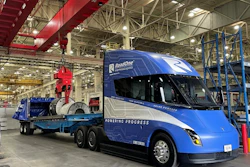
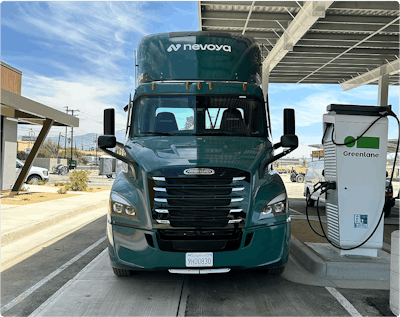
The first-of-its-kind program in trucking facilitates the deployment of approximately 40 battery-electric heavy-duty trucks operated by Nevoya, a 30-truck, fully-electric motor carrier based in Colton, California, running over-the-road and drayage operations in California, Texas, and Arizona. GMA Program Manager Clayton Gerber expects the 40 additional trucks to be rolling by the end of this year and into early next year.
These vehicles are expected to cover 7 million miles annually, eliminating an estimated 60,000 metric tonnes of CO2 while significantly reducing local noise and air pollution.
The project, the companies claim, addresses a critical bottleneck in the industry: while many companies have climate goals, less than 1% of new heavy-duty vehicles in the U.S. are currently electric. To solve this, GMA is utilizing a "book and claim" system—a model already used in sustainable aviation and maritime shipping.


"This is an opportunity for an all-electric carrier to scale in a new location at a faster rate than otherwise possible," said Sam Brundrett, Environmental Lead at Etsy, Inc. "With millions of Etsy items moving through Texas each year, strengthening shipping reliability while cutting emissions and improving air quality for local sellers and buyers is essential."
Nevoya Co-Founder and Chief Commercial Officer John Verdon noted it's difficult for carriers to raise the upfront capital for trucks and charging infrastructure "when you are looking to build a network in a new market," he said. "Having that committed revenue over a four-year period via this GMA RFP program massively de-risked the deployment. It enables the financing of the trucks. It helps facilitate the underwriting of the infrastructure build-out, and that ultimately allows us to expand into new markets where customer freight density is still building from an EV perspective."
The book and claim program, Verdon said, also accelerates the path to cost parity.
"EVs have the higher capital expenditure but a lower operating expenditure," he said. "You need the utilization and the infrastructure efficiency to reach that TCO parity with diesel. Book and claim lets us really front load those investments that drive that efficiency. We can focus and deploy optimal charging locations from day one. We can deploy a larger number of trucks, which means better charging utilization and therefore a lower per truck infrastructure cost."
How does book and claim work?

The goods traveling on the battery-electric trucks do not belong to the involved GMA Trucking members buying the certificates; rather, the members are providing the catalytic revenue that enables the trucks’ deployment. Members can therefore claim the benefits associated with the GHG reduction impact.
- Verified credits: Starting as early as 2026, participating companies will receive verified certificates for their purchase. Corporate members (like Amazon or Meta) purchase these attributes to meet their climate goals, even if their specific packages were moved elsewhere.
- Third-party auditing: An independent, accredited auditor will verify the environmental impact as Nevoya operates the Dallas–Houston lane.
- Renewable power: All charging for the fleet will be fully backed by Green-e Renewable Energy Certificates (RECs).
McCluskey's example
Assume Shipper One wants to transport its goods on a zero-emission vehicle but is unable to find a carrier or a route to do so. Shipper One will continue to move its goods through Carrier A, which in this example is a traditional diesel trucking service, and Shipper One can buy an emissions credit issued by another carrier—in this case, Carrier B.
Because Carrier B is selling credits through a book and claim model, they're able to deploy the zero-emission vehicles in geographies and on routes that are most economical for them, even if the physical shippers on those routes don't want to pay the premium associated with the zero-emission trucking service. Shipper One contracts with Carrier B to procure the environmental attributes associated with their service. Carrier B is still transporting another shipper's goods at diesel prices while Shipper One pays the premium associated with operating the zero-emission vehicle in exchange for the credit.
"It lets carriers deploy zero-emission trucks where they're most operationally efficient, maximizes vehicle and infrastructure utilization, and because buyers are willing to commit to purchasing (credits) rather than moving their physical freight on zero-emission trucks, they're more comfortable with longer, multi-year contracts, as we saw through our pilot procurement," McCluskey said. "Together, these factors make projects more economical and feasible."
Eleanor Bastian, Amazon's Senior Manager of Worldwide Operations Sustainability noted that what book and claim did in this case was "provide producers with a set of buyers without creating these issues for truck utilization."
"And then, in a very seamless way, it gives the buyers like Amazon the ability to make these credible and verifiable environmental claims that can go towards our climate goals," she added.
Scaling the future
With the Texas pilot contracted, GMA and SFC are already developing a second, larger procurement phase. This next step will combine the book and claim model with direct physical procurement to further accelerate the transition to zero-emission heavy-duty transport.
The GMA Trucking buyers alliance, launched in 2023 to accelerate the decarbonization of heavy-duty trucking, has grown to include nearly a dozen companies across technology, consumer goods, food and beverage, and other sectors who are ready to support action to address road freight emissions. Other notable transportation companies include PepsiCo and Kuehne+Nagel.