










Fleet operators are turning to propane autogas for their medium-duty trucks to avoid costly diesel maintenance, lower total cost of ownership, and reduce emissions without relying on restrictive public grants.
- Widespread Adoption: Leading fleet operators—such as Bimbo Bakeries USA, Office Depot, and McAbee Trucking—are using propane autogas to power medium-duty vehicles ranging from route delivery vans to box trucks.
- Significant Cost & Maintenance Savings: Propane autogas eliminates costly Diesel Exhaust Fluid (DEF) systems, lowers engine replacement costs to roughly $16,500 (compared to $40,000 for diesel), and allows fleets to lock in stable, direct fuel pricing.
- Operational Agility & Dual-Fuel Options: Fleets maintain operational flexibility through mobile, generator-powered fueling stations and dual-fuel (propane/gasoline) vehicles, allowing seamless asset transfers across diverse service networks.
- Bypassing Grants for Autonomy: Rather than facing restrictive three-to-five-year grant conditions, major fleets rely on propane's fast return on investment (ROI) and marketer-backed fuel contracts to fund infrastructure independently.
Fleet operators across the country are increasingly leveraging propane autogas to power medium-duty vehicles, citing significant cost savings, fuel price stability, and drastic emissions reductions over traditional diesel and gasoline engines.
During a webinar hosted Wednesday by the North American Council for Freight Efficiency (NACFE), executives from several commercial fleets shared real-world results from adopting propane in their operations, ranging from route delivery vans to box trucks.
Bimbo Bakeries: Agility and off-grid fueling
Bimbo Bakeries USA, one of the nation's largest baking companies, currently operates more than 600 propane route trucks within its company-owned fleet of 5,600 route trucks, 304 tractors, 39 yard trucks, and 2,700 trailers.
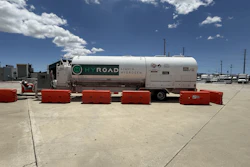
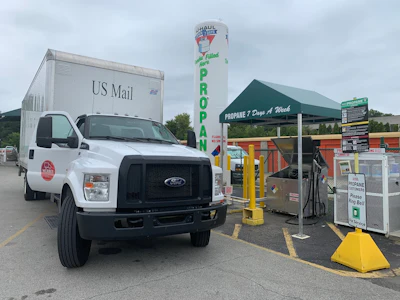
To maintain operational agility and avoid being locked down by fixed infrastructure, Bimbo Bakeries developed self-contained, generator-powered propane fueling stations, according to Eric McCann, senior director of fleet operations. These portable sites can be relocated via flatbed truck in under an hour to accommodate shifting parking and facility needs.
"The agility of vehicles is very important," McCann said. "In a pinch, we can fill up at a Love's or Flying J. ... It's really like a safety blanket for the sales team making sure that we're getting the product out."
McCann also highlighted the financial advantages, noting that propane infrastructure can often be bundled into long-term fuel contracts at minimal upfront cost.
Beyond conventional propane, the baker is aggressively expanding its use of renewable propane. After fully rolling out the fuel across its California operations, the company is establishing railheads to expand renewable propane to eight major U.S. facilities to support true well-to-wheel sustainability.
The company is also testing advanced fuel technology, running a 4% blend of dimethyl ether with renewable propane to lower its carbon intensity index. After a year of testing the blend, McCann reported zero engine issues.
Office Depot: Dual-fuel flexibility for diverse networks
For Office Depot, operating a network of over 500 vehicles across widely dispersed satellite locations required a solution that balanced sustainability with operational agility.

The company currently operates 31 dual-fuel vehicles spread across seven locations in four states, including Texas, Virginia, Pennsylvania, and Louisiana. These units represent a growing share of Office Depot’s total fleet, which consists of just over 500 vehicles across 28 U.S. locations.
Erik Smith, senior manager of private fleet operations at Office Depot, explained that by opting for dual-fuel technology rather than propane-only systems, Office Depot maintains the flexibility to reassign vehicles to different satellite sites as customer demand shifts, without needing dedicated propane infrastructure at every location.
"We wanted to make sure for our initial purchase we had as much flexibility as possible," Smith said. "For everything that we've had to put those propane units against, we've had no issues, no service problems, no performance issues."
In smaller markets where on-site fueling stations are impractical, the company relies on mobile wet-hosing services from local propane suppliers to keep vehicles fueled and on the road.
Smith added that drivers often report better performance due to propane's higher octane rating compared with standard gasoline.
McAbee Trucking: Long-term reliability and maintenance savings
McAbee Trucking has been a contractor for the U.S. Postal Service for 55 years and started exploring green fleet options in 2014. After experimenting with compressed natural gas, the carrier demonstrated its first propane autogas truck in 2019. The company steadily expanded its adoption and last year became a 100% propane box truck fleet.
Lisa McAbee, vice president of McAbee Trucking, emphasized the dramatic maintenance and replacement savings compared with diesel trucks, particularly regarding emissions control systems.
"The carbon footprint that we're leaving behind us was not looking very well," McAbee said. "So with the propane autogas, I can leave a low carbon footprint that's a little better for my family and my generations to come."
The fleet now consumes roughly 200,000 gallons of propane autogas annually. To support its vehicles, McAbee Trucking expanded its private fueling infrastructure from a single tank and dispenser to a three-tank dispensing system at its primary facility.
Maintenance for propane engines, she said, mirrors that of standard gasoline engines. Upkeep requires routine oil changes every 8,000 to 10,000 miles and basic spark plug replacements, making it easy for technicians to adapt to the technology without extensive retraining.
A major reliability advantage for fleet operators is the complete absence of diesel exhaust fluid (DEF) systems and complex selective catalytic reduction (SCR) equipment. By relying on simple three-way catalysts rather than multicomponent diesel emissions systems, fleets avoid common sensor failures, active regenerations, and costly DEF repair bills that can reach $10,000 to $14,000 per incident.
Additionally, component replacement costs are markedly lower, according to McAbee, who estimated that replacing an entire propane engine costs approximately $16,500—including a three-year, unlimited-mile warranty—compared with roughly $40,000 to replace a comparable diesel engine.
Low emissions and low total cost of ownership
According to NACFE consultant Jeff Seger, propane offers a lower total cost of ownership with prices averaging significantly below diesel gallon equivalents. Furthermore, current propane engines are certified at 0.02 grams per brake horsepower-hour for nitrogen oxide (NOx) emissions—well below upcoming federal standards set for 2027.
Propane's low-carbon burn results in less carbon buildup inside the engine, which Joel Stutheit, senior manager of autogas business development at the Propane Education & Research Council (PERC), noted is a primary factor in extending overall engine life. The fuel also provides additional lubrication benefits that help reduce wear over time.
Rather than purchasing expensive fueling equipment, fleets frequently partner with propane marketers to secure low-cost or free infrastructure. Under long-term fuel supply agreements, marketers often provide and install fueling stations at minimal upfront cost, bundling the equipment expenses directly into the fuel rate.
McAbee noted that it's not difficult for fleet operators to negotiate direct fuel pricing with propane marketers to lock in stable, predictable fuel costs across delivery routes. Stutheit noted that propane's price stability stems from its status as an abundant, domestically produced fuel.
While federal, state, and local subsidies are available to assist with alternative fuel transitions, the fleet managers used contrasting approaches to grants to acquire vehicles and fueling infrastructure.
For larger fleets like Bimbo Bakeries, avoiding public grant programs has become an intentional strategy to maintain operational agility. McCann explained that grant conditions can lock a vehicle into a specific facility or state for three to five years.
Because the company frequently shifts assets to meet changing demand, it opts out of grant funding for its propane vehicles, noting that the fuel's return on investment makes subsidies unnecessary.
McAbee Trucking and Office Depot similarly noted that grant funding was not a primary driver in their transition to propane. McAbee highlighted that a lack of available grants in South Carolina when she began researching alternative fuels led her to focus on long-term fuel and maintenance savings to justify the cost.
Smith agreed, echoing that his company focused on upgrading aging vehicles in key markets based on operational need rather than chasing state financial assistance.