










Facing escalating industry liabilities and cargo protection challenges, Schneider streamlined its logistics operations by cutting its approved brokerage carrier pool down to 14,000.
- Network contraction: Schneider scaled back its third-party logistics brokerage network from 60,000 down to 14,000 carriers to eliminate high-risk operators and prevent cargo theft.
- Risk mitigation: Rising legal pressures and compliance standards are forcing major logistics providers to enforce stricter vetting processes beyond basic operating authority.
- Asset efficiency: Rather than chasing unvetted volume, Schneider focused on high-single-digit improvements in driver productivity and disciplined intermodal growth.
- Market outlook: Executives noted that cumulative supply-side corrections, including tighter ELD enforcement and insurance pressures, are steadily purging excess capacity heading into 2027.
Facing escalating compliance hurdles, cargo theft vulnerabilities and rising liability risks across the supply chain, Schneider National (CCJ Top 250, No. 6) has aggressively restructured its third-party logistics operations.
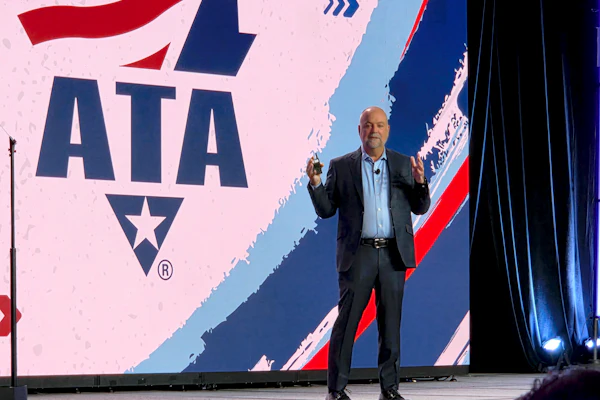
Speaking at Morgan Stanley’s 14th Annual Laguna Conference earlier this month, President and CEO Jim Filter said Schneider trimmed its brokerage carrier network from 60,000 down to 14,000 partners to protect customers and manage risk exposure, contending that standard verification methods are no longer enough to safeguard freight in the current operating environment.
The legal landscape for freight brokers shifted following the Supreme Court's Montgomery ruling in mid-May. The decision effectively eliminated preemption protections under the Federal Aviation Administration Authorization Act (FAAAA) across jurisdictions that previously shielded freight brokers from certain state-level tort claims.
Brokerages for many years operated under the assumption that active Federal Motor Carrier Safety Administration (FMCSA) authority was enough to clear a carrier for a load. Those days are over, according to Chad Krueger, vice president and managing director at Central Analysis Bureau (CAB) by Fusable.
"We had to go much further than just saying, 'Are you authorized to haul freight?" Filter told conference attendees, noting that the sweeping reduction was necessary to eliminate high-risk operators and shield customer shipments.
Landstar (No. 11) in August noted it had tightened its third-party capacity, reducing its pool of approved carriers from more than 100,000 in mid-2022 to approximately 64,000 at the end of the second quarter — a 35% reduction.
"If you have a conditional or unsatisfactory rating, you can't haul for us," Filter said, "but we realized that wasn't enough. We had to start taking a lot of other actions, and we took very broad actions to be able to reduce our carrier base to make sure that we're protecting our customers' freight."
Despite cutting more than 76% of its third-party carrier network, Filter said Schneider sees only upside.
"We don't see challenges in this space," he said, "specifically with the cost of claims (and) cost of insurance."
Raising the vetting bar
The contraction of Schneider's approved carrier pool comes as freight brokers face mounting pressure over safety compliance, insurance costs, and fraudulent carrier identities. Filter noted that while the industry has long wrestled with bad actors, tightening legal standards and cargo security risks forced the company to take aggressive, broad-based action to purge vulnerable links from its digital and third-party networks.
Chief Financial Officer Darrell Campbell added that stricter qualification standards will likely alter broker and shipper behavior across the broader market. As legal liabilities and insurance requirements mount, Campbell expects underwriters to squeeze unsafe operators out of business entirely.
Managing capacity and seasonal demand
Beyond tightening its brokerage network, Schneider leadership addressed how the company is balancing capacity across its core asset-based and intermodal divisions:
Driver productivity: Rather than chasing unvetted fleet expansion, Schneider achieved high-single-digit improvements in driver productivity during the first half of the year, maximizing output while controlling capital expenditures.
Intermodal discipline: While high diesel prices and strong rail service have created a favorable setup for intermodal growth, Campbell emphasized that expansion will remain tightly disciplined to avoid straining local drayage fleets.
Peak season outlook: Although the summer months brought normal seasonal volume dips, Schneider is seeing increased mini-bid activity as shippers work proactively ahead of October to lock down reliable capacity.
With structural supply-side corrections—including stricter enforcement of electronic logging devices (ELDs) and entry-level driver training rules, taking effect—Schneider believes the market is in its first true year of recovery.
"I don't think we would proclaim today that 2027 is kind of normal cycle because we've gone through 4 years of a down cycle," said Campbell, "and, typically, the down cycle mirrors the up cycle. So we're kind of in year one of recovery."
Backed by ongoing cost-reduction programs and strict risk management, the carrier aims to steadily narrow the gap between spot and contract pricing.