










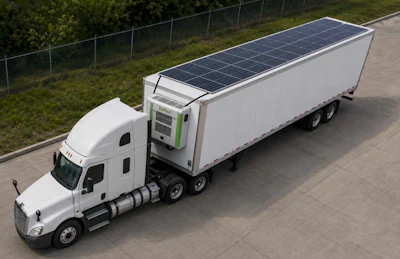
EkoHaul is a startup developing a solar panel and battery system mounted on semi-trailers to eliminate engine idling, potentially saving truck fleet owners $5,000 to $15,000 per vehicle annually by providing power for heating, cooling and accessories without running the engine.
- Truck engine idling costs up to one gallon of fuel per hour and is the largest expense for owner-operators
- EkoHaul's solar and battery system generates 15-30 kilowatt hours daily to power HVAC and accessories for up to three 10-hour driver rest periods
- The retrofit equipment costs less than $20,000 with an expected ROI in 18-24 months
- Engine idling increases maintenance costs by $2,000 annually per truck and shortens engine life compared to solar-powered alternatives
One of Steven Antalics’ advisers worked in the cab of a truck in Iowa in the middle of winter for several hours, believing he very well may walk away on frostbitten feet. Though the truck was idling, the idling was set so low that the heating system never kicked on.
“People are trying to reduce their fuel consumption, so the way they set the idle on a lot of trucks is so low that it's barely keeping anything alive,” Antalics said. “If you had my battery there, you could just run the heater, and you don't have to worry about idling the engine.”
Antalics, founder and CEO of a startup called EkoHaul, has designed a trailer-based solar and battery retrofit system to reduce or eliminate main engine idling for long-haul trucking fleets, and he’s seeking fleets to pilot the prototype.
Truck idling can cost up to a gallon of fuel per hour, according to the National Service Center for Environmental Publications. Fuel is the single largest expense for an owner operator, according to Truckstop.com, which estimated the cost between $50,000 and $85,000 in 2026 due to national on-highway diesel prices running above $5 a gallon through much of the year based on data from the U.S. Energy Information Administration.
Antalics estimates that his solution could save long-haul fleet owners $5,000 to $15,000 per truck per year.
Creating a solar solution
The EkoHaul solution involves mounting solar panels across the roof of a trailer, where they consume energy from the sun throughout the day. Antalics said the setup would generate between 15 and 30 kilowatt hours over the course of one day — plenty to charge the 24-kWh battery, which could power the HVAC system and vehicle accessories for up to three of a driver’s required 10-hour resets.
The driver would shut the engine off entirely, and electricity would be supplied from a separate, high-capacity, trailer-mounted battery.
“Charge the battery, truck stops, battery runs, and that's it. It's a very straightforward implementation,” Antalics said. “You no longer have to worry about the starter batteries at all or idling the main engine to power hotel or other auxiliary loads.”


He has already selected the suppliers for the batteries and the panels.
He said the panels he has found guarantee a 20-25-year commercial life, which could easily outlast the life of a trailer. They have been used on boats and RVs and are proven to withstand the harsh environments semi-trailers are exposed to, including water and vibration. Being attached to the roof of the trailer, the panels are relatively protected from road debris, but in the event of damage, the solution is designed so any panel can be removed and replaced for easy maintenance.
“I've got solar panels on my house. It was built in 2015. It's 2026. I haven't had to do a thing,” Antalics said. “As long as the wires are still okay connecting it to the battery, other than cleaning them every once in a while, you shouldn't really have to do any maintenance on that.”
Turning an old idea into a new reality
Antalics studied engineering at the University of Michigan, where he joined the Solar Car Team, a student-run organization that designs, builds and races solar electric vehicles. He learned the best place to attach solar panels on a car is the flat surface of the roof, where it has the most access to sunlight. His father drove for J.B. Hunt in 2005, and combining those two experiences, it occurred to him that the roofs of semi-trailers were prime real estate for solar panels.
His idea didn’t make sense in 2005, he said, because the batteries back then were too weak, but now battery technology has come a long way. Like the solar panels, the batteries he plans to use have “been through the ringer,” he said.
His engineer-minded brain is always looking at new and better ways to use existing things, he added, noting that all the components for his solution already exist on the commercial market and have been tested and proven.
“Nothing is new; it’s just looking at the problem from a different angle,” he said. “We have the panels that are very efficient now. We have the batteries that are lightweight and very powerful now. So, 20 years ago, this wasn't a good idea because you’d spend more fuel carting around all the extra weight than you would save. Now, it is a good idea.”
Now, Antalics just needs to prove his solution can save as much fuel as he thinks it can. His estimates are currently theoretical because every truck is different, he said.
Antalics is ready to order the parts; he just needs a partner that owns at least one truck and one trailer to test his theory. Though based in Switzerland, he said he is hoping to partner with a trucking company in the U.S.
“My feeling is there are a lot more owner operators in the U.S. There are a lot more people that are just willing to take a punt and/or give something a try to see if it works rather than wait for 15 research studies to tell them it's the best option,” he said.
Testing a theoretical ROI
In addition to a truck and trailer test subject, Antalics is seeking funding for his solution. He said the equipment would be free to the fleet if he is able to obtain funding, but if not, he expects the parts to cost less than $25,000 in the U.S., which is an estimate based on tariffs. He said he expects the fleet would see an ROI in 18-24 months.
That’s just in fuel and maintenance costs compared to idling from the engine or an auxiliary power unit (APU).
According to the American Trucking Associations, engine wear from idling increases maintenance costs by $2,000 per truck annually and shortens the life of the engine.
Diesel and electric APUs reduce idle time, but the former still burns fuel, consumes lubes and requires heavier maintenance, and the latter is limited by storage capacity and battery duty cycles.
“You go on TikTok or YouTube, and you can see dozens, if not hundreds, of videos about truckers complaining about APUs broken down,” Antalics said. “They're complaining that it's not doing what it's supposed to do, and they’re losing money in the sense that they’ve got this weight that's not cargo, so they’re using more fuel but not getting paid for it.”
For comparison, a typical diesel APU weighs between 150 and 220 kilograms, and the EkoHaul battery weighs 200 kilograms. An APU costs between $12,000 and $17,000 installed by an established brand as of July 2026, according to a post by Green APU that noted articles that quote the price around $8,000 are outdated; everything costs more now than it did five years ago. Antalics noted that his $20,000 price tag is based on retail prices (he doesn’t have discounts yet) and a maintenance fee already factored in.
“And it's still coming out ahead in terms of the money,” he said.
The EkoHaul solar solution aims to offer lower lifetime operating costs, no fuel burn and less dependence on alternator charging or shore power compared to APUs.
Antalics also highlighted potential benefits from edge cases, including decreased downtime, emissions reduction, improved safety and less driver turnover. He attributed the potential for the latter two to an increase in driver comfort with the solar solution because drivers may not achieve optimal sleep with the sound and vibration from the engine idling, which could result in fatigue-related accidents.
“For me, it's just a no-brainer. Obviously, you have to pay for the system, but from the numbers I ran, if a trailer is owned for 15-20 years in the U.S., if you're in the high idle case, you're making money within like 22 months,” he said. “You guys are lighting the fuel that you spend a lot of money to buy on fire while your truck isn't moving. That’s the pitch.”