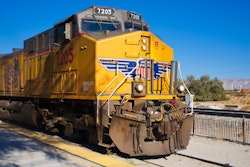











The merger application submitted Friday by Union Pacific and Norfolk Southern—a nearly 7,000-page document spelling out why the landmark deal is in the country's best interest—paints a picture of the two railroad giants' quest to better compete with trucking and develop routes the carriers claim lack viable rail options.
"Nowhere will this transformation be more consequential than in the American heartland—the 'watershed' markets within roughly 250 miles of Chicago, St. Louis, Memphis, and New Orleans," the companies wrote in their filing. "These are the central interchange gateways between UP and NS, where freight today must change hands, where delays and costs accumulate, and where railroads lose freight to trucking."
"We support the additional movement of goods by rail across the country while still maintaining a strong truck network for the final delivery miles. The potential improvement in transit times, and reduced transportation costs, across the United States via a nationwide rail service is better for supply chains and consumers." – David Duncan, CEO of Duncan & Son Lines, Inc.
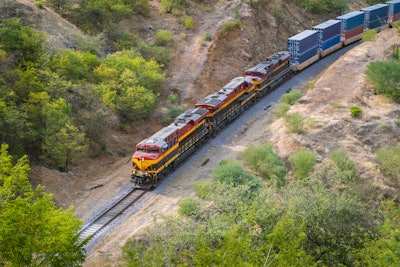
The number of loads at stake is not a small one, the companies claim: "Applicants project the combined UP/NS will convert more than 2 million truckloads of traffic from long-haul trucking to rail... One freight train can replace several hundred trucks... We want to increase rail’s share of traffic and remove trucks from our highways."
The merger covers 50,000 route miles that connect 43 states and more than 100 ports, Norfolk Southern President and CEO Mark George noted.
"Our current and prospective customers have made clear that to keep or gain their business, we must offer ease of use and a customer-centric approach akin to that already offered by the trucking industry," George wrote in the application.
The two rail carriers argue truck-to-rail conversions have cascading benefits for multiple stakeholders: freight customers who benefit from more effective competitive options; commuters who will see reduced highway congestion; local taxpayers and communities that will see reduced repair costs for highway wear and tear; and reduced emissions and improved air quality.

"As noted above, these benefits will be particularly dramatic in the watershed region, where the transaction will open up significant new rail service options for customers that currently rely on trucking," the application said.
The UP/NS transcontinental single-line service, by offering the responsiveness of one-stop shopping and unified commercial terms, the companies claim, "will foster stronger competition with trucking and other railroads and will result in substantial growth for the combined railroad."
In their application, UP/NS say they plan to introduce new trains to provide truck-competitive service in select markets. For example, UP/NS will operate a new train for traffic moving from Texas, Louisiana, and Arkansas to Michigan, Ohio, Pennsylvania, and New Jersey. UP/NS will also introduce new trains for traffic moving between Texas, Louisiana, Arkansas, and western points on the legacy UP system, and Kentucky, Alabama, Tennessee, and northeastern and southeastern points on the legacy NS system.
"Consider the airline industry by comparison. It would be unthinkable to force passengers to change airports mid-journey when traveling from the West Coast to the East Coast if they have a non-stop option. Worse yet, imagine making them change airports on a shorter trip from Dallas to Detroit. Such inconveniences would understandably cause passengers to take to the highway, rather than endure the hassle. Yet, this is the current reality for U.S. railroads today for traffic crossing the middle of the country," wrote Jim Vena, Chief Executive Officer of Union Pacific Corporation. "And when you substitute 'freight' for 'passengers' and 'railroads' for 'airports' in the example above, that reality is why trucks have maintained their advantage over rail."
Phillip Yeager, President and CEO of Hub Group (CCJ Top 250, No. 33); Adam Miller, CEO of Knight-Swift Transportation (No. 3); David Duncan, CEO of Duncan & Son Lines; and Zach England, COO of C.R. England (No. 32) are among the authors of 2,000 letters of support from stakeholders.