










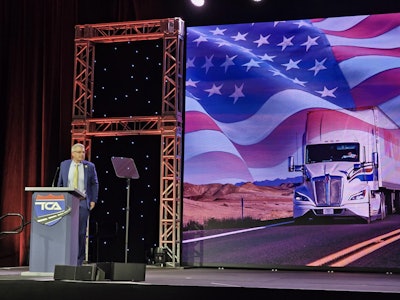
FMCSA Administrator Derek Barrs laid out his agency's active regulatory agenda Monday at the Truckload Carriers Association convention in Orlando, summing up its growing list of priorities matter-of-factly: “We have a lot of work to do. We have a lot of enforcement to do. We have a lot of education to do,” he said. “One of the things I like to say is, ‘We're going to bite off more than we can chew at FMCSA, most likely, but our team's going to keep chewing.’”
“We have a lot of work to do. We've done a lot of work over the last few months, but that's just the beginning of the things that we have planned and the things that we need to do to help clean up the mess that is inside this industry,” he added. “A safety culture, when taken seriously, produces measurable results. This drives what we need to see in every single organization, and protecting that standard is what brings us together ... protecting the lives of Americans on our roadways.”
Safety, he said, is a mission close to his heart because of his experiences on the sides of the roadways as the former chief of the Florida Highway Patrol, where he had the duty of speaking to families whose lives were changed in an instant because of unsafe driving behavior.
“Those are things that you can’t unsee in your life,” Barrs said. “So when I talk about reducing crashes, injuries, and fatalities involving large trucks and buses, which is our mission at FMCSA, I'm not just speaking in general terms. I'm speaking from experience, and that experience shapes how I lead this agency.”
Non-domiciled CDL
Barrs said he recently met with Dalilah Coleman, a young girl who was in a crash in 2024 that involved a truck driven by an undocumented immigrant. That event inspired the Dalilah Law, or the Secure Commercial Driver Licensing Act of 2025—a bill introduced in February that aims to overhaul the issuance of Commercial Driver's Licenses (CDLs) by restricting eligibility to U.S. citizens, lawful permanent residents, and specific visa holders (E-2, H-2A, H-2B). That bill includes the recertification of all current CDL holders because, Barrs said, the FMCSA identified inconsistencies in how certain states were issuing licenses, which raised concerns about documentation, identity verification, and whether federal standards were being applied.

[RELATED: USPS to remove unvetted non-domiciled drivers from trucking fleet]
FMCSA issued a final rule in February in response to those issues, banning non-domiciled CDLs.
"We strengthened safeguards; we clarified state expectations; we reinforced verification requirements because when loopholes exist, bad actors will find a way to get into them. And when bad actors exploit the system, good carriers like yourselves pay the price,” Barrs told the crowd. “You all invest in compliance; you invest in training; you invest in safety technologies. The regulatory system must protect that investment by ensuring a level playing field.”
English Language Proficiency
Barrs noted FMCSA’s additional action with English Language Proficiency (ELP) testing requirements. CDL tests will now be administered in English only, and all drivers will need to be recertified in English.
[RELATED: Trucking tech providers respond to regulatory changes with new solutions]
“The ability to read road signs, understand safety instructions, and communicate effectively—when that standard is applied inconsistently, it creates risk, not only to the public but to the professional drivers operating alongside someone who may not fully understand the critical instructions. I can tell you that's difficult whenever you're doing roadside inspections and the like, and they can't understand what you're saying,” Barrs said. “We are ensuring this requirement is applied as written and as it is intended—not selectively, not unevenly, but consistently.”
CDL training and more
Barrs also pointed out FMCSA’s crackdown on CDL training providers, noting that more than 7,000 have been removed from the federal registry because they weren’t meeting standards—some lacking the ability to demonstrate that training was even being delivered. He said the organization is working toward removing many more.
“Your CDL should represent real training, real qualification, and real competency, and it must be issued in a way that is consistent and resistant to fraud,” Barrs told the drivers in the room.
Instead of pushing drivers through like cattle, he said drivers deserve real preparation, and carriers deserve confidence that they hired a properly trained driver.
“Everyone traveling on American roads deserves assurance that when someone earns a CDL, it represents real competency,” Barrs added.
ust as the FMCSA is removing CDL trainers that it investigates and determines are not qualified to be on the federal registry, Barrs said the organization has also been removing ELDs from its registry as part of its efforts to modernize decades-old legacy data systems and to adapt to new technologies.
Over 80 ELD devices have been decertified in the last six months, and the FMCSA is now implementing an internal vetting process rather than allowing self-certification. Barrs said the FMCSA is also working to mitigate fraud across all systems and is addressing shell entities and chameleon carriers.
HOS regulation is one of several changes the FMCSA is working on that Barrs addressed during the Truckload Carriers Association convention. Professional drivers will have a direct opportunity to inform national policy surrounding hours-of-service (HOS) regulation by joining one of two FMCSA HOS pilot programs.
Barrs also called on the trucking companies Monday at Truckload 2026 to help in the organization’s recruitment of 18 drivers during the initial phase of the effort.