










Regulatory changes have robbed some of the momentum alternative fuels and zero emission-solutions enjoyed just a year ago, but incoming President and CEO of FedEx Freight John Smith said fleets will always invest in the solutions that can justify themselves.
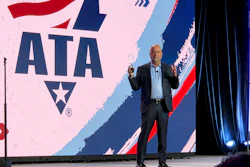
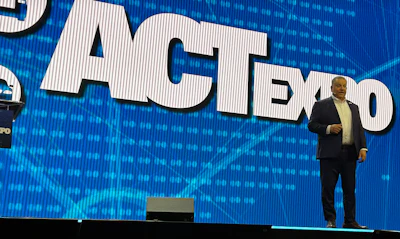
"Sustainability is only sustainable if it makes business sense," said Smith, who spoke Monday at the ACT Expo in Las Vegas, and will assume the top job at FedEx Freight when it spins off from the FedEx (CCJ Top 250, No. 1) mother ship June 1, creating the largest LTL carrier in the country. "You can only make a difference if you stay in business".
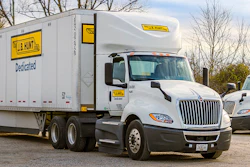
The new entity, which will trade under the ticker symbol FDXF, enters the market with a massive infrastructure consisting of 365 locations and 30,000 vehicles, many of which are powered by alternative fuels.
The carrier is navigating its most significant transformation in decades, driven by breakneck technological shifts and increasing pressure to reduce its carbon footprint.
Smith, who currently is the COO of U.S. and Canada for FedEx Corp., emphasized that the company is "advancing the ball" through incremental gains in efficiency rather than waiting for a "silver bullet" solution.
Multi-fuel roadmap
While electric vehicles (EVs) are becoming a staple at FedEx, Smith noted that range and charging infrastructure remain hurdles for Class 8 tractors. In the immediate term, FedEx Freight is leaning heavily into compressed natural gas (CNG) powered by renewable natural gas to slash carbon intensity.
"From our perspective, it is a ready-now solution that fits the rigors of our duty cycles," Smith said. He called on utilities to reinforce the power grid and urged manufacturers to develop a universal charging standard, calling proprietary charging silos a "non-starter" for fleet flexibility.
As the company looks toward local pickup and delivery, electric vehicles are beginning to find their place. "We are integrating these units where the range is predictable and charging can be more consistent," Smith said. "We have a fair amount of EV vehicles in our fleets today, but where electric makes more sense for us right now is at our service centers. We are investing in electric forklifts and in electric (yard tractors)."

Whether the future is hydrogen fuel cells or next-generation hybrids, Smith said FedEx is committed to scaling technologies the moment they prove they can handle the high utilization demands of a class-A tractor.
"So whenever the new technology may be, or whatever that may be, it needs to fit seamlessly into our day-to-day operations," he said. "Put simply, from a fleet operator’s perspective, we need these new technologies to be just another truck, another tool that easily fits in our network. Now we're open to any technology that allows us to run our business in a way that is better for the environment, whether that’s an EV, CNG, or something that hasn't been invented yet."
AI as the industry 'quarterback'
Beyond fuel, the company is betting big on artificial intelligence and predictive analytics to modernize its operations. Smith described AI as a "quarterback" capable of anticipating "every blitz," from lane-level demand shifts to weather-related delays.
By utilizing dimension-in-motion technology to capture shipment dimensions in real time, FedEx Freight has increased its trailer cube utilization by 12% over the last year. Predictive data is also being used to address potential mechanical breakdowns before they happen by identifying fault codes in real time.
Safety and efficiency
The company’s strategic shift has already yielded measurable results. Since 2023, FedEx Freight has consolidated 39 service centers—removing 1,000 doors while strategically adding 600 others in dense freight markets. This has helped pull 187 million linehaul miles out of the network over five years, a 5% reduction.
Safety remains the "mission above all," Smith said. Investments in collision avoidance, blind spot monitoring, and electronic mirror technology have contributed to a 30% reduction in accidents over the past five years.
With its spinoff from FedEx Corp. just weeks away, Smith challenged policymakers and partners to provide the legislative consistency and infrastructure support needed for long-term growth.
"We are in the game," Smith said, "but we need all of you as teammates."