











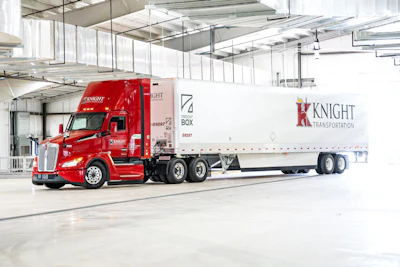
Knight-Swift Transportation Holdings Inc. (CCJ Top 250, No. 3) reported a net loss for the first quarter of 2026, as severe winter weather, spiking fuel prices, and costly charges weighed on results.
The Phoenix, Arizona-based carrier posted a net loss of $1.3 million, swinging from net income of $30.6 million (down 104.3%) in Q1 2025. Total revenue reached $1.85 billion, up 1.4% year over year from $1.82 billion.
The company identified three key items that heavily dragged the quarter: an estimated $12-$14 million in volume and cost headwinds from severe winter weather disruptions and rising fuel prices; $18 million of adverse claims development in the less-than-truckload segment tied to a 2022 arbitration ruling; and $4.1 million in the truckload segment related to a VAT reimbursement in Mexico for previous tax years.
Get 80 tips to boost your fuel efficiency
“The first quarter had its challenges, but these were largely transitory and even bring some upside as the weather disruption exposed market tightness that has served to accelerate the pricing environment, and the spike in fuel prices adds one more headwind to truckload capacity,” said CEO Adam Miller.
Regulatory cleanup push market tightness
Stricter regulatory enforcement by the Federal Motor Carrier Safety Administration and the Department of Transportation to revoke invalidly issued CDLs, shut down noncompliant CDLs, and examine hours-of-service log violations is removing capacity from the market, Miller said Wednesday on an earnings call.
"When our industry saw spot rates jump dramatically in 2021 and we had a push for immigration, this industry was targeted, and we had many people enter without much trucking experience, with weak safety backgrounds, without proper training, and many were exploited by chameleon carriers and ultimately paid rates well below what a U.S. citizen would view as livable wages," he said. "That population is getting pushed out with the pressure on eliminating improperly issued non-domiciled CDLs."
Miller added that proposed federal legislation such as Delilah’s Law could further help eliminate the improperly issued non-domiciled CDLs. New proposals for $5 million insurance requirements would make noncompliant operations economically nonviable, along with enforcement on drug testing.
“Any one of these could move the needle, we are already starting to see them influence the market,” Miller said. “The improvement we are seeing and our ability to get rate is driven largely by capacity reduction versus demand.”
If demand follows, along with these regulatory-driven efforts, Miller said the company could be in a “much more favorable position.”
Early evidence of market tightening was evident during the January storms. “The severe weather in January led to acute tightness and an elevated spot market almost overnight. We were able to leverage our one-way over-the-road capacity at scale to provide solutions across multiple brands to help our customers recover from the storm when others in our space were not able,” Miller said.
After recovery from the storm, tightness in the truckload market continued, Miller said, largely driven by declining capacity, though some signs of demand are emerging.
Management pointed out improving trends for load tenders, tender rejections, and spot pricing. Early first-quarter bids showed volumes holding steady while achieving mid single-digit percentage rate increases, Miller said, a step up from lower price increases from this time last year.
"Pricing activity is very busy now. In addition to bid season being in full swing, many-bid activity has increased, indicating incumbent carriers are unable to or perhaps unwilling to service freight at existing rates," he said. "In addition, turn-back bids are happening more frequently, as bid awards are being at least partially rejected by the awarded carriers as networks have shifted or the market has moved well past rates that were proposed even one or two months ago.”
Additionally, shippers are having peak season conversations earlier than usual, which Miller flagged as an atypical development for this point in the year.
Shift towards asset-based capacity
Knight-Swift executives pointed out that shippers are now seeking out asset-based relationships. “Unlike the past few years, shippers are generally not issuing off-cycle bids opportunistically to improve service or drive prices lower; these actions are driven by a need to secure capacity,” Miller said.
The regulatory environment and recent enforcement actions have made shippers sensitive to risk in their supply chains, Miller explained. The company has observed willingness to pay for dependable asset capacity. “We expect that to continue as the market tightens.”
Miller noted that driver supply could be the next constraint, particularly in the back half of the year.