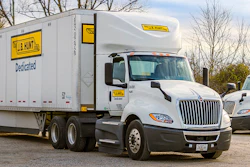











Buyers of transportation companies are pivoting from their mergers and acquisitions playbooks.
Median travel, transportation and logistics (TTL) deal multiples rose in the first four months of 2026 compared to 2025, from 9.5 times to 10.2 times EBITDA, according to PwC’s Transportation & Logistics: US Deals 2026 Midyear Outlook Report.
Average transaction value among global TTL deals above $50 million grew from $340 million in the January to May 2023 period to $1.43 billion in the same window this year, a 321% increase.
But the premiums are selective.
“TTL M&A is becoming less about who has the biggest network and more about who owns the most defensible capability,” PwC’s report stated.
Broker liability
A near-term shift for the trucking industry is the Supreme Court’s ruling in Montgomery v. Caribe Transport II. Eric Heath, managing director of Bluejay Advisors, called it a genuine inflection point.
“The ruling doesn't mean brokers are automatically liable when a carrier they booked causes an accident. What it means is those claims now get to the merits,” he said.
A broker’s exposure now hinges on whether it can produce documented carrier diligence — safety ratings, operating authority, out-of-service rates, insurance verification — before tendering the load.
“Brokers who can produce a timestamped record of that inquiry are in a very different position than those who can’t,” Heath added.
The consolidation effect was discussed in public earnings commentary. RXO CEO Drew Wilkerson said during RXO's Q1 call that the ruling would “drive out the tail on brokers and will create a lot of opportunity for organic growth very quickly in our business. It’ll also create some opportunities on the M&A side for consolidations.”
Smaller and regional brokers were already under margin pressure before the Montgomery ruling, Heath said, and the compliance cost of building defensible vetting infrastructure favors firms with the systems and scale to handle it.
But will brokers start acquiring carrier capacity to reduce exposure? Heath is skeptical because owning assets may solve the vetting problem but could create another set of issues. It’s more likely that most brokers would invest in compliance infrastructure.
“Where you do see integration, it'll be strategic acquirers who already have carrier relationships, not pure brokers entering the asset business for the first time,” he said.
What are buyers paying for in a supply-driven market?
Against that legal backdrop, with capacity exiting the market through bankruptcies and regulatory enforcement pressure, Heath said the freight market is seeing a supply-driven recovery.
Buyers essentially bet on the cycle in a demand-driven recovery, but Heath said what the firm is seeing now is the opposite: rates are improving as capacity exits the market, though not because freight volumes have grown. With demand still soft, shippers are being selective.
“Strategic deals get more surgical,” Heath said. “Financial buyers are more disciplined on leverage because there's no demand surge to bail out an aggressive entry multiple. It's a network-logic deal market, not a momentum deal market.”
The PwC report said fuel costs are impacting deal flow, too, noting that if diesel prices remain elevated through the second half of 2026, investor interest is likely to focus on firms with fuel-efficient fleets.
The report drew comparisons to the 2022 cycle. After fuel prices spiked during the Russia-Ukraine conflict, it took months before some carriers either sold or shut down. By late 2022 through 2023, more than 15 U.S. truck carriers exited, and the buyers were large players such as Knight-Swift Holdings (CCJ Top 250, No. 3), TFI International (No. 4) and Schneider (No. 6).
“The strong got stronger. A similar dynamic could unfold in the current cycle,” the report noted.
Specialization remains key in M&A
Specialization persists as a major factor for consolidation activity, said Mike Ross, U.S. consumer markets deal leader at PwC.
Specialized trucking providers and non-asset-based logistics providers, including brokers and technology-led providers, are likely to see the most M&A activity in the second half of the year, Ross said.
PwC’s report also pointed to a buyer preference for “operators with scarce capabilities:" cold chain, healthcare logistics, reverse logistics, dedicated fleet, cross-border logistics, automation and AI-enabled visibility.
Craig Decker, head of transportation and logistics infrastructure at Brown Gibbons Lang & Company, echoed the point. For truckload carriers, deal interest will cluster on high-margin, recurring revenue from shippers such as dedicated contract carriage and freight with defensible end-market exposure.
Decker said the focus would be on prioritizing freight and not just acquiring for the sake of growth.
“Key end markets that provide high margins, relative resilience in all market conditions and are in high demand include healthcare/pharmaceuticals and cold chain/refrigerated,” he said, “particularly if the latter is focused on high sectors like healthcare and pharmaceuticals that require strict environmental controls.”
Werner Enterprises’ (No. 14) approximately $245 million acquisition of FirstFleet (which grew its dedicated revenues by roughly 50%) and Koch Companies’ (No. 86) acquisition of Store Opening Solutions reflects exactly that playbook: buyers acquiring operators to solve specific issues rather than merely increasing assets.
[RELATED: Amazon says it will offer LTL service, going head-to-head with traditional carriers]
For LTL carriers, Decker said density is vital to optimizing their networks.
“Larger carriers will seek selective geographic expansion of smaller, less well-capitalized carriers whose operations can be optimized within the larger LTL's existing network,” he said.
He added that the increasing cost of operations could inspire smaller carriers to sell to a larger consolidator.