










Leighton Transport has built a reputation across the Pacific Northwest as a dependable flatbed carrier that punches above its weight class. Running with 53-foot maxi flatbed trailers to haul steel, lumber, and recyclable commodities, the fleet has scaled intentionally while maintaining financial independence and a driver-first culture.
- Originally operated under a three-partner structure, the carrier evolved after co-founder Randy Leighton retired.
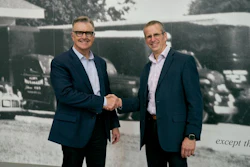
- Today, Leighton Transport operates under a 50-50 ownership structure between Andy Lott and Michelle Miller.
- Andy Lott oversees capital equipment acquisitions and high-level strategy, while Payson Lott manages day-to-day operations.
- A small-fleet culture centered on family, relationships, and drivers' career journey to biz ownership permeates the day-to-day at Leighton, while resources of an affiliated larger biz have helped fuel a recent-years expansion.
Leighton Transport's roster has surged to 28 trucks, piloted by 15 company drivers and 13 owner-operators.
"The ownership's priorities have always kind of been the same: offering a service that competitors have a hard time keeping up with and that customers can rely on," Payson Lott said. "It's kind of gone the same trajectory of just trying to provide a level of service that others have a hard time matching."
Despite having only two dedicated in-house office employees, Leighton avoids administrative strain through its common-ownership affiliation with 185-truck Arlo G. Lott Trucking.
That strategic relationship also gives Leighton the buying leverage of a fleet many times its size, including Arlo G. Lott’s fuel purchasing power and terminal network.
 This is one of several Small Fleet Champ semi-finalist profiles that will air through next week. (Access all of the published stories via this link.) Two finalists in each category (3-10 trucks, 11-30 trucks) will be then be announced when judging concludes.
[Related: Beating the '24-hour logbook' competition, with a circle of trust]
Leighton, too, offers owner-operators a generous compensation plan that includes 90% of the dispatched load's rate.
"Our hiring advertisement is starting off as a company driver and working your way into becoming your own boss," Lott said. "We strive to make it as easy as possible if someone is motivated to become an owner-operator, passing on that same deep discount that we get with our purchasing power."
Small-fleet culture, big-fleet resources: Financial discipline, reliability fueling expansion
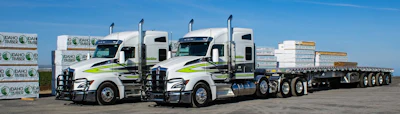
 Two of the late-model Kenworths in the Leighton stable
Between 2022 and 2025, Leighton expanded from 16 trucks to 25, drivers and leased owners backed by two dedicated non-driving support staff. The company operates entirely without factoring receivables, relying on disciplined cash flow rather than selling off invoices.
The business is comfortably profitable, but in recent years has shaved some of its margin, bringing on more than $1 million in equipment --additional trucks and trailers that expanded capacity to capture larger dedicated contracts.
Lott views the investments as groundwork for long-term gains and leans on strict internal billing practices to keep cash flow healthy across their direct accounts.
"We always try to stay within net-30 if we can," he said of receivables. "We've got a lot of customers that pay within a week or two, and we've been hauling for those companies for years and years. At the end of the day, the squeaky wheel gets the grease. We're consistently staying on top of it so customers are paying within 30 days."
Equipped with a truck trade cycle of four to five years and trailers kept around eight, Leighton navigates seasonal lulls with winter weather through customer loyalty rather than spot-board churn.
"They make life easy," said Ryan Kotter, a sales rep for longtime Leighton shipper Idaho Timber. "When we've got a truck that we've got to ship out -- our niche here at Idaho Timber is fast, quick service -- they are the standard. They just they get it done."
Getting it done sometimes means doing it yourself.
"Payson actually showed up a couple times in his truck to do a local run for a customer that was really in need of some fiber," Kotter recalled. "Just him actually showing up, doing the trucking himself and helping us out; we love Leighton Transport."
 The National Association of Small Trucking Companies sponsors the Small Fleet Championship. Finalists receive a year's worth of membership in the association, with access to a myriad of benefits from NASTC's well-known fuel program to drug and alcohol testing services and much more. All are recognized at the association's annual conference, where winners will be announced later this month Nashville, Tennessee. Find more about the association via their website.
"I’ve known Payson since he was very young. While attending college he would run trucks for me all over the West," he recalled. "I could ask him to get a truck to a certain place and he took control and made it happen without any questions. As I’ve watched him and his brothers grow up, I’ve seen them take the work ethic their father [Andy] and grandfather instilled in them and has made them very successful."
Nebeker said that one of the most comforting things about doing business with Leighton Transport and the Lott family is their reliability.
"Their word is solid," he said. "There is never a doubt they will do what they tell you."
[Related: 80 years of specialized excellence: Otto Transfer]
Insulating against market and fuel volatility
Leighton's load balance is 70% spot, 30% contract, but Payson Lott said rather than chasing volatile spot-market freight, Leighton anchors its business in long-term customer relationships, using load boards mostly to balance irregular backhauls.
Flatbedders have seen a volume boost of late thanks to a construction boom fueled by AI data centers. Lott noted Leighton's not seen a lift that he can directly attribute to the AI infrastructure buildout, but pressure on flatbed capacity in the wider market stands to deliver gains in contracted rates moving ahead.
To mitigate surging fuel expenses, the carrier combines smart technology with strategic alliances:
- Terminal fueling: Drivers utilize an on-site fuel island alongside access to terminal fueling networks through its partnership with Arlo G. Lott Trucking partnership.
- Smart routing & fuel controls: Utilizing the Relay fuel app, dispatch directs purchasing toward lower-cost states like Idaho, Utah, and Oregon, while restricting gallon limits in high-tax jurisdictions like California and Washington.
- Driver training & equipment care: Fleet-wide initiatives focus on idle reduction, tire pressure monitoring, and proactive maintenance.
[Related: Drumroll, please ... Meet your Small Fleet Champ semi-finalists]