










Strong rate discipline and improving demand trends helped Old Dominion Freight Line boost Q2 earnings to $1.68 per share while improving its operating ratio to 70.1%.
- Profit & Revenue Jump: Net income rose 30.5% year-over-year to $350.6 million on $1.55 billion in revenue, up 10.4%.
- Yield Management Drives Success: Core LTL revenue per hundredweight (excluding fuel surcharges) grew 5.5%, allowing the company to overcome a 4.1% dip in daily tonnage.
- Operating Efficiency Gains: Operating ratio improved by 450 basis points to 70.1%, matching the company’s all-time record diluted EPS of $1.68 set in Q3 2022.
- Capital Allocation & Outlook: Old Dominion reiterated its full-year CapEx plan of $380 million to expand real estate and fleet capacity, while projecting continued momentum into Q3.
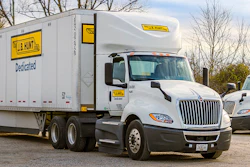
Old Dominion Freight Line (CCJ Top 250, NO. 9) on Wednesday reported a 30.5% jump in second-quarter net income, driven by a rebound in revenue and improved operating efficiency amid a stabilizing domestic economy. The less-than-truckload (LTL) motor carrier posted net income of $350.6 million for the three months ended June 30, up from $268.6 million in the same period a year earlier.
Chief Financial Officer Adam Satterfield noted during an earnings call with analysts that volume trends strengthened as the quarter progressed. After a soft April, sequential tonnage rebounded in May and June, positioning the carrier above typical seasonal averages. Satterfield added that preliminary July revenue per day is tracking 7.5% to 8% higher year-over-year.
Revenue for the quarter rose 10.4% to $1.55 billion from $1.41 billion in the second quarter of 2025.
Disciplined pricing and rising yield rates proved to be the primary engine driving record-matching profitability for ODFL in the second quarter, successfully offsetting cost inflation and broader economic softness.
LTL revenue per hundredweight jumped 15.2% year-over-year to $37.84. Even when stripping out fluctuating fuel surcharges, core LTL rates rose 5.5%.
"Consistently providing our customers with superior customer service is the cornerstone of our strategic plan," President and Chief Executive Officer Kevin Freeman told investors during the company's conference call. "Doing so supports our yield management initiatives. Our disciplined approach to pricing, which focuses on individual account level profitability, is designed to offset our cost inflation over the long term and support reinvestment back into our business."
Old Dominion Freight Line most recently implemented a general rate increase November 3, 2025—a 4.9% boost.
The strong rate environment allowed Old Dominion to overcome a 4.1% decline in LTL tonnage per day during the quarter. Because higher rates generated more revenue on each shipment, the company achieved significant operating leverage, driving its operating ratio down by 450 basis points to 70.1%—one of the strongest operational efficiency scores in company history.
Looking ahead into the third quarter, Satterfield noted that yield growth, excluding fuel surcharges, is expected to moderate slightly to between 4% and 4.5%. However, he emphasized that the change reflects a positive shift toward heavier shipment weights rather than price erosion.
"Yield management initiatives have helped us become the most profitable carrier in our industry," Satterfield said, adding that strong pricing paired with improving shipment volumes positions the company for continued earnings momentum through the remainder of the year.
Six-month performance and capital allocation
For the first six months of 2026, Old Dominion reported:
- Total revenue: $2.89 billion, up 3.8% from $2.78 billion in 2025.
- Net income: $588.9 million, a 12.5% increase from $523.3 million.
- Diluted EPS: $2.82, up 14.6% from $2.46.
The company generated $272.7 million in operating cash flow during the quarter and ended the period with $283.9 million in cash and cash equivalents.
Capital expenditures stood at $77 million for the quarter and $139.6 million for the first six months. Old Dominion reiterated its full-year capital expenditure forecast of approximately $380 million, which includes $180 million for real estate and service center expansions, $155 million for fleet tractors and trailers, and $45 million for technology and other assets.
The carrier continued returning capital to shareholders, spending $239.7 million on share buybacks and paying $120.7 million in cash dividends through the first six months of the year.