









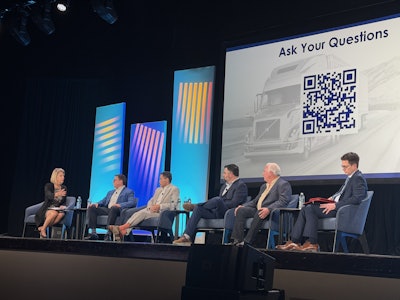
Fleet executives told distributors and suppliers at Heavy Duty Aftermarket Dialogue on Monday they need more communication.
From tariffs and pricing information — "I want detail. I want real numbers." — to performance and availability, fleet leaders just want to know what's going on, they said.
Dennis Meyer-Razon is transportation category manager for CHS Inc., a farmer-owned co-op that runs its own fleet of about 6,000 power units and 8,000 trailers. Agriculture was heavily impacted by tariffs in 2025 and sees some business units rebounding, but the effects are lingering.
[RELATED: Fleet Pride CEO talks TruckPro merger at HDAD]
"When you lose the majority of where you export your soybeans to, it's a significant hit to the U.S. farmer," Meyer-Razon says. He purchased about 150 trucks last year and only plans on 50 this year.
Tariffs aren't only impacting his farmers. They're also targeting parts prices and the prices of the trucks he plans to buy. But to what extent is a mystery, Meyer-Razon says.
"We can't get anything, at all, from any of our suppliers," he says. "They're charging us for it, so somehow they're getting the number. How come they can't actually give us the number when we're asking for it?"
Joseph Richey, vice president of maintenance at Groendyke Transport, shared a similar frustration. His company focuses on bulk tank hauling in chemicals and refined products. He called 2025 the "worst year we've ever had," and doesn't know if 2026 is going to be any better.
[RELATED: Truck Equipment Inc. wins 2025 Distributor of the Year]
He didn't buy any trucks last year and probably won't this year. But if he did buy trucks, he couldn't say how much tariffs have impacted pricing.
"I can't get almost any of my OEMs to actually give me a clear answer on how it's going to impact you," Richey says. "I want to be able to see. I want detail. I want real numbers."
Richey says it took him two months to get a price for a day cab and, when asked how much he planned for purchases in his budget, he said he baked in a question mark.


[RELATED: ACT: Final December Class 8 orders hit 42,000 units]
David Schnautz is vice president at Clark Freight Lines and operates in the Houston area. He says even in such a large city, tariffs are impacting parts availability and pricing. He says companies aren't ordering parts because they don't know how tariffs affect pricing.
Clark didn't purchase trucks in 2025 but, for 2026, he's trying full-service leasing instead. He says maintenance costs were "eating us up." He couldn't get parts and he says to him, it seemed like the OEMs were concerned only with newer trucks and didn't give his fleet any concessions for keeping the truck in the shop.
As far as adding any technology, Clark says he likes the factory-standard safety suites, but he doesn't order anything special.
"It's good when it works, but it's not foolproof," he says, adding his fleet has had a malfunctioning sensor shut down the whole truck.
Richey also points to maintenance as a problem in his fleet, saying that was one of the costs Groendyke trimmed in 2025. Soon, his aging fleet is going to present a new problem.
"If I go another 12-18 months (without new trucks), it's going to get expensive to maintain," he says.
None of the fleets on the panel were exploring alternative fuels, with most of the executives citing payload difficulties and infrastructure problems as their hesitation.
Meyer-Razon says the majority of fleet is in rural America, where the infrastructure doesn't exist.
"A big city for us is Minot, N.D.," he says.
Another headache, says Jim Burg from James Burg Trucking Company, is that any added technology for the trucks often doesn't perform as promised.
"(We're) not getting what we were told we were going to get," he says, adding he's happy to install anything that will make his vehicle safer. Richey says that for him, he feels any new tech's failure rate is higher than it should be. He says his fleet had a couple of collisions where they weren't able to support their drivers.
To save on costs, fleet leaders say they're shifting parts purchasing from OE parts to more value lines. Richey says if it's a good part with good quality, he doesn't care what name is on the part.
"There are still certain parts that we go OE on," Meyer-Razon says. "One of the things we've started doing is researching who the manufacturer of the OE parts is and going to those manufacturers and using our size to go directly to the manufacturer."
Schnautz says he goes value line when he can, adding OE parts "aren't what they used to be."