










Trucking news and briefs for Wednesday, Nov. 4, 2026:
Chains now required on many Washington state routes
Truck drivers hauling across many routes in Washington state, beginning this week, must be carrying tire chains. From Nov. 1 through April 1, chains are required for all vehicles over 10,000 pounds on designated routes.
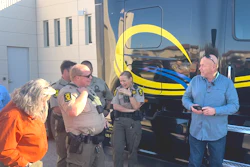
Washington State Patrol troopers are reinforcing the requirement Tuesday and Wednesday, Nov. 3-4, on the Snoqualmie Pass/I-90 with a two-day chain enforcement emphasis. During the effort, troopers will ensure commercial motor vehicles are carrying “the appropriate amount of snow traction devices on Snoqualmie Pass during the winter months.”
“Our main goal is to educate and gain compliance with CMV drivers to carry chains from November 1 to April 1,” said Trooper Jeremy Weber.
Washington’s chain law requirements can be viewed here. Routes that require chains include:
- I-90 between North Bend (MP 32) and Ellensburg (MP 101)
- I-82 between Ellensburg Exit 3 (MP 3.00) and Selah Exit 26 (MP 26.00)
- SR-97 between (MP 145) and Junction
- SR-2 between Dryden (MP 108) and Index (MP 36)
- SR-12 between Packwood (MP 135) and Naches (MP 187)
- SR-97 between junction SR-14 (MP 4) Columbia River and Toppenish (MP 59)
- SR-410 from Enumclaw to Naches
- SR-20 between Tonasket (MP 262) and Kettle Falls (MP 342)
- SR-155 between Omak (MP 79) and Nespelem (MP 45)
- SR-970 between (MP 0) and (MP 10)
- SR-14 (MP 18) to Junction 97 (MP 102)
- SR-542 Mt Baker Highway between (MP 22.91) and (MP 57.26)
EV maker Cenntro delivers electric trucks under New York voucher program
Commercial electric vehicle maker Cenntro has delivered 20 of its LS450 electric trucks under the New York Truck Voucher Incentive Program (NYTVIP).
The company also plans to deliver LS450 trucks under the New York City Clean Trucks Program (NYCCTP), extending its participation in programs designed to help fleet operators adopt cleaner commercial vehicles.
In addition, the LS450 has qualified for and been listed under the California Clean Fuel Reward (CCFR) and the New Jersey Zero-Emission Incentive Program (NJ ZIP), broadening the opportunities for eligible customers to access incentives when purchasing the company's electric trucks.
 Cenntro expects these program qualifications to support additional LS450 deliveries as it continues to develop its U.S. commercial vehicle business.Cenntro
"Delivering 20 LS450 trucks under New York State's incentive program is an important step in expanding our U.S. commercial vehicle business," said Peter Wang, Chairman and Chief Executive Officer of Cenntro. "These programs help lower the upfront investment for eligible customers and support their transition to electric vehicles. With deliveries underway under New York programs and eligibility in California and New Jersey, we see opportunities to bring the LS450 to more fleet operators."


FMCSA moving forward with Crash Causal Factors study
The Federal Motor Carrier Safety Administration announced Tuesday it will award up to $7 million in total funding to support data collection for the Crash Causal Factors Program (CCFP) Heavy-Duty Truck Study.
The study will examine fatal crashes involving heavy-duty trucks to better understand the factors contributing to these crashes.
FMCSA’s announcement opens the application period to eligible state and local law enforcement agencies for the CCFP Cooperative Agreement Program. No single grant award will exceed $500,000. This will be the only funding opportunity that will be offered in support of the study, and awards are intended to support the duration of the data collection period.
Funding may be used for activities and equipment that directly support data collection on qualifying crashes within the study’s sampling locations, including:
- Post-crash commercial motor vehicle (CMV) inspections
- Crash reconstructions
- Post-crash investigations
- Crash data reporting
- Equipment needed for data collection
Qualifying crashes involve fatalities and Class 7 or 8 heavy-duty trucks. All expenses must directly support data collection on qualifying crashes within the study’s designated sampling locations. More details and limitations can be found in the Notice of Funding Opportunity (NOFO).
States selected to participate in the CCFP Heavy-Duty Truck Study, designated alternate States, as well as local law enforcement agencies that meet the study’s participation requirements, are eligible to apply.
The funding will be made available through a cooperative agreement.
The CCFP is part of the U.S. Department of Transportation’s and FMCSA’s effort to reduce roadway fatalities involving CMVs and aims to strengthen the scientific understanding of CMV-involved crashes through a series of peer-reviewed studies, a national crash data repository, and ongoing analysis. The findings and anonymized data will help government agencies, state and local partners, researchers, safety advocacy groups and other stakeholders improve safety programs and develop effective crash countermeasures.
[Related: FMCSA launching fatal truck crash causation study]
Tour coach rental buses built from Mack MD7 chassis
Nashville-based luxury tour bus rental company Pullman Coach will purchase another 10 Mack MD7 chassis in 2027, Mack announced last week.
Pullman placed its initial order for the Mack MD7 in 2024 and currently operates a fleet of approximately 80 vehicles, including 40 Mack MD models.
 The specially designed touring vehicle built on the Mack MD7 chassis offers emerging artists, production crews and touring professionals a practical alternative between passenger vans and high-end entertainer coaches.Mack Trucks
Developed by Nashville-based Autobus USA under the leadership of founder and CEO Jeremy Maul, Pullman Coach was created to address a gap in the touring transportation market. While luxury entertainer coaches serve major recording artists and large national tours, many working musicians, support crews and touring professionals lacked an affordable, practical solution that combines comfort, functionality and reliability.
“We saw a need for something more upscale and functional than a passenger van and more affordable than a high-end entertainer coach,” Maul said. “There wasn't much available in that space."
That observation led to the creation of Pullman Coach, a touring vehicle powered by the Mack MD7 chassis and designed specifically for those who spend hundreds of days each year on the road.
To bring the concept to life, Maul worked closely with teams at Mack and Prevost, drawing on both heavy-duty truck engineering and touring-coach expertise. The result is a coach that combines the durability of a commercial truck platform with the amenities touring professionals expect on the road.
The Pullman Coach is 39 feet long sleeps up to nine passengers. Features include nine tour bus-size memory-foam bunks, a full bathroom and shower, full-size refrigerator, convection microwave, dual 51-inch televisions and a Bose sound system. A 90-gallon fresh-water system supports the galley and bath, while onboard 5G Wi-Fi operates on both AT&T and T-Mobile networks, helping crews remain connected between venues.
The coach also features three storage bays, a 10,000-pound tow hitch, enhanced sound insulation, three rooftop air-conditioning units and a DuraWatt generator. The vehicle serves as transportation, sleeping quarters, office space and crew lounge in a single platform.
“The Pullman Coach is a great example of how customers continue to find innovative ways to leverage the versatility of the Mack MD Series,” said Alex Lee, senior product manager vocational and medium-duty. “Jeremy and his team identified an underserved segment of the premium touring market and developed a solution that combines comfort, functionality and durability. Built on the Mack MD7 chassis, the Pullman Coach delivers the reliability, ride quality and service support customers need to keep people and operations moving efficiently from one destination to the next.”