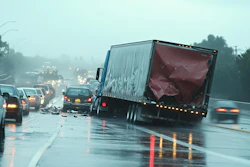











Believe it or not, inspection officers don’t want to hand out citations, and on this week's CCJ 10-44, CVSA Roadside Inspection Specialist Jeremy Disbrow is going to tell us how to avoid getting parked.
The 2026 CVSA International Roadcheck is scheduled for May 12–14, 2026, and beyond the focuses (ELD compliance and cargo securement), inspectors will obviously be on the lookout for other violations.
Contents of this video
00:00 10-44 intro: 2026 CVSA International Roadcheck
01:24 The New Age of ELD Tampering & Hacking
02:30 Looking for Altered ELD Data
02:58 Traditional Falsification vs. Digital Tampering
05:14 Cargo Securement
06:04 Sealed Trailers
07:38 Brakes
08:56 Lights
09:54 Tires
10:57 How to Handle Getting Inspected
Speaker 1:
This week we're talking with CVSA because believe it or not, inspection officers don't want to hand out citations and we're going to tell you how to avoid them. Hey everybody. Welcome back. I'm Jason Cannon, my co-host on the 1044 is Matt Cole. In just about two weeks, CBSA's international road check will get underway. Last week we covered ELD compliance, specifically falsification, manipulation, and improper use of personal conveyance, which will be the focus of this year's campaign. Also, a focus this year is cargo securement.
Speaker 2:
The 2026 CVSA International Roadcheck is scheduled for May 12th through the 14th, 2026. And beyond the focuses that Jason mentioned, inspectors will obviously be on the lookout for other violations. If your cargo straps are tight and your ELD is good, but your brakes are shot, you're still going to have some problems.
Speaker 1:
But let's start this discussion with ELD manipulation or tampering because this is kind of a new age issue brought on partially by the ELD self-certification process and the overall sophistication of current generation technology.
Speaker 3:
Really the focus with ELDs is tampering, and it's a form of falsification. So it'll be this year when we do this, it's going to fall under the false records of duty status category for numbering and everything. And I don't think a lot of people understand what tampering actually is. When we're talking about tampering, we're talking about these shady devices that are out there that are able to be hacked essentially, and they use AI technology. It's terrifying how quick it works. If I turn on my blinky lights and pull a truck over, the driver is immediately texting this ELD provider. It's not their company. It's an ELD provider saying, "Hey, I'm getting pulled over." And within two minutes, that thing is perfect. The ELD looks, it's completely fictitious, but all the locations match and they're even falsifying their supporting documents electronically and providing those to the inspector.
So it's definitely a form of falsification and it'll fall under that category. It's not even your regular false logging people that are doing this. This is like criminal networks almost that are putting these devices out there and marketing them as devices that you can tamper. I mean, they're doing it on purpose and FMCSA's been weeding those out and revoking them very quickly, but they're still out there.
Speaker 2:
If a driver hands over a device that has been manipulated by the provider, they may think they're in the clear to get away with it. But Jeremy says there's always a crumb trail.
Speaker 3:
There's internal data built into that system that they can, if they know what they're looking for, they can identify it and see that some of the technical data has been altered, but you really have to know what to look for. And so again, this wasn't on our radar before, now it is. And we've been putting out training to inspectors on some of the internal diagnostic type things they can look for to identify it better.
Speaker 1:
Now, if that's the new age tampering and falsification, what's the old school way? Because you don't want to do those either.
Speaker 3:
I kind of look at it like a difference between a general falsification and tampering. So a general falsification would be like personal conveyance. You're driving when you really shouldn't be driving, you're actually going to deliver a load, you're misusing personal conveyance. So you're claiming off-duty time when you really should be claiming driving time. That's a pretty standard one. I can still track you like on an ELD. I can see the vehicle was moving. I can pinpoint where you were at at each step of the way. So that is a traditional falsification. Tampering would be more like either scrubbing the logs like we talked about or a driver unplugging it, driving 500 miles and then plugging it back in. There's a big mileage jump, but you have no idea what they did during that time period. They tampered with it. Like by definition, tampering is altering, re-engineering, reprogramming, or disabling an ELD.
So in that case, they disabled it, that's tampering. They're two different regulations, but they're both a form of falsification, if that makes sense. So another one would be what we're seeing a lot of the time now is drivers. A company has Jason Cannon as a driver, and then they make another login for Jason Cannon, but it's all lowercase instead of capitalized. And it looks the same and an inspector sees Jason Cannon, they look at the license and say, "Yep, that's the same guy," but they don't realize they have two logins for the same person and he's running basically a fake co-driver. So that would be another form of tampering because they're using fictitious logins and tampering with the device to get more hours. So that's kind of the difference. Those are things we've tried to put out to inspectors to show them what's happening. That's exactly what that fatality, I don't know if you remember, it was a couple years ago now in Virginia, there was a bus that got rear-ended by a semi-truck and the truck driver never touched his brakes, just slammed into the back of it, killed nine people.
And NTSB went in and did a very thorough investigation and that's what they found. It was one driver. He had two logins that were extremely similar. They changed one digit in the license number, so you wouldn't really notice it. And he was basically running 20 hour days, 19, 20 hour days and clearly was fatigued. So yep, it's been around for a while.
Speaker 2:
Inspectors will also be checking for cargo securement. You may think this really only applies to flatbedders, but that's not the case at all.
Speaker 3:
It's definitely more prevalent with flatbeds for sure, but you're still responsible for cargo securement inside the van trailer, especially if it can affect the maneuverability of the vehicle. So yeah, if you're hauling a load of packing peanuts that don't weigh anything, I couldn't care less. If it's tumbling around in there, it doesn't really matter. But if you're hauling paper rolls in the back of there that weigh 10,000 pounds of roll or metal coils, which are common intermodal bulk containers that have hazardous materials a lot of the time, all of those things have to be secured and properly secured. You'd be amazed. I mean, people transport cars in the back of van trailers and they don't secure them. They'll just set the parking brake and put it in there and drive 2,000 miles. So things like that still have to be secured even if they're in a van trailer.
Speaker 1:
"Oh, but my load is sealed and I can't inspect it. "Well, that's not really an excuse and trailer seals aren't really even the gray area that you might think that they are.
Speaker 3:
We all know that a lot of trailers are picked up and they're sealed loads. They already have a bolt seal on the trailer. They're told not to open the trailer. I always get asked," Am I responsible for that as a driver? "And unfortunately, the answer is yes. And it's not just an inspection issue. I mean, it's a liability issue. Obviously you're driving that truck and if something happens and somebody gets hurt or killed or whatever, try to convince an attorney you're not responsible for that. It's not going to happen. So the fact is a couple of suggestions. If you have an enclosed trailer, either ask the shipper if you can supervise the loading of it or watch them load it to make sure that it's secured properly. If you're not able to do that, then my other suggestion would be to have them sign a statement or something saying that it was loaded in accordance with the regulations and everything was properly secured.
It gives you something to fall back on because I think a lot of people just figure it's sealed. I can't do anything about it, but ultimately you are the one responsible for it if you're driving that load. So I know that it's not ideal, but it's a fact. Most inspectors carry seals, replacement seals. So they'll break it, they'll write it on the inspection report. They'll usually write it on the shipping paper as well that they broke that seal and they replaced it and they'll put the seal number on there that they replaced it with. But yes, they are opening those because quite frankly, a lot of the time there's hazardous materials in there that may not be declared. There's all kinds of things in that trailer. Maybe even the driver doesn't know what's in there, but if there's hazmat or things like that, it needs to be placarded potentially in different things.
So they're going to look in there usually. We've
Speaker 2:
Mentioned on this show many times before that there's really nothing special about road check and that these inspections happen everywhere every day. But now is as good of a time as any to hone your pre-trips because Jeremy says a solid driver inspection can solve most of the equipment violation problems like brakes, lights and tires before officers park the
Speaker 3:
Rig. Pre-trip inspections are not always done properly, I guess, but brakes are part of that pre-trip inspection. And it's rare that a driver gets under that truck or even looks underneath that truck at the brake components. And we push it every year. That's why this isn't a secret detail. We want to get the word out for people to look at those things. So at a minimum, at a minimum on a pre-trip inspection, we should be poking our head under there at least and looking to see, do the brake pads look like they're in good condition? Do the push rods look like they're shooting way farther out than they should when you hit your brakes? But I know that doesn't happen regularly. People rely on their periodic maintenance every three, six, 12 months that they bring it in to have it maintained to make sure their brakes are okay.
So it's not surprising, it's disappointing, and that's why we keep trying to raise awareness. That's why we also do a separate inspection detail throughout the year in addition to road check that's called Brake Safety Week, and that's all they focus on is to try to get the word out on that stuff.
Speaker 1:
And lights?
Speaker 3:
People are pretty good about checking their headlights and the running lights that are easy to walk around and see, but they don't check the brake lights because that requires an extra step. You either have to back up to a mirror or something so you can see them or have somebody help you do it. But in this day and age, we all have cell phones, right? You have cameras on them. So throw your camera at the back of the truck, go into the truck, hit your brakes, make sure that it lights up when you look at the video and you know they're working right. Those are the ones that get overlooked a lot of the time, I think. And we all know that sometimes a light can go out during transit. I get that, but it's rare. You and I both know that. It's more commonly because it was already there that morning and they just didn't check it.
And it is. It's a big red flag that inspectors are going to see. So turn signals, same thing. That's probably one of the most common ones I got because people don't always check their turn signals. They turn on their four-way flashers at best, walk around and make sure they have four lights blinking, but those are separate circuits. So your four-way flashers can work sometimes, but that doesn't mean your turn signals are going to work.
Speaker 2:
And tires.
Speaker 3:
The most common things we see are treadwear. So making sure that the steer tires are at least four, 30 seconds of an inch. The other tires, all the other tires have to be at least two, 30 seconds at all locations. And I know that's tough because people get a little flat spot somewhere on that tire and they don't want to replace the tire. And I get that they're expensive, but any location that's below that four 30 seconds or two 30 seconds is going to be a violation. Those are low hanging fruit. Flat tires, a lot of drivers, especially on dual tires, don't notice that the inside tire is flat. They'll drive that way for a long time, but inspectors are kicking those tires, thumping those tires, and if it doesn't sound right and it's less than 50% of what's marked on the sidewall, it's going to be considered a flat tire and it's going to be put out of service.
So it ends up costing twice as much money when you're put out of service on the side of the road and roadside maintenance has to come out and fix it for you instead of just doing it right the first time on your pre-trip. Kick the tires, make sure they're inflated. And then less common, I guess, would be things like steel belt showing through and things like that. But those are things that are obvious to an inspector when they're walking around.
Speaker 1:
As a driver, how you handle getting inspected, not just during road check, but any day of the week will go a long way in determining how it goes for you and how long it takes.
Speaker 3:
There's two components, right? You have the driver's side and you have the vehicle side. So the driver preparation is huge. And that means a lot to an inspector. An inspector can tell within 10 seconds if you have all your stuff together, you seem like you take pride in your job, you're organized and things like that. So knowing how to use your ELD, for instance, and how to transmit things, knowing where all your documents are and making sure that they're current. The one that I always saw that was really common was the annual inspection or the periodic inspection that every vehicle has. And if a driver doesn't know where that's at or can't find it, that kind of tells me maybe they didn't look over their truck real well and things. So making sure all your documents are together is helpful. And then on the vehicle side, again, I keep preaching the pre-trip, but that's really what it comes down to.
If you're doing a thorough pre-trip and I want to take it a step further, it's not just the driver, it's the motor carrier. The motor carrier has to support you doing pre-trips. They have to have a culture of safety too, and they need to fix things when you tell them they're broken. They need to encourage you to find defects rather than discouraging you to find defects. And some companies push you to not find defects. So those things are all kind of coming together, but if you do a good pre-trip, the company supports you on that and fixes things when they need to. You really shouldn't have any issues. You're checking your lights, you're checking your tires, you're checking your brakes. This isn't a secret. We know what the common violations are. Make sure those are in order. Make sure all the lights are working and you should have a pretty good experience.
I will say one thing, last year, if you noticed, I think we did roughly 56,000 inspections during road check. There was 70 some thousand violations discovered. So it comes out to like 1.4 violations per inspection on average, but tons of those inspections are clean inspections. So some of them have 10 defects, some have none. And so this can be a positive thing. Everybody wants their truck inspected because it helps their safety rating. As long as there's no violations, it's a good thing. So this is your opportunity to go get an inspection. And as long as you have your stuff together, this will help your company. It'll help your insurance rates. It'll help all that stuff by having a clean inspection. So I think people view this as a bad thing on the industry side and it's really not. It's very helpful in some ways.
Speaker 1:
That's it for this week's 10:44. You can read more on ccJdigital.com while you're there, sign up for our newsletter and stay up to date on the latest in trucking industry news and trends. If you have any questions or feedback, please let us know in the comments below. Don't forget to subscribe and hit the bell for notifications so you can catch us again next week.