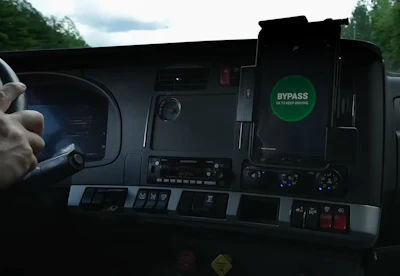
One J&M Tank Lines driver said, “There’s nothing like getting close to a station and seeing that green light light up.” He was referring to the green circle that reads “BYPASS: OK TO KEEP DRIVING” that appears on screen when approaching a weigh station.
Using a weigh station bypass solution like PrePass (as in the aforementioned instance) or Fleetworthy doesn’t guarantee a bypass. But for fleets with good safety scores, it lowers their odds of having to decelerate to pull in for inspection, idle during inspection, and accelerate post inspection.
“Those are some of the absolute biggest impactful events in the operation of a truck when it comes to their fuel efficiency,” said Mark Doughty, president and CEO of PrePass Safety Alliance. “The trucks run most efficiently at speed.”
Get 80 tips to boost your fuel efficiency
Weigh station and toll bypass solutions are just one type of technology available to fleets to help them save on fuel costs at a time when geopolitical tensions in the Middle East have driven up diesel prices, which have consistently remained above $5 per gallon since March, according to data from the U.S. Energy Information Administration.
PrePass customers between 1997 and January 2026 were able to complete 1.16 billion bypasses, saving 584 million gallons of fuel, which contributed to $12 billion in operational cost savings, according to PrePass’s inaugural Mile Marker 2026: The National Bypass Impact Index.
J&M Tank Lines, according to a PrePass case study, logged more than 14,000 bypasses in a single year after adopting PrePass, saving $152,000 in operational costs, $37,000 in fuel and 2,400 driver hours.
PrePass’s cost, fuel and efficiency data indicates fleets save an average of half a gallon of fuel and seven minutes of drive time, contributing to $10.65 in operational costs per bypass. Fleetworthy estimates drivers save about eight minutes of time and 0.55 gallons of fuel, contributing to about $11.95 in cost savings per bypass.
Martin Murtland, vice president of product at Fleetworthy, said Fleetworthy also recently launched expedited inspections, which automatically transmits driver, vehicle and Hours of Service data to enforcement. Providing officers with this standardized, pre-filled information reduces inspection time and minimizes errors.


Murtland said it saves an average of 10 minutes during inspection, reducing idle time.
The North American Council for Freight Efficiency (NACFE) estimates that Class 8 trucks burn roughly 0.8 gallons of diesel fuel per hour of idling and that trucks often idle for six to eight hours daily, resulting in up to 1,800 gallons of wasted fuel per vehicle per year.
The time it takes for an inspection varies, but Fleetworthy estimates a clean Level 1 inspection takes about 45 to 60 minutes, a clean Level 2 inspection takes about 30 to 45 minutes, and a clean Level 3 inspection takes about 30 minutes. A Class 8 truck would burn roughly 0.4 gallons of fuel during the latter due to idling.
[RELATED: Fuel card providers offer capabilites for greater fuel management]
One Fleetworthy customer with a 750-truck fleet completed more than 4,500 bypasses in a month, resulting in savings of over $40,000 in fuel expenses, Murtland said.
“I think the biggest opportunity for fleets is perhaps not necessarily just in one tool,” Murtland said, adding that combining tools like Fleetworthy’s weigh station bypass with telematics, safety and routing platforms, etc. is the best way to reduce fuel spend.
Fuel savings via toll bypass
Another solution Fleetworthy and PrePass offers is toll bypass, again, reducing a truck’s deceleration, acceleration and idling, which is considered a leading source of diesel fuel waste.
“First and foremost, just from an efficiency perspective, to be able to have a truck continue with highway speeds is incredibly helpful,” Doughty said, but “the main benefit of taking toll roads is really to help with route efficiency,” Murtland said.
Toll roads are often shorter and less congested with, creating fewer stop-and-go instances that contribute to fuel waste.
Fleetworthy and PrePass both offer tools to help fleets determine whether a toll road is worth taking.
Fleets can input their route into Fleetworthy to see the estimated toll cost to conclude if that expense will be offset enough by time and fuel efficiency.
Those types of tools are currently implemented prior to a truck’s departure, but Doughty said the future and what he considers the “Holy Grail” will be in real-time route optimization that gives drivers a notification within a safe distance, alerting them to pursue the toll road or the alternate route based on which provides the greatest efficiency to the fleet.
“Nobody's at that level yet. We get closer and closer, but there's obviously a tremendous amount of dependence on other third-party sources of data in order for those types of decisions to be real-time,” he said. “That having been said … when we look at our customer base, where their trucks run, there are a lot of those drive patterns that take place that are very similar for time of day, day of week, etc. So, from that, we're taking and helping them to turn that raw data into recommendations to assist with routing for their fleets.”