










There is a link in the upper right corner of the Central Intelligence Agency’s (CIA) website that guides sources through the process of reporting information to the CIA, but the agency doesn’t just rely on that digitally shared information. It bridges the digital-to-physical divide by validating claims with real-world signals from sensors, satellites and other intelligence sources.
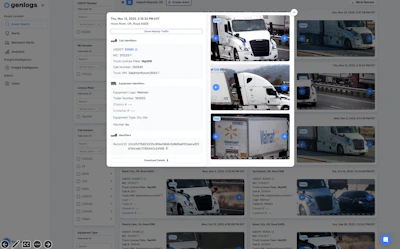
Ryan Joyce applied the methods he learned while working for the CIA to create freight intelligence platform GenLogs, which operates a nationwide, privacy-enabled network of roadside sensors, cameras and AI to verify that a carrier claiming to exist digitally is legitimate by observing their operations in the physical world.
GenLogs recently completed a new funding round that will allow the company to continue building out its core platform and extend capabilities to shippers, governments, and financial institutions.
Several tech companies have stepped up, rolling out new tools to help mitigate freight fraud, which has consistently trended upward in the 2020s.
The American Trucking Associations reported that strategic theft has risen 1,500% since the first quarter of 2021. ID fraud attempts in the U.S. cargo and logistics sector have surged 213% over the past two years, according to the 2026 Cargo and Logistics ID Fraud Report from identity verification firm IDScan.net.
According to DAT Freight & Analytics, losses due to freight fraud and cargo theft are expected to remain high throughout 2026 as thieves become more sophisticated, coordinating physical theft with identity-based schemes. Preventing double brokering – one form of ID fraud – is one of the use cases for GenLogs.
“The double broker issue in this space has become a leading cause of fraud and theft, and that is essentially someone who's digitally claiming that they are a trucking company – that they carry a load from Point A to Point B, but they actually don't have any trucks on the roads,” Joyce said. “They might be in another country, even posing as an American trucking company, just to figure out where to go pick up a really expensive load of Samsung phones or whatever it might be.”


Visual evidence
While there are many digital platforms that vet carrier legitimacy based on details like registration with the Federal Motor Carrier Safety Administration or the U.S. Department of Transportation, GenLogs validates based on visual evidence.
With its own network of north of 1,000 cameras coast to coast, GenLogs daily collects on 15 million images of trucks, using AI to filter out passenger cars and blur windows of vehicles to ensure privacy. The cameras capture front, back and side views of trucks and trailers as they pass by, and AI extracts identifiers like DOT number, motor carrier number, license plates, equipment logos, types of equipment, etc.
Joyce searched for the Walmart logo using the GenLogs system, finding Walmart trailers all over the U.S. Users can also search by operating area to find carriers that run specific lanes. In just seconds of searching the GenLogs system, he was able to find 1,500 carriers that run from Chicago to Dallas – a stark contrast from shippers and brokers calling directly on the phone to identify a carrier that can meet their needs.
“If you're telling me that you're a real carrier and that you run from Dallas to Chicago with a certain type of equipment … I should be able to validate that you are a real carrier, that you really run quite often between Dallas and Chicago, and that you have the appropriate equipment that could actually carry that valuable load,” he said. “When you do validate that, the chance of theft drops to nearly zero because they're real.”
Joyce said GenLogs will show a map of where a carrier operates, as well as whether they meet compliance rules, when searching for a specific company. If the GenLogs system can’t find a carrier on its map, it is likely a fraudster double brokering.
“We've had a number of those issues,” Joyce said. “It would literally be a red pin on our map where they are supposed to be based out of and then a white map because we've never actually seen them out there.”
GenLogs customers, which include J.B. Hunt and Werner, then simply move on to the next motor carrier they want to work with, he said.
“The beauty of this is that the bad guys get passed over for freight, and this allows freight brokers and shippers to find even the smaller carriers out there on the roads that sometimes have never been inspected,” Joyce added. “I think that's an important distinction: one of the only ways that you could verify physical presence on the road in the past, before Gen logs, was if a truck carrier got inspected.”
GenLogs, he said, regularly sees over 20,000 carriers on the roads that have never had an inspection.
Additional use cases
Joyce said the other side of the GenLogs platform is it looks at shipper activity, lanes and equipment needs to help carriers and brokerages engage shippers as new customers.
J.B. Hunt has even used the platform to find missing trailers and it's helped law enforcement rescue a few human trafficking victims as well as stop drug trafficking done through trucks.
He said the company also gets hit up weekly by hedge funds, banks and other financial organizations because GenLogs’ data offers insights into economic indicators.
Finally, Joyce said the company has a product in the works for owner-operators and small fleets to help them obtain validation and, therefore, better freight from brokers and shippers as well as improved insurance rates and fraud protection.
“We have a product that's essentially going to allow us to look at a trucking fleet on the roads. We know what their truck should be,” he said. “If we see another truck that's trying to pose as them, we can alert them in real time and take action with law enforcement on their behalf in order to stop the damage before it happens to their reputation.”
Other fraud mitigation tools
In addition to GenLogs, others have recently rolled out new products and tools aimed at preventing fraud.
Overhaul, for example, recently launched SecureBOL, which creates a digital copy of a bill of lading (BOL) and provides instant, verifiable proof of authenticity at delivery.
Paper BOLs are easily disputed, misplaced or modified, and a quarter of global shipping industry losses are linked directly to bad actors altering BOLs, Overhaul stated in a recent news release.
SecureBOL links a photo of the signed BOL to a tamper-evident QR code that is placed on the document. The label travels with the freight, providing a verifiable reference to the original BOL throughout transit. At delivery, the receiver scans the QR code and accesses the document through a secure, PIN-protected web page. Cross-referencing the paper BOL with the digital version exposes discrepancies and verifies validity.
Additionally, TOP Worldwide recently unveiled its Secure Driver Network, which validates driver identity with AI and biometric verification before shipments are dispatched. Going beyond manual vetting, the system checks every driver against more than 40 data signals, including domicile status and other risk factors, to confirm identity.