










Samsara has introduced multiple AI-powered features including two-way dashcam communication with AI agents, automated ride-alongs that assess driver behavior against 22 safety factors, and coaching priority solutions that identify high-risk drivers needing personalized training. These innovations aim to improve fleet safety by reducing distractions while providing consistent, scalable driver coaching and real-time hazard awareness.
- Two-way AI conversations allow drivers to receive start-of-shift briefings, safety coaching, and route hazards via dashcam without phone dependency
- AI ride-alongs assess drivers against Samsara's proprietary 22-factor Safety Assessment Standard, identifying silent signals that predict crashes
- Coaching priority evaluates 45+ risk factors to identify high-risk drivers needing intensive coaching versus low-risk drivers suitable for AI training
- Bird's Eye View stitches four external cameras into a top-down view, highlighting safe zones in green and risk areas in red for improved situational awareness
- New AI Multicam detections include Rear Collision Warning and Vehicle in Blind Spot alerts for real-time hazard awareness during reversing and lane changes
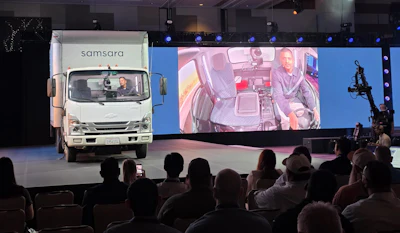
When Arpan Podduturi hopped into the cab of a box truck, he was soon greeted by an AI agent on a recorded line via the Samsara dashcam.
The agent prompted him to turn his radio off and proceeded to give him a “start-of-shift” briefing that included his safety score, safe-speed streak and the details of his trip, along with a weather and traffic report.
“This week, I noticed you had one following-distance event, so today let's aim for 4 seconds of space, especially when traffic is merging,” the agent said last week during Podduturi’s live demonstration at the annual Samsara Beyond conference.
The reimagined driver experience, which fleets can customize, offers automatic voice assignment, personalized start-of-shift briefings, hands-free messaging and acute risk intervention to give every driver consistent coaching and support.
Podduturi, Samsara’s new head of safety, was able to respond to the system. He asked the agent if there were any high-risk areas along his route, and the agent provided details of a construction zone on Interstate 15. The agent noted that the driver would intersect that zone in about 10 minutes of driving time, where the speed limit would drop to 45 mph, and reminded him to give himself extra clearance and watch for sudden stops.
Podduturi said drivers are inundated with screens and alerts, and the only alternative is yet another distraction that requires human effort: calling the driver on the phone.
“We need to build products ... without creating new distractions,” he said.
The new two-way AI conversations feature allows driver managers to contact drivers in the moment via an AI agent. Alternatively, driver managers and drivers can call each other through the same channel—a direct line that doesn't depend on a phone, a charged battery or a cell signal.
“We tried contacting a driver in his truck via phone but were unable to reach him. I then used the dash camera to contact him and connected successfully,” Otis Anderson, safety compliance analyst at Jordan Carriers, said in a Samsara news release. “The driver mentioned that his phone lost battery. It’s this kind of technology that helps ensure our drivers stay safe.”



Ride-alongs
Samsara introduced another AI feature this year that offers an alternative to in-person evaluations: Ride-alongs, available to Samsara customers in open beta.
The tech vendor created this feature to scale a previously manual process in which a senior driver rides in the cab and takes notes on other drivers. This process identifies risky behavior that is often missed by safety cameras, such as a driver’s judgment, ability to anticipate situations before they happen, or signs of aggressiveness and disengagement.
Samsara chief product officer Johan Land said the company analyzed millions of miles of driving across its data pool and identified 22 “silent signals,” or behaviors across six principles, that are the best predictors of crashes. The ride-along feature assesses every driver against this proprietary 22-factor Samsara Safety Assessment Standard.
Land said this is different from Samsara’s in-cab dashcam alerts, which identify when a driver does something like pick up a mobile phone or follow too closely.
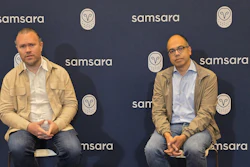
“They're typically fairly rare events. It's a few events a week,” he said during a press conference held at Beyond. “The difference with ride-along is that it's a time period: 10, 20, 30 minutes or so, and then you get the full picture during that.”
It is a continuous view of how each driver operates over time, and it can happen any time the driver is on the road versus having to schedule another human to be present in the cab. Land also noted that fleets can choose whether they make the driver aware of the AI ride-along.
“Ride-alongs are very impactful. They're very complementary to cameras and AI events, but [in-person] ride-alongs are hard to scale, and drivers tend to be on their best behavior when someone is sitting next to them,” he said.
Driver managers can review the AI ride-along video and receive an AI-generated summary. The feature also assigns training to the driver based on their behavior during the recorded time.
Coaching priority
Samsara’s new coaching priority solution takes a holistic look at a driver’s history, including their ride-alongs, events and every other data point Samsara has about the driver. It also considers environmental factors like road conditions and weather.
This proprietary model for identifying and prioritizing coaching opportunities is available now.
[RELATED: Samsara launches an online hub for customers to foster community]
Coaching priority continuously evaluates more than 45 risk factors and benchmarks across all drivers in a fleet using AI trained on data from thousands of crashes annually across the Samsara Network. This identifies the highest-risk drivers who need more intense, personal coaching versus low-risk drivers who can be effectively coached using AI.
New AI Multicam detections
Samsara has also addressed high-risk moments like reversing, lane changes and tight maneuvering. The company launched its AI Multicam last year and has added new capabilities this year to give drivers more awareness of their surroundings.
Available by the end of this summer, Bird’s Eye View stitches together camera feeds from four external cameras into a single, top-down view. This gives drivers visibility into their immediate surroundings, enabling them to navigate through crowded yards and tight spaces. Using on-device AI, it highlights surroundings in the safe zone in green and those at risk in red.
It is not designed for 53-foot tractor-trailers but is most valuable for vehicles like school buses, garbage trucks, heavy machinery and box trucks.
In addition to Bird’s Eye View, Rear Collision Warning and Vehicle in Blind Spot alerts notify drivers of the hazards most likely to cause collisions in real time. Wireless Link automatically connects tractor-trailer cameras without any driver input. When reversing or changing lanes, drivers receive visual and audio alerts in the moment because this capability runs at the edge of the device.
Tehzin Chadwick, chief safety officer at wholesale grocery distributor UNFI, said UNFI drivers operate in environments ranging from large retail spaces to tighter urban spaces, making these types of maneuvers part of their daily routine.
“What we have found with the AI Multicam is that for our drivers, who are highly trained professionals, it doesn't replace their skills; it's just complementing those skills that they have,” Chadwick said during a presentation at Beyond. “One of our drivers actually said that it's like having a second set of eyes, and I think that just speaks volumes. So, the drivers are feeling confident with this technology. They are enjoying the technology, and they're using the technology.”
Land said Samsara will continue to add more detections like these to the AI Multicam.
In other cameras
Samsara also introduced its new 360 camera for operated equipment like forklifts, baggage tugs or excavators. Similar to the Bird’s Eye View cameras, this single-mount, all-weather unit offers a 360-degree view by stitching together the feed from two cameras facing opposite directions.
This gives equipment operators visibility into risks in real time. Additionally, safety managers can examine any angle of a recorded event in detail with an interactive pan and zoom function, providing greater insight into the camera’s view of the operator's hands, feet and surroundings.