










People often overlook how small tools and equipment drive outsized downtime and ultimately drive up costs, said David Gal, vice president of connected equipment at Samsara.
“You might not immediately notice a few missing pallet jacks on the balance sheet, but if it delays drivers from heading out on their routes and causes missed delivery windows and cancelled contracts, the bottom-line costs multiply exponentially,” he said.
Tracking for heavy assets has been the primary focus for trucking companies for years because those were the most high-value assets, despite smaller assets costing companies 2.5 times more annually than larger assets, according to Samsara’s forthcoming State of Connected Operations: Asset Theft & Loss report , in which 77% of organizations said a missing critical tool, attachment or part caused a significant shutdown or delay in the past 12 months.
Gal said fleets have always needed to protect equipment of all sizes. The technology was just too bulky, too expensive or simply didn’t work because there was no network to support it.
With advancements in technology, those barriers are gone. That has become apparent as three big tech brands that serve the trucking industry have all recently rolled out small asset trackers.
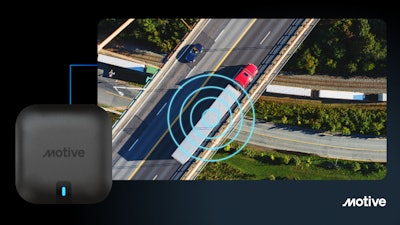
Samsara’s include the Asset Tag designed for small equipment and the ultra-compact Asset Tag XS for even smaller equipment like handheld tools; Motive’s new compact tracking device is called Beacon, designed to locate containers and small equipment; and Geotab unveiled at its Connect conference in February its Go Anywhere family of asset trackers, which includes its Go Anywhere Plus, Go Anywhere and Small Asset Tracking devices.
Powering small asset tracking
Thirty-seven percent of consumers now link rising theft directly to higher prices, and 38% of fleet operators are more concerned about cargo theft today than they were a year ago, according to Geotab research. They’re also concerned about equipment theft due to rising prices, Gal added, noting that the cost of equipment found in yards, terminals and the cab have gone up 50% over five years, making the loss of an asset twice as expensive as it used to be.


[RELATED: How fleets, trucking industry can prevent cargo theft]
David Wooten, senior manager of product management at Geotab, said this is pushing fleets to adopt trackers, not just for loss prevention but to maintain brand trust and supply chain integrity.
“While asset tracking technology has been a staple of the industry for decades, we are currently witnessing a massive resurgence driven by escalating cargo theft,” Wooten said.
He added that advancements in battery technology and cellular coverage is what’s making the tracking of smaller assets possible.
“We have reached a technological tipping point where modern devices like the GO Anywhere offer up to 10 years of battery life,” he said. “This long battery life allows fleets to ‘set-and-forget,’ removing the historical barrier of high maintenance and frequent battery swaps, ultimately lowering total cost of ownership.”
Samsara’s Asset Tag provides up to six years of maintenance-free battery life – a 50% increase over the previous generation. Its Asset Tag XS offers three years of battery life. Motive Beacon has a four-year battery life.
Wooten said satellite coverage is also more accessible now with a shift toward software-defined satellite access that allows standard IoT devices to communicate directly with satellite constellations. Satellite solutions have historically required expensive, specialized hardware and high monthly fees, making it cost-prohibitive.
Connecting to the network
GPS tracking via satellite is reserved for larger asset tracking, while Bluetooth powers the small asset trackers from these providers. They can operate for years on a small battery because BLE (Bluetooth low energy) tags use very little power.
“The trade-off is that BLE tracking is event-based rather than continuous, since location updates occur only when the tag comes within range of a vehicle or reader,” Wooten noted.
Bluetooth tracking requires another device to detect and report the location of the asset, said Motive’s Director of Product Robert Higdon. Geotab’s, Samsara’s and Motive’s Bluetooth trackers are all powered by their individual networks of devices.
In Geotab’s ecosystem, any vehicle equipped with a GO device can act as a Bluetooth “listener,” capturing signals from asset tags within roughly 300 feet. When this happens, the GO device associates the tag with the vehicle’s GPS location and timestamp and sends that information to the MyGeotab platform.
Samsara’s mesh network, which the company said has doubled in density over the last two years, leverages millions of Samsara-connected devices that travel on 99% of major U.S. roads. Similarly, Motive’s Beacon is powered by its mesh network, which uses Motive Vehicle Gateways and devices running the Motive Fleet App and Driver App to detect Beacons via Bluetooth.
“Bluetooth … is more agile,” Higdon said. “It’s lower cost, highly power efficient and much more compact, meaning it’s harder for thieves to find and remove and can fit on many more types of equipment.”
Shoring up bottom lines
TEAMS Transport lost 28 pallet jacks, costing the company $19,600. The loss prompted the trucking company to roll out Samsara’s Asset Tag.
“The real cost of a missing asset isn’t just the replacement invoice. It’s the missed pickup, the stalled job, the rescheduled driver, and the downstream customer impact,” Gal said. “With equipment costs up due to tariffs and skyrocketing material prices, you can’t afford to let your profit margin fall off the back of a truck or get stolen from the yard.”
Higdon said lost equipment costs companies billions of dollars annually in what he called a “death by a thousand cuts” scenario as the daily loss of individual small assets adds up and causes operational disruptions.
While theft grabs attention, Higdon said the bigger payoff of asset trackers is knowing exactly where equipment is so it can be used efficiently. The goal, he said, is to reduce operational waste, avoid over-purchasing or over-renting, and make better decisions in real time.
“When visibility is poor, assets can end up misplaced or parked at low-volume sites while high-demand locations scramble to make do,” Higdon added. “Teams waste hours searching, dispatches get delayed, detention costs pile up, and equipment that should be earning its keep sits idle in the wrong place.”
According to Geotab’s State of Commercial Transportation 2026 Report, many fleets sit on idle capital with assets often active only half the year.
“Trackers turn that idle iron into billable hours,” Wooten said.