










SaaS companies are vulnerable to the disruption artificial intelligence is bringing to the foundation of software. That’s what Geotab CEO Neil Cawse asserted at the annual Geotab Connect conference held this week in Las Vegas.
His view of AI changed as quickly as AI is changing itself. Cawse told members of the media Wednesday that as recently as last November, he would’ve said AI helps software developers do their job better. Their jobs have now been relegated to quality control, he said.
“Now, I'm telling you they are not doing the work. The AI is doing the work, and they are simply framing what needs to be done,” he said. “There's a large number of the developers now that are not writing code, and that's almost sacrilege for developers, like, ‘How can I not be the one writing my code? It's my craft. It's what I've done for 20 years. It's my skill.’ That's the big change. They really are nursing the AI. They are monitoring it. They are guiding it in some ways.”
[RELATED: Geotab's 2026 prediction: AI-driven boom for fleets that adapt]
Cawse said that’s because AI is as effective—and sometimes even better—at writing code to the point a non-developer could use it to build a SaaS system’s replacement, putting SaaS companies at risk of going out of business. SaaS platforms that perform routine work will take a “massive knock,” Cawse said, offering Salesforce and Atlassian as examples.
Geotab’s defense
Geotab is a SaaS company.
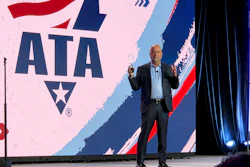
“We're going to have to really up our game even more,” Cawse said in his keynote to an audience that made up a large portion of the conference’s 4,000 attendees.
But he said Geotab has a “moat.” Its defense is in its hardware solutions, its AI models, and the amount of data it gathers at over 100 billion data points daily from more than five million vehicle subscriptions. Cawse said Geotab will continue its mission to apply data analytics to deliver insights to its customers—now using AI more than ever.
[RELATED: Experts share trucking tech predictions for 2026]
“You've told us that the areas of your maximum focus are operations, maintenance, and safety, and so that's where you'll see us paying the most attention, of course, powered by AI,” he said during his keynote.

Geotab uses AI to develop its AI products
Geotab announced multiple new and revamped products at its conference Wednesday.
Geotab launched its GO Focus road-facing sensor and its GO Focus Plus AI-powered dual-facing dash camera last year. The company introduced its new GO Focus Pro dash cam, available in Q2, at Connect this year.
It offers AI-powered coaching and real-time, in-cab audio alerts informed by its 360-degree visibility via up to five weatherproof auxiliary cameras that cover the driver, cargo, and surrounding environment, including trailers. Its AI-driven pipeline eliminates systematic human review.
The new member of the GO Focus family also provides predictive AI safety features, including traffic-light violation detection, forward-collision warnings, and detection of vulnerable road users in blind spots using AI models on external auxiliary cameras. It also includes a latency-free video feed to support precise backing, docking, other low-speed maneuvers, and blind-spot overview.
Its automated scoring system helps identify repeat infractions and risky behavior patterns, such as mobile phone use or fatigue, to prioritize coaching and recognize safe driving. Additionally, drivers are recognized when they get behind the wheel via its automated identification feature.
Also available in Q2 is the next generation of MyGeotab and Geotab’s enhanced GO and GO Plus telematics devices, engineered with a completely new format and built on a new shared architecture for faster processing and superior data handling. The GO and the GO Plus are designed to capture high-quality, high-fidelity data to help fuel AI solutions like analytics assistant Geotab Ace, which transforms complex datasets into clear, actionable answers for fleet operators.
Data matters
Throughout the conference, Cawse billed Geotab as fleets’ partner in navigating and leveraging AI by focusing on the outcomes its customers are seeking to achieve.
Cawse said it starts with the customer, and the customer needs to turn what they do into objective key performance indicators (KPIs) tied to the goals of the company, whether that goal is creating a safer fleet or saving money on fuel.
KPIs are how Geotab determines what data matters—what data is needed to solve the customer’s problem, Geotab Vice President of Product Management Sabina Martin told media Wednesday.
“They rely on a partner like us to figure out that quality and data foundation to help them achieve that ultimate goal,” Martin said.
Mike Branch, vice president of data and analytics, said creating that foundational layer of trusted data is crucial, and Geotab has been building that foundation for years.
Cawse said the more data fed into the AI, the better the output becomes. The data is the basis of digital twins, which are needed to implement an effective AI agent that can answer questions like, “Am I utilizing my assets in the smartest way?” or “How do I grow revenue and improve cost control?”
When experts refer to quality data, what they mean is, “Are you measuring the right things in the right way so that you can reconstruct your digital twin properly?” Cawse said.
But it can’t be done without access to the data.
“If your data is trapped in silos like PDFs and paper, AI will never reach its full potential. If the data matters, it must be digital, accessible and usable,” he added. “To prime the world of AI, everything needs to be connected.”
Branch said Geotab will launch its own MCP (Model Context Protocol) connector this year, enabling customers to securely connect their data to Geotab’s AI to provide deeper insights and allow the AI to take action.
“Oftentimes, there are so many solutions out there that give you insights, but it doesn't translate insight to outcome,” Branch said.
Geotab transforms those data insights into outcomes with its AI models, and “it's changing outcomes for people in the real world, in real communities, and on real roads,” Cawse said. “We have a choice. We can stand on the sidelines and watch the world transform around us, or we can get on that roller coaster, grab the bar, and ride it with everything you've got. Learn the tools and become the experts, because it's your leadership in your organization that will determine whether your people thrive in the new world.”