Trucking news and briefs for Friday, May 15, 2026:
California launching new electric-truck rebate program
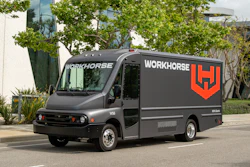
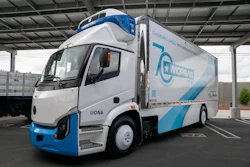
The California Air Resources Board (CARB) is launching a new $1 billion rebate program for electric medium- and heavy-duty trucks.
The new California Clean Fuel Reward (CCFR) is currently open to retailer enrollment. Beginning June 26, rebates will be available at authorized retailers for public and private fleets across the state.
The rebates range from $7,500 for Class 2b vehicles (8,501-10,000 pounds gross vehicle weight) to $120,000 for Class 8 vehicles over 33,000 pounds GVW. The rebates can only be applied toward the purchase of new electric medium‑ and heavy‑duty commercial vehicles registered in California, including drayage trucks, electric semis, box trucks, delivery vans, and other fleet vehicles. Hybrid, fuel cell, used vehicles, and battery-electric motorcycles are not eligible, CARB noted.
Funded with revenue utilities generate from the state’s Low Carbon Fuel Standard (LCFS), the program is expected to become the largest utility rebate program for electric trucks in the country, with $250 million available this year and over $1 billion in total rebate funding expected through 2030.
“This new rebate program builds on California’s long record of incentivizing zero‑emission vehicle deployment and reaffirms our unwavering commitment to clean transportation,” said California Air Resources Board Chair Lauren Sanchez. “By returning revenue from the Low Carbon Fuel Standard directly to truck buyers at time of purchase, we’re making zero‑emission trucks the better choice for fleets and delivering cleaner air along freight corridors where it’s needed most.”
The program is administered statewide by Southern California Edison on behalf of CARB, Pacific Gas & Electric Company, San Diego Gas & Electric, the Los Angeles Department of Water and Power, and the Sacramento Municipal Utility District.
FMCSA issues first exemption to non-domiciled CDL rule
The Federal Motor Carrier Safety Administration has granted its first non-domiciled CDL exemption since publishing its final rule in February restricting which classifications of foreign worker visas can obtain the licenses.
In a Federal Register notice published May 14 in response to a September 2024 petition from the Hawaii Department of Transportation, FMCSA has granted all state driver’s licensing agencies (SDLAs) a five-year exemption to issue non-domiciled CDLs/CLPs to citizens of Freely Associated States (FAS) who reside in the United States and who have a valid, unexpired passport issued by an FAS and a Form I-94 or I -94A.
The FAS are the Federated States of Micronesia, the Republic of the Marshall Islands, and the Republic of Palau. United States agreements with FAS nations, known as the Compacts of Free Association, grant unique status to FAS citizens based in part on the role of the FAS in supporting the United States security presence in the Pacific Islands region.
Under federal law, states are authorized to issue Real ID licenses to FAS citizens with modified documentation requirements implemented by the Department of Homeland Security.
“The exemption allows SDLAs to accept a valid, unexpired passport issued by an FAS and an Arrival/Departure Record, meaning a Form I-94 or I-94A issued by DHS, to prove that the individual has entered the United States lawfully, and to issue non-domiciled CLPs and CDLs to those individuals that otherwise meet the eligibility requirements,” FMCSA said in granting the exemption.
[Related: FMCSA issues Final Rule banning non-domiciled CDLs almost entirely]
Because FAS citizens were granted a unique work status by Congress, do not require a visa to work in the United States and do not have expiration dates on their Form I-94s or I-94As. As a result, “FAS citizens do not need an H-2A, H-2B, or E-2 visa to receive a non-domiciled CLP or CDL,” under the new exemption, FMCSA added.
Hawaii DOT also requested that it be allowed to issue standard CLPs and CDLs to FAS citizens in its 2024 request. FMCSA denied that portion of the state’s request, noting that it “believes that it would be inconsistent with the Agency's Non-Domiciled CDL final rule to allow SDLAs to issue standard CLPs and CDLs to individuals who are not domiciled in the United States.”
The new exemption supersedes the prior exemption granted to the Oregon Department of Transportation that allowed Oregon to issue standard CLPs and CDLs to FAS citizens, rather than non-domiciled CLPs and CDLs.
The exemption is effective through May 14, 2031.
[Related: Lawmaker looks to increase FMCSA oversight of non-domiciled CDL applicants]
ATRI requests trucking industry’s input on cabotage
With federal law prohibiting the use of foreign B-1 visa-holding truck drivers from engaging in point-to-point service while operating in the U.S., known as cabotage, the American Transportation Research Institute is beginning to conduct research on the scale and impact of cabotage activities in the U.S.
ATRI’s Research Advisory Committee identified the topic as a top research priority in 2025.
While B-1 visa-holders are generally allowed to make one pick-up or delivery in the U.S., anecdotal evidence indicates that some foreign truck drivers actively conduct new business throughout the U.S. and beyond the border commercial zones.
ATRI’s cabotage research includes a trucking industry survey that asks truck drivers and motor carriers to provide input on when and where this illegal activity is most often observed.
The survey findings will help develop an economic model that will calculate the real costs and impacts that cabotage has on U.S. truck drivers and truck fleets.
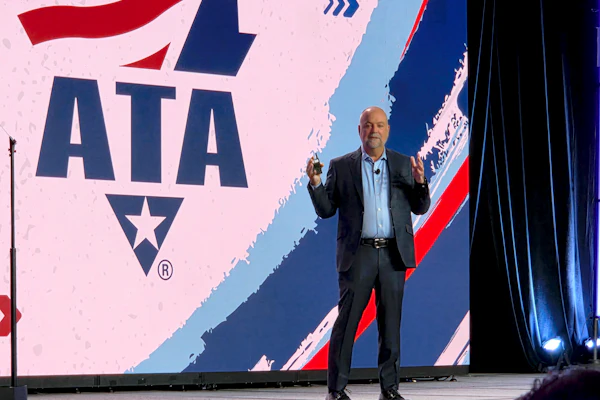
“Cabotage laws were created to protect U.S. jobs and ensure that a level playing field exists,” said Kaitlyn Holmecki, American Trucking Associations’ Director of International Policy. “When illegal low-cost transportation services undercut domestic freight operations, the entire trucking industry pays the price.”
All survey responses will be kept strictly confidential and used only in summary statistics.
The survey can be found here and is open through Friday, June 12.