










Trucking news and briefs for Tuesday, July 14, 2026:
Paper Transport evaluating Tesla Semi Long Range in Chicago market
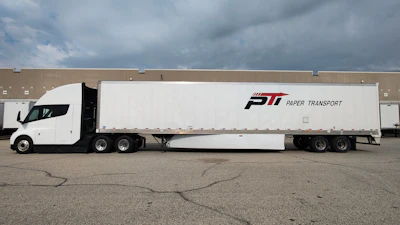
Paper Transport (CCJ Top 250, No. 105) is partnering with Tesla to evaluate the Tesla Semi Long Range within its dedicated operations in the Chicago market, the company announced Monday.
The evaluation aims to test the battery-electric performance of the Class 8 tractor on predictable, consistent routes to help shippers reduce Scope 3 supply chain emissions.
"Our partnership with Tesla expands our portfolio alongside renewable natural gas and intermodal, giving customers more ways to reduce Scope 3 emissions without compromising service or economics," said Tyler Ellison, CEO of PTI.
The Green Bay, Wisconsin-based carrier has focused on sustainable transport for over 15 years, having already logged more than 87 million miles using compressed and renewable natural gas.
Congress looks to enshrine EPA’s DEF-related guidance for next 10 years
Members of Congress, on the same day the Environmental Protection Agency proposed to end engine derates related to diesel exhaust fluid (DEF) faults, introduced a bill that would create a 10-year “safe harbor” window for DEF-related guidance issued by EPA in 2025 and 2026.
EPA’s notice of proposed rulemaking also introduced Thursday, as reported, would do away with DEF derates altogether and get rid of extended warranty requirements that are due to take effect with model year 2027 engines.
The Diesel Engine Flexibility Act (DEF Act) was introduced July 9 by Reps. Julie Fedorchak (R-ND), Don Davis (D-NC), Michelle Fischbach (R-MN), Jack Bergman (R-MI), and Brad Finstad (R-MN).
"Farmers, truckers and equipment operators depend on reliable equipment to keep our economy moving. They shouldn't be sidelined by faulty sensors or unnecessary shutdowns that have nothing to do with actual emissions," Fedorchak said. "The DEF Act brings commonsense certainty by preserving the EPA's updated guidance in law while creating a stable regulatory framework for the next decade. It gives manufacturers, operators and independent technicians the certainty they need to invest, innovate and keep equipment running without sacrificing emissions performance."

According to bill sponsors, the DEF Act aims to strengthen monitoring capabilities, limit engine shutdown and performance reductions, and give independent technicians the legal clarity to service their customers’ equipment. EPA guidance covered by the bill includes the August 2025 guidance that directed engine manufacturers to do away with 5-mph DEF-related derates, and March 2026 guidance that removed DEF sensor requirements in favor of more reliable sensors.
Perhaps most notably, the bill would prevent future EPA administrations during the 10-year period from making new rules “that is more stringent than the 2007 standards and the 2010 standards,” the bill states.
If passed, the new legislation would:
- Create a 10-year statutory safe harbor for EPA diesel emissions guidance issued in 2025 and 2026
- Allow EPA to continue approving software updates, diagnostic improvements, recalls and other administrative actions consistent with the guidance
- Require future emissions standards to include meaningful lead times, including at least three model years of applicability and five years before taking effect
- Direct EPA to consider reducing unnecessary shutdowns, derates, and operational disruptions when developing future emissions regulations after the 10-year safe harbor period
Without congressional action, these improvements remain subject to future administrative changes, the sponsors noted.
Carrier Transicold launches new reefer unit replacement program
Owner-operators in the reefer business who own trailers equipped with Carrier Transicold reefer units have a new option to upgrade the unit without replacing the entire trailer.
Carrier Transicold this week announced Fleet Refresh, a new program that allows refrigerated fleets to replace aging transport refrigeration units (TRUs) on existing trailers, providing an alternative to full trailer replacement.
Rising trailer acquisition costs and extended lead times are prompting many reefer fleets to look for alternatives to traditional equipment replacement cycles, Carrier Transicold said. Its new Fleet Refresh program is designed for companies that want to extend the life of existing trailer assets while upgrading aging refrigeration equipment.
Because the program focuses on replacing the TRU, certain trailer-mounted components such as the fuel tank and light bar are not required, resulting in potentially lower acquisition cost compared to a standard new TRU installation.
Fleet Refresh is available across Carrier Transicold’s single- and multi-temperature trailer TRU models, including the X4 7500, X4 7700, Vector 8500, Vector 8700, Vector 8600MT and Vector 8800MT.
“Many fleets are extending trailer life cycles because of equipment costs and supply constraints, but they still need reliable refrigeration performance,” said Greg Turner, Trailer Product Manager, Truck Trailer Americas, Carrier Transicold. “Fleet Refresh gives customers access to the latest Carrier TRU technology and performance, along with Lynx Fleet telematics and BluEdge service coverage, without replacing a productive trailer.”
Older trailers naturally lose insulating efficiency over time, the company added, which means maintaining temperature performance can become more demanding on refrigeration equipment. Fleet Refresh pairs the new unit with Lynx Fleet telematics and BluEdge coverage, providing visibility into unit performance and access to a service plan to help maximize uptime.
Fleet Refresh TRUs are Lynx Fleet-ready, an added value for fleets whose removed units may predate Lynx Fleet-compatible hardware.
Fleet Refresh TRU installation and removal are performed by Carrier Transicold dealers and are available now.
API updates engine oil quality and certification standards
The American Petroleum Institute has issued an updated standard governing how engine oil marketers certify that their products meet the organization's performance regulations for gasoline and diesel engines.
The 24th edition of API 1509 details the voluntary Engine Oil Licensing and Certification System, or EOLCS. It outlines the methods used to develop new performance standards and provides marketers with guidelines on licensing, aftermarket enforcement procedures, and the proper display of API quality marks.
Bill O’Ryan, director of API EOLCS/DEF, said the updated standard plays a crucial role in managing the certification system.
"The updated standard assures consumers that API certified engine oils are the highest quality option for their vehicles," O’Ryan said in a statement.
According to the institute, its standards are developed under a process accredited by the American National Standards Institute. API said this third-party accreditation helps facilitate acceptance of its standards by state, federal and international regulators.
The API was formed in 1919 as a standards-setting organization and has developed more than 800 standards aimed at operational and environmental safety. The Washington-based trade association represents approximately 600 members across all segments of the U.S. natural gas and oil industry.