










J.B. Hunt Transport Services (CCJ Top 250, No. 5) posted improved first-quarter earnings, driven by intermodal growth, with company executives pointing to early signs that a recovery may be underway.
The Lowell, Arkansas-based carrier reported total revenue of $3.06 billion, compared to $2.92 billion, up 5% from the first-quarter of 2025. Net earnings reached at $141 million, up 4.6% from $117 million in the same period a year ago.
The company saw strong demand in the quarter, partially offset by weather impact and volatile fuel prices. "We experienced strong demand for our service offerings as a predominantly supply-driven freight recovery continued to gain steam, coupled with some modest improvements in demand," CFO Brad Delco said.
Get 80 tips to boost your fuel efficiency
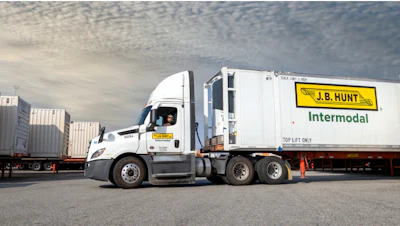
JBI, the carrier’s intermodal services, remains its largest profit driver at $1.5 billion in revenue (up 2%), with operating income rising 21% to $114.5 million, contributing 55% of total company operating income.
“We set a record for first-quarter volume,” said intermodal president Darren Field, noting intermodal’s volume increase of 3%. By month, volume was down 1% in January, up 1% in February, and up 8% in March. Eastern network’s loads were up 7%, driven by service execution and mode conversion wins. Profitability improved through fewer empty container moves and lower storage expense compared to the prior year.
“With elevated truckload spot rates and rising fuel prices, the value proposition of our intermodal offering becomes increasingly more attractive for customers. We continue to see strong rail service from all of our rail providers, a trend we have seen for several years now,” said Field.
With winter weather impacting the country, Field said their rail networks were able to quickly recover their service.
Truckload also saw its revenue surged 23% to $205 million, driven by a 19% increase in load volume and a 3% improvement in revenue per load. Trailer turns improved 15% year over year from better asset utilization and network balance.




Nick Hobbs, EVP of highway, pointed out, “Our revenue increased 23% on 19% load growth, but our gross profit declined 5%, primarily due to the higher purchased transportation rates.”
Freight cycle outlook
In last quarter’s call with analysts, President and CEO Shelly Simpson described the truckload market as “fragile,” with the company “testing the elasticity of supply.”
This proved to be true, Simpson said, as ongoing regulatory enforcement removed non-compliant capacity and increased difficulty hiring qualified drivers. Combined with early signs of improved demand, this has resulted in a tighter truckload market during the quarter.
“While predicting inflection points is never precise, we believe we are on a path to recovery,” Simpson said.
There’s a structural shift in the truckload market, execs pointed out in the call with analysts.
Driver needs are at their highest level since June 2022, said Hobbs, with border-adjacent markets like Ohio and Michigan particularly affected.
Spencer Frazier, EVP of sales and marketing, said, “Capacity has been steadily exiting for extended period driven by regulatory enforcement, rising costs, and financial performance that does not support capital reinvestment.”
“Even if spot rates increase capacity continues to leave the industry,” Frazier continued. “Truckload rates, tender rejections, the ISM PMI, and several others are all at their highest levels since 2022, and trucking employment is at the lowest levels since 2022—all proof points of structural change.”
Frazier cited key cycle signals, including how spot pricing moved first, consistent with 2017-2018 ELD cycle, and 2020-2022 demand cycle.
Customers are also behaving differently, with “less price-led decision making and far more focus on execution quality,” said Frazier. “They are adjusting to capacity challenges with frequent mini bids, they are consolidating freight with fewer, more reliable providers, and they are prioritizing scale, visibility, and execution.”
Tariffs, consumer resilience, and broader demand environment remains factors. “We just need a more normalized environment from demand overall," Simpson said.