










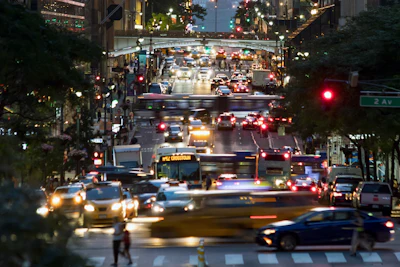
Logistics professionals spend 80% of their time and effort moving freight 20% of the total distance it needs to travel—in other words, urban centers.
Increasing population, green space initiatives, changing customer expectations, and municipal restrictions as some of the most significant obstacles to moving goods through and around cities.
In 2026, those trends have not only persisted but intensified, compounding longstanding problems like congestion, pollution, and infrastructure degradation. With the freight market showing signs of recovery and growth, there’s little margin for inefficiency. Urban logistics remains one of the industry’s most urgent, and least forgiving, problems to solve.
Still growing
Urban population growth has slowed in recent years, but that hasn’t translated into less congestion. Cities aren’t emptying out but rather becoming denser and more complex.
Highways, beltways, and arterial roads in and around major metros remain pushed to capacity, particularly in cities like Chicago, Atlanta, and Houston, which consistently rank among the worst freight bottlenecks in the country. Slower growth hasn’t eased traffic. Instead, it’s simply layered new demand on infrastructure that was already strained.
Every day, millions of people in urban centers need goods delivered at roughly the same time. Grocery stores, restaurants, hospitals, construction sites, and consumers all depend on reliable freight movement, often within tight delivery windows. For logistics professionals, that means navigating midtown congestion, competing for limited curb space, and maneuvering large vehicles through streets that were never designed for modern freight volumes.
But maybe what’s changed most dramatically isn’t necessarily the number of people but where and how growth is happening. Population increases are uneven, with rapid expansion in certain cities and neighborhoods outpacing infrastructure investment. Roads, alleys, and loading zones are asked to handle traffic volumes they were never intended to support. Each new development introduces unfamiliar routes, traffic patterns, and seasonal demand swings, adding variables that make urban delivery planning more fragile and less predictable.




Green space and the shrinking right of way
Cities are also making deliberate choices to reclaim space from vehicles. Green space initiatives, pedestrian zones, bike lanes, and outdoor dining have reshaped urban streetscapes. And while these changes improve quality of life, an unintended consequence is less space available for freight.
As loading zones disappear or shrink, trucks are pushed farther from delivery points, increasing dwell times and congestion as drivers search for legal places to stop. The result is a paradox: efforts to reduce pollution and improve livability can unintentionally increase idling, circling, and emissions when freight has nowhere efficient to go.
Regulations (and their unintended consequences)
Few would argue against cleaner air or quieter streets. However, the patchwork nature of municipal regulation presents real challenges, as idling rules, emissions standards, noise ordinances, and delivery-time restrictions can vary block by block and city by city. For fleets moving through multiple jurisdictions in a single route, compliance becomes a constantly shifting target.
On a broader level, emissions regulations have accelerated the shift toward alternative fuels and electric vehicles. While necessary, this transition introduces new constraints around range, charging infrastructure, and vehicle availability—particularly in dense urban environments where space and time are limited.
Some cities have also restricted delivery hours to reduce congestion or noise, pushing freight into narrower time windows. That compression often results in more trucks competing for the same space at the same time, intensifying congestion rather than easing it.
Why it’s getting worse
Since I last explored this topic, the COVID‑19 pandemic fundamentally altered urban logistics. E‑commerce and home delivery surged, and never retreated. Today’s customers expect fast, precise delivery, often within 24 hours, regardless of location.
At the same time, cities are building at a rapid pace. Construction activity brings its own logistics demands while simultaneously disrupting traffic flow and reducing available road capacity. Add aging infrastructure and deferred maintenance to the mix, and the system becomes increasingly fragile.
Today, urban logistics is all about navigating competing priorities in spaces that are being asked to do more with less. Until cities, shippers, and carriers align on how freight fits into the urban fabric, congestion, pollution, and infrastructure strain will remain defining challenges of modern logistics.