










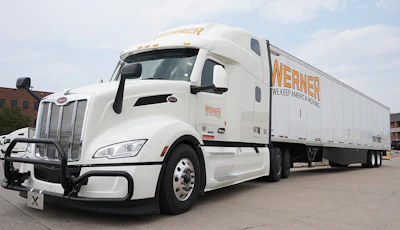
Enforcement-driven capacity reductions are still in the early stages and will keep pushing freight rates higher into peak season, according to Werner Enterprises (CCJ Top 250, No. 14) executives.
During the company’s earnings call Tuesday, Werner Chairman and CEO Derek Leathers said cost pressures that impacted third-quarter earnings are largely short-term, and they don’t change his view that the industry is barely at the beginning of a freight upcycle.
The industry remains “in the early innings of capacity reductions as a result of enforcement efforts,” he added, noting that about 15% of industry capacity is out of alignment with current regulations.
“We’ve seen 3%, 4% of capacity come out," Leathers estimated.
Enforcement has widened to cover CDL schools audits and CDL issuance, Leathers said, noting that B-1 visa cabotage enforcement is “only really just getting started."
Rising costs and scrutiny are also making it harder for new capacity to replace what leaves, Leathers added. He listed escalating insurance premiums, aggressive carrier vetting, heightened litigation risk, high fuel prices and stringent regulatory requirements as the combined carriers. Because new entrants face a tougher path, he said disciplined operators face less threat from non-compliant carriers.
“This structural floor creates a stronger, more sustainable market backdrop, paving the way for further rate increases, reduced volatility and healthier operating margins,” Leathers said.
Knight-Swift Transportation (No. 3) Chief Executive Adam Miller, speaking at the WEX OTR Summit in Ponte Vedra, Fla., this week, agreed, noting that higher barrier to entry for new operators "could lead to a more durable upcycle than we’ve seen historically."
Leathers said shippers are also acknowledging the need for higher-quality capacity in the wake of the Montgomery court ruling, a case in which a freight brokerage was held liable for an accident involving a contracted carrier, though the shift is costly for those who were paying below-market rates.

Looking at near-term freight conditions, Leathers said spot rates eased in July and August, but tender rejections remained elevated and spot rates have improved more recently. Combined with expected further capacity attrition and higher peak season volumes, he said that points to continued rate increases through the end of the year.
“We expect peak revenue to outperform the last couple of years,” he said.
As high fuel costs and interest rates push consumers to seek value, Leathers said this plays to Werner’s footprint in discount grocery and non-discretionary retail. With retailers carrying leaner inventories, he said demand could play a larger role as the market recovery progresses.
[RELATED: Knight-Swift says truckload recovery is finally here]
Driver investment and fuel weigh on margins
The Omaha, Nebraska-based carrier’s total revenues rose 23% year over year to $950.5 million from $771 million. Through nine months, revenues are up 20% to $2.69 billion. Operating income was $17 million, compared with an operating loss of $13 million in the prior-year quarter. Werner said the swing was partly due to the non-recurrence of $21.4 million in litigation costs tied to a class action settlement recorded a year ago.
Net income attributable to Werner was $6.6 million, versus a $20.6 million loss a year ago. Adjusted EPS is $0.42, compared with an adjusted loss of $0.07 a year earlier.
Of the roughly $0.18 per share sequential drag, Chief Financial Officer Chris Wikoff said about a third, or $0.06, was driver investment. The remaining $0.12 was largely fuel, along with some insurance reserve development on select FirstFleet claims.
J.B. Hunt (No. 5) also pointed to inflationary pressures in driver pay, insurance and medical claims in its third-quarter financial results.
Leathers said Werner deliberately front-loaded spending on advertising, recruiters, sign-on and transition incentives, and driving-school instructors. Drivers in the dedicated segment also saw pay increases funded by customers.
The payoff is evident in its fleet counts.
The Truckload Transportation Services (TTS) fleet ended the quarter at 8,740 trucks, up 17.4% year over year. Dedicated added about 130 net trucks sequentially. Leathers said the lag between the employee investment and revenue is significant, since a new driver can take eight to 10 weeks to become productive. He said the investments will continue in the fourth quarter.
Wikoff said the spending is aimed at volume with higher contribution margin.
“A small percent increase in the fleet growth can translate to a much more meaningful increase in operating income and earnings,” he said.
Driver applicant screening is getting harder industry-wide, Leathers said, pointing to third-party data showing rejection rates on driver applications up 170% since January. Enrollment at Werner’s Roadmaster schools and others across the country is down 20-30%, he said.
Fuel is bringing additional pressure.
Werner’s fuel expense more than doubled to $130.3 million, while trucking fuel surcharge revenue rose 111% to 125.2 million. Leathers said the problem was less the price level than its steady climb through the quarter, which kept the roughly one-week surcharge lag hitting results.
He added that the spread between wholesale and retail diesel fell to historically low levels during the quarter and that Werner has revised some fuel programs with customers.
[RELATED: Higher truckload rates lift Marten's Q3 earnings, but diesel pulls it back]
Segment breakdown
- Truckload Transportation Services (TTS): Trucking revenues net of fuel surcharge rose 28% to $579.6 million. Operating income was $23.2 million, versus a $13.8 million loss a year ago. Werner attributed the adjusted improvement to the FirstFleet addition, lower insurance and claims expense (excluding FirstFleet), and higher gains on used equipment sales. Average trucks in service rose 15.5% to 8,668, and revenue per truck per week rose 11% to 5,144.
- Werner Logistics: Revenue fell 7% to $215.8 million, with an operating loss of $0.4 million. Truckload logistics, 70% of the segment, fell 13% due to a 40% decrease in shipments, partly offset by a 44% increase in revenue per shipment. Intermodal revenue rose 7%, and final mile grew 18%.